Table of Contents
- Introduction to Global SaaS Architecture
- Why Multi-Region Strategy Matters
- Core Components of Global SaaS Infrastructure
- Data Management and Consistency Challenges
- Latency Reduction Techniques
- Strategies for Disaster Recovery
- Choosing the Right Cloud Foundation
- Managing Traffic with Global Load Balancing
- Handling Multi-Tenant Data Requirements
- Automation and Infrastructure as Code
- Cost Management in Multi-Region Setups
- Challenges in Cross-Region Connectivity
- Operational Complexity and Monitoring
- Conclusion
Introduction to Global SaaS Architecture
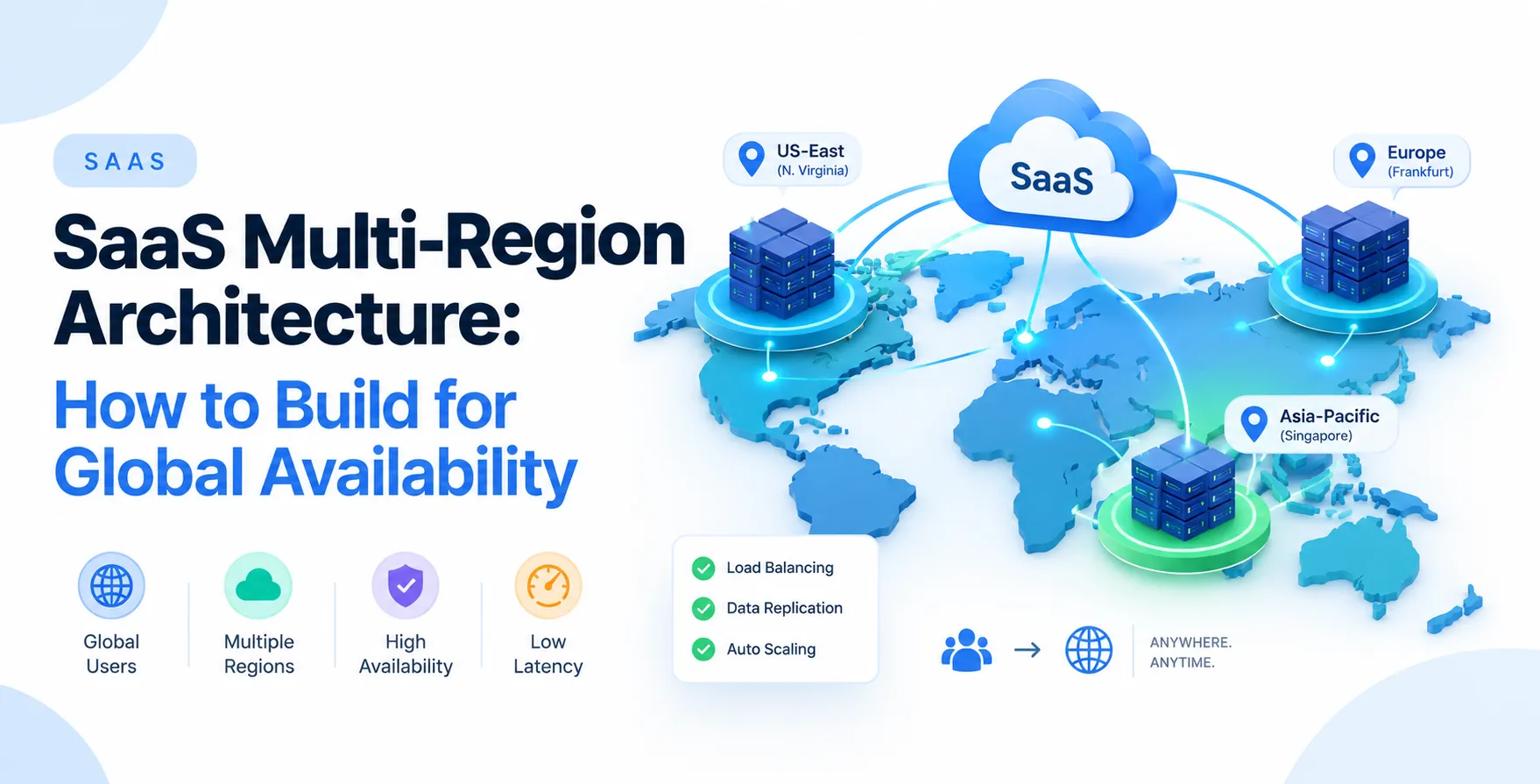
Scaling a modern application to serve a worldwide user base involves significant engineering hurdles. A robust SaaS multi-region architecture for global availability is no longer optional for enterprise-grade platforms.
You need to balance performance, compliance, and reliability across disparate geographical locations. This requires a shift in how you think about your core infrastructure.
Why Multi-Region Strategy Matters
Deploying across multiple regions provides several distinct advantages for growing products. It moves your compute resources closer to the user to minimize round-trip times.
Regional isolation also prevents a single failure from cascading across your entire customer base. This is the primary driver behind most high-availability initiatives.
- Reduced network latency for remote users
- Improved fault tolerance during outages
- Compliance with local data residency laws
- Enhanced disaster recovery capabilities
Core Components of Global SaaS Infrastructure
Building a global SaaS infrastructure requires more than just cloning your environment in different data centers. You must maintain state and configuration consistency across the entire footprint.
Stateful services often pose the biggest hurdle in these architectures. You must carefully design your data layers to handle synchronization or partitioning across regions.
Global Networking
Your networking layer must intelligently route users to the nearest healthy deployment. This prevents users from hitting overloaded or unreachable regional endpoints.
- Anycast IP addresses
- Global DNS traffic management
- Regional load balancer clusters
Compute Resources
You need a standard way to spin up and tear down environments globally. This ensures uniformity across regions and reduces configuration drift.
- Containerized service deployments
- Automated scaling groups
- Regional compute isolation
Data Management and Consistency Challenges
Managing data in a multi-region environment is notoriously difficult. Synchronous replication across continents is physically limited by the speed of light.
You must decide between strong consistency and high availability for every service. Most global systems eventually settle on eventual consistency for non-critical paths.
Latency Reduction Techniques
Minimizing latency is the primary goal of any distributed system. Delivering content from the edge significantly improves the perceived speed for end users.
You can offload static assets and even some compute tasks to regional edge locations. This keeps the core application lean and focused on processing complex business logic.
- Content delivery network caching
- Edge functions for request processing
- Database read replicas in multiple zones
- Local caching layers near users
Strategies for Disaster Recovery
A multi-region setup acts as your ultimate insurance policy. If an entire region goes dark, your traffic must shift seamlessly to another healthy geography.
This requires a well-tested failover plan that you should practice regularly. Automating the switchover process is the only way to meet strict uptime SLAs.
- Active-active deployment models
- Active-passive standby regions
- Automated health monitoring triggers
Choosing the Right Cloud Foundation
Selecting your cloud provider is a foundational decision that impacts your long-term scalability. You need a provider with a mature global backbone and consistent service offerings across regions.
Whether you choose AWS, Azure, or Google Cloud depends on your specific regional requirements. Each provider offers different performance characteristics for cross-region data transfer.
| Provider Feature |
Global Reach |
Inter-Region Latency |
| AWS |
Industry leading |
Highly predictable |
| Azure |
Extensive enterprise focus |
Optimized for hybrid |
| Google Cloud |
Fast private network |
Lowest jitter |
Managing Traffic with Global Load Balancing
Effective traffic management is the heartbeat of SaaS architecture. You need a smart layer that understands the health of every regional cluster.
This layer must also be capable of performing geolocational routing. It ensures that traffic from Tokyo doesn't accidentally end up in a US-based cluster.
- Health-aware routing decisions
- Automatic traffic failover
- Intelligent load distribution
Handling Multi-Tenant Data Requirements
When dealing with multi-tenant SaaS architecture database design, you face the additional challenge of data sovereignty. Different regions may require different data isolation strategies.
You might need to pin specific tenants to specific geographic regions to satisfy legal requirements. This complicates your global data sharding and synchronization logic.
Automation and Infrastructure as Code
Managing regional configurations manually is a recipe for disaster. You need a consistent GitOps infrastructure management approach to ensure every region is configured identically.
This allows you to treat your entire global footprint as a single versioned system. It also simplifies the process of spinning up new regions as you expand.
- Declarative infrastructure definitions
- Automated deployment pipelines
- Consistent environment drift detection
Cost Management in Multi-Region Setups
Running resources in multiple locations significantly increases your operational expenditure. You must implement robust Cloud Cost Management practices to keep your margins healthy.
Egress costs for data moving between regions can quickly become your largest bill. Optimize your data sync patterns to minimize unnecessary inter-region traffic.
Challenges in Cross-Region Connectivity
Network reliability between regions is often assumed to be perfect, but it rarely is. You need to design your services to handle intermittent connectivity issues gracefully.
Circuit breakers and retries are essential patterns in your service-to-service communication. Without them, a minor network hiccup can trigger a widespread service failure.
Operational Complexity and Monitoring
Observability becomes exponentially harder as you add more regions to your footprint. You need a unified view of your entire multi region SaaS deployment to troubleshoot effectively.
Aggregating logs, metrics, and traces from diverse regions into a single dashboard is critical. If your monitoring is fragmented, your incident response will be significantly slower.
Conclusion
Building a successful platform requires balancing architectural complexity with business needs. A global strategy is essential for any company aiming to scale internationally.
Focus on automation, data consistency, and intelligent traffic management to succeed. By following these principles, you can provide a reliable, high-performing experience for users anywhere in the world.


 In collaboration with