Table of Contents
- Introduction to Database Isolation
- Understanding Row-Level Security
- Defining Tenant Context
- Implementing Multi-Tenant RLS Policies
- The Benefits of Native Isolation
- Common Pitfalls in Implementation
- Performance Considerations
- Testing Your Security Policies
- Handling Schema Migrations
- Managing Superuser Access
- Connection Pooling and RLS
- Debugging Policy Failures
- Best Practices for SaaS Security
- Conclusion
Introduction to Database Isolation
Building a secure SaaS platform requires a solid approach to data separation. In a shared database environment, developers must guarantee that one customer cannot access another customer's data.
Multi-tenant database isolation is the foundation of trust in your software. If this layer fails, the business impact is severe and immediate.
Understanding Row-Level Security
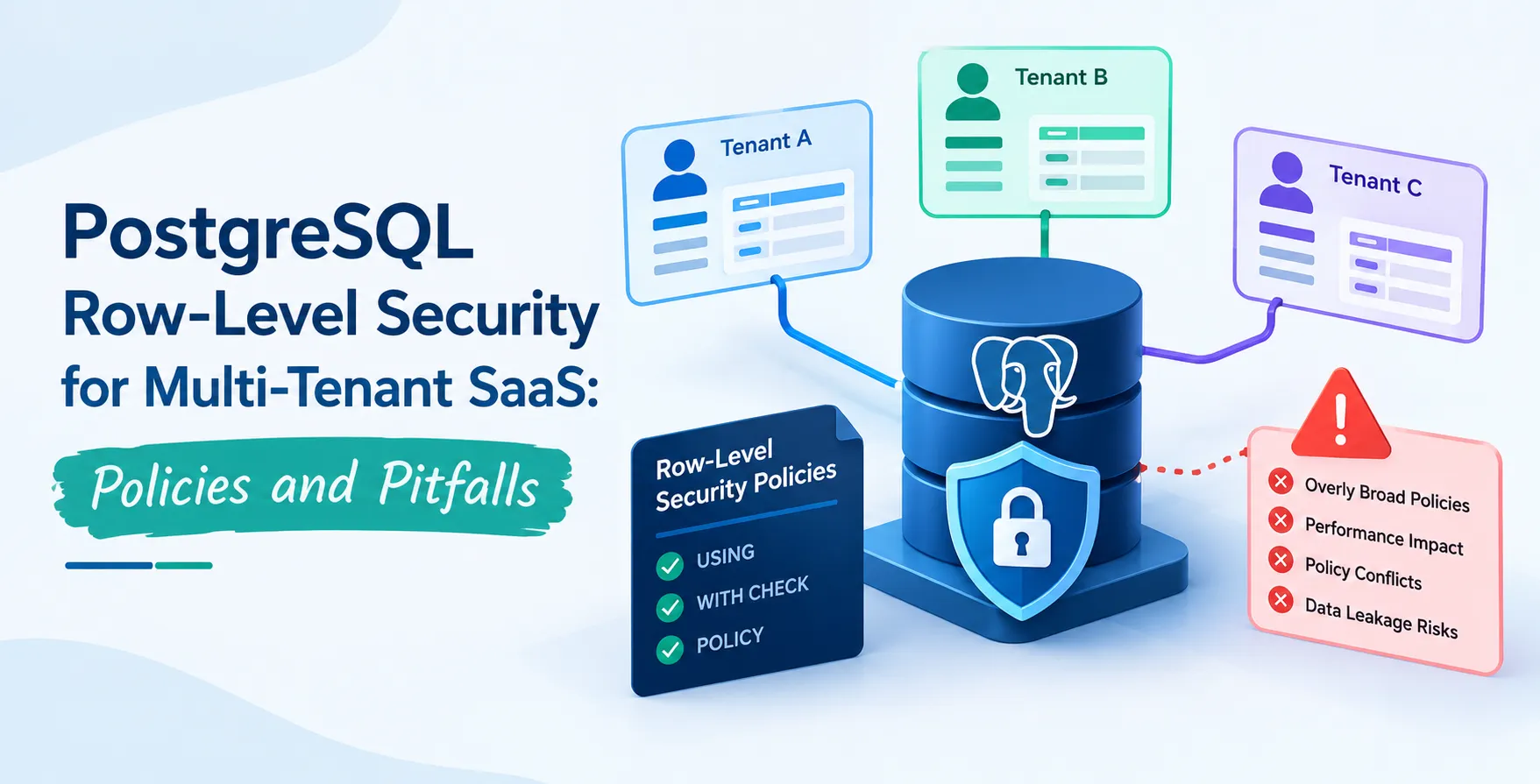
PostgreSQL row-level security acts as a gatekeeper at the database layer. Instead of relying solely on application-level filtering, you enforce constraints directly on the table rows.
When enabled, every query must satisfy a specific policy before the database returns any data. This ensures that even if a developer forgets a WHERE clause in the code, the database prevents unauthorized access.
- Enforces security at the engine level
- Reduces reliance on application code
- Provides a centralized security model
Defining Tenant Context
To use RLS effectively, the database needs to know which tenant is currently active. You typically achieve this by setting a session variable when a connection is established.
This variable holds the tenant ID for the duration of that specific database transaction. Every subsequent query uses this ID to filter results.
Session Variables
You can set these variables using standard SQL commands. This pattern is highly effective for web applications that use connection pools.
- SET LOCAL app.current_tenant_id = '123'
- Automatically cleared after transaction
- Accessible within all RLS policies
Alternative Approaches
Some developers prefer using local settings or custom configuration files. The choice depends on how your application handles database sessions.
- Using custom session configuration
- Leveraging middleware for injection
Implementing Multi-Tenant RLS Policies
A standard policy involves creating a condition that compares the row's tenant identifier with the session variable. This is the core mechanism of multi-tenant database isolation.
You must ensure that every table containing tenant-specific data has an RLS policy attached. Without this, the table remains globally readable.
- Enable RLS on the table
- Create a using policy
- Create a with check policy
- Grant necessary table permissions
The Benefits of Native Isolation
Native database isolation provides a layer of defense-in-depth that application code cannot match alone. It simplifies the development process by removing the need for manual filtering in every query.
Engineers can focus on business logic rather than writing repetitive data-access code. This leads to cleaner repositories and fewer security oversights in the long run.
- Centralized security rules
- Simplified application architecture
- Consistent data protection
Common Pitfalls in Implementation
The most common danger involves forgetting to enable RLS on newly created tables. Another issue is improper handling of administrative or shared tables that shouldn't be filtered.
Developers often struggle with join performance when policies are complex. You must always monitor how these policies interact with your query optimizer.
| Pitfall |
Impact |
Solution |
| Missing Policies |
Data leakage |
Automated schema audit |
| Over-complex logic |
Slow queries |
Optimize policy expressions |
| Superuser bypass |
Security risk |
Use non-privileged roles |
| Connection pooling |
Context bleed |
Always reset variables |
Performance Considerations
RLS adds a small overhead to every query processed by the database. While usually negligible, complex policy definitions can impact performance on high-traffic systems.
Ensure that your tenant ID columns are indexed properly. The database engine needs to scan these columns efficiently to apply security filters.
- Index tenant ID columns
- Keep policy logic lean
- Use constant expressions
Testing Your Security Policies
Rigorous PostgreSQL RLS policy testing is mandatory before deploying to production. You should write integration tests that simulate different tenant identities.
Verify that a query run as Tenant A cannot see rows belonging to Tenant B. These tests should be part of your automated CI pipeline.
- Use multiple database users
- Validate empty result sets
- Check write operations
- Verify policy bypass attempts
Handling Schema Migrations
Schema changes can easily break existing RLS policies. Whenever you add a new table, you must include the RLS configuration in your migration scripts.
Treat security policies as version-controlled code. This keeps your database state predictable and manageable over time.
Managing Superuser Access
Superusers are exempt from RLS by default. This is a significant risk if your application connects to the database as a superuser.
Always connect with a restricted role that respects RLS policies. This ensures that even the application user account is subject to your security rules.
- Create least-privilege roles
- Avoid superuser connections
- Audit role permissions regularly
Connection Pooling and RLS
When using connection poolers, you must be careful about session state. If a connection is returned to the pool without resetting the tenant ID, the next request might see the wrong data.
Always ensure your application resets or clears session variables immediately after finishing a request. This prevents data leakage across different user sessions.
Debugging Policy Failures
Debugging can be difficult when queries return zero rows unexpectedly. Use the EXPLAIN command to see how the database is applying your policies.
Sometimes a policy is active but not triggering as expected due to user role permissions. Check that the current user has the correct ownership or access rights.
Best Practices for SaaS Security
Start by auditing your existing database structure. Move shared configuration data into tables that do not require row-level security while isolating customer data strictly.
Maintain clean documentation for all your security policies. This helps the entire engineering team understand how to work within the existing security framework safely.
- Review policies periodically
- Minimize policy complexity
- Document all access rules
- Monitor for policy violations
Conclusion
Implementing RLS is a powerful way to secure your SaaS database. By following these guidelines, you can build a robust, multi-tenant application that protects customer data by default.
While the implementation requires careful planning and testing, the security benefits far outweigh the initial effort. Stay vigilant, test frequently, and keep your policies simple to ensure long-term stability.


 In collaboration with