Table of Contents
- Introduction
- Understanding Trial-to-Paid Conversion
- The Role of SaaS Onboarding
- Optimizing Feature Adoption
- Using Data to Drive Conversions
- The Power of In-App Communication
- Leveraging Customer Feedback
- Pricing Strategy Considerations
- Removing Friction Points
- Communicating Value Early
- Monitoring Key Metrics
- The Impact of Technical Performance
- Common Conversion Mistakes
- Conclusion
Introduction
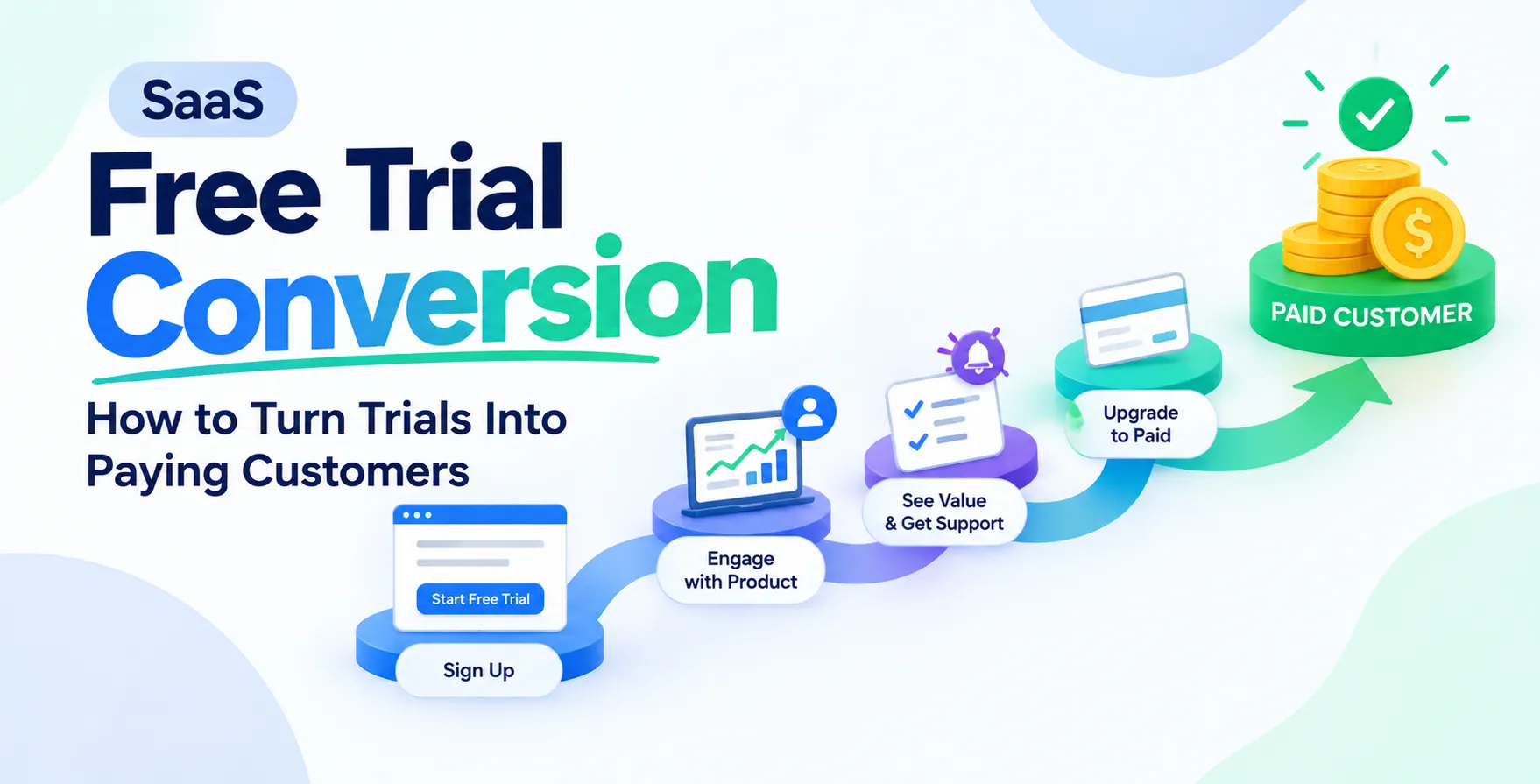
Capturing a lead with a trial is just the beginning of the journey. The real challenge for any growth-focused team is the SaaS free trial conversion process.
You have a limited window to prove your value. If you miss that opportunity, your potential customer leaves without ever paying a dime.
Understanding how to turn trials into paying customers requires a mix of psychology, data, and design. You need a structured approach to guide users from sign-up to subscription.
Understanding Trial-to-Paid Conversion
A high trial to paid conversion rate is the lifeblood of your business. It signifies that your product not only attracts users but actually solves their problems.
Many founders obsess over top-of-funnel traffic. However, real revenue growth comes from optimizing what happens after the initial sign-up.
Focusing on the transition from trial to paid ensures that your marketing spend actually yields a return. It transforms curious onlookers into committed partners.
- Increases monthly recurring revenue
- Validates product market fit
- Lowers customer acquisition costs
- Reduces waste in marketing
The Role of SaaS Onboarding
Your onboarding process determines whether a user finds value within minutes or gets frustrated and leaves. An effective strategy for SaaS onboarding is to prioritize quick wins for the user.
The goal is to move the user to their first "aha!" moment as fast as possible. If they can see the solution to their pain point, they will likely stay.
Avoid overwhelming new users with excessive features. Instead, guide them through the core workflow required to get their first successful outcome.
- Welcome emails with clear next steps
- Interactive product walkthroughs
- Tooltips for contextual guidance
- Checklists for setup tasks
- Progress bars showing completion status
Optimizing Feature Adoption
Feature adoption is the bridge between a trial and a subscription. Users who engage with your core features are significantly more likely to convert.
You should identify which specific features correlate most strongly with long-term retention. Once identified, ensure your onboarding flow drives users directly toward those features.
Do not let users get lost in secondary settings. Keep the focus on the value-driving activities that make your platform indispensable to their daily work.
- Identify high-value core features
- Track feature usage patterns
- Simplify access to key tools
- Remove unnecessary UI clutter
- Provide automated helpful tutorials
Using Data to Drive Conversions
Data provides the roadmap for your conversion efforts. You cannot improve what you do not measure, so tracking your conversion rate is non-negotiable.
Look beyond vanity metrics like sign-up counts. Analyze behavioral data to see where users drop off during the trial period.
Segment your users based on their activity levels. This allows you to send targeted messages to those who are close to converting but need a small nudge.
- Analyze drop-off points
- Identify active versus inactive users
- Track session duration trends
- Monitor feature usage frequency
The Power of In-App Communication
Email is useful, but in-app messaging is immediate. When a user is inside your application, they are in the right mindset to learn and act.
Use well-timed modals or banners to highlight advanced features. This keeps the conversation focused on value rather than just administrative upgrade prompts.
Keep your messages concise and actionable. Every notification should serve a purpose, whether it is teaching a new trick or highlighting a missed opportunity.
- Contextual prompts for features
- In-app upgrade reminders
- Helpful milestone celebrations
- Proactive support chat triggers
Leveraging Customer Feedback
Direct communication is vital for understanding why users convert or churn. Proactively seeking customer feedback provides insights you cannot get from analytics alone.
Talk to users who are currently in the trial phase. Ask them what they are finding difficult and what they are enjoying about the product.
This information helps you refine your messaging and product roadmap. Listening to your users is the most effective way to build a product that they will happily pay for.
- Short surveys after key tasks
- User interviews for product development
- Direct email outreach to inactive users
- Feedback loops in your support tickets
Pricing Strategy Considerations
Your pricing strategy impacts how easily users can transition to a paid plan. A clear and logical pricing page helps users understand the value they will receive for their investment.
Avoid overly complex tiers that confuse potential buyers. Make the upgrade path obvious and include a clear call to action on your platform.
Consider offering annual billing options to secure longer commitments. This shift in billing strategy can significantly improve your cash flow and reduce the frequency of churn risks.
- Transparent pricing tiers
- Annual versus monthly discounts
- Clear upgrade buttons
- Social proof on pricing pages
Removing Friction Points
Every extra click or field is a potential point of abandonment. Simplify your sign-up and upgrade processes to ensure that users do not encounter unnecessary barriers.
If you require credit card information upfront, monitor how this impacts your conversion rate. Sometimes, removing this requirement can boost trial numbers significantly.
Audit your checkout experience regularly. A seamless and fast payment process is essential for high conversion rates.
- Minimize form fields
- Offer multiple payment methods
- Reduce page load times
- Simplify the upgrade UI
Communicating Value Early
You must articulate your unique value proposition clearly from the moment they land on your site. Don't wait until the trial ends to remind them why they signed up.
Show them the tangible results they can achieve. Use case studies or examples that demonstrate how others have successfully used your tool.
Reinforce this value through every touchpoint. Your messaging should remind them of the solution you provide to their specific business problems.
- Highlight success stories
- Emphasize time savings
- Showcase ROI metrics
- Provide clear benefit-driven copy
Monitoring Key Metrics
Success depends on constant monitoring. You should watch your conversion rates closely to see how changes to your onboarding or pricing affect your bottom line.
Don't just look at the final conversion number. Track the health of your trial users throughout their journey to identify potential churn early.
Small adjustments in your funnel can lead to massive improvements over time. Stay agile and be ready to pivot based on what the data tells you.
- Trial to paid conversion rate
- Activation rate metrics
- Time to first value
- Churn rate during trial
The Impact of Technical Performance
Performance matters as much as design. If your platform is slow or buggy, users will assume your service is unreliable and will not convert.
Ensure your infrastructure is robust and handles concurrent users well. High-quality SaaS development is essential for building a platform that users trust with their data.
Invest in reliable hosting and regular maintenance. A smooth, fast experience builds confidence in your brand and product quality.
- Fast page load speeds
- High system uptime
- Seamless API integrations
- Responsive mobile performance
- Clean and intuitive UI design
Common Conversion Mistakes
Many companies fail because they focus on the wrong things. Trying to force a sale before a user finds value is a common error that leads to instant churn.
Another mistake is ignoring your inactive users. You should have a re-engagement strategy to remind them why they signed up in the first place.
Finally, do not hide your pricing. Obscurity does not build curiosity; it creates distrust and frustration for potential buyers.
- Selling too early
- Ignoring inactive users
- Poor communication of pricing
- Overly complex onboarding
Conclusion
Turning trials into paying customers is a continuous process of optimization and learning. By focusing on onboarding, feature adoption, and clear communication, you can significantly improve your results.
Remember to listen to your users and use data to guide your decisions. Stay consistent with your efforts and keep refining the user journey.
With a thoughtful strategy, you can build a sustainable and growing customer base. Your dedication to the trial experience will pay dividends in long-term revenue.


 In collaboration with