Table of Contents
- Introduction
- Why Customer Interviews Matter for SaaS
- Preparing for Customer Interviews
- Choosing the Right Customers to Interview
- Asking the Right Questions
- Avoiding Common Interview Pitfalls
- User Research vs Unfiltered Customer Feedback
- Structuring User Interviews for Product Development
- Turning Interview Insights into Product Features
- Customer Feedback vs Product Analytics
- Scaling Customer Interviews in Growing Teams
- Integrating Research into the Software Discovery Phase
- Conclusion
Introduction
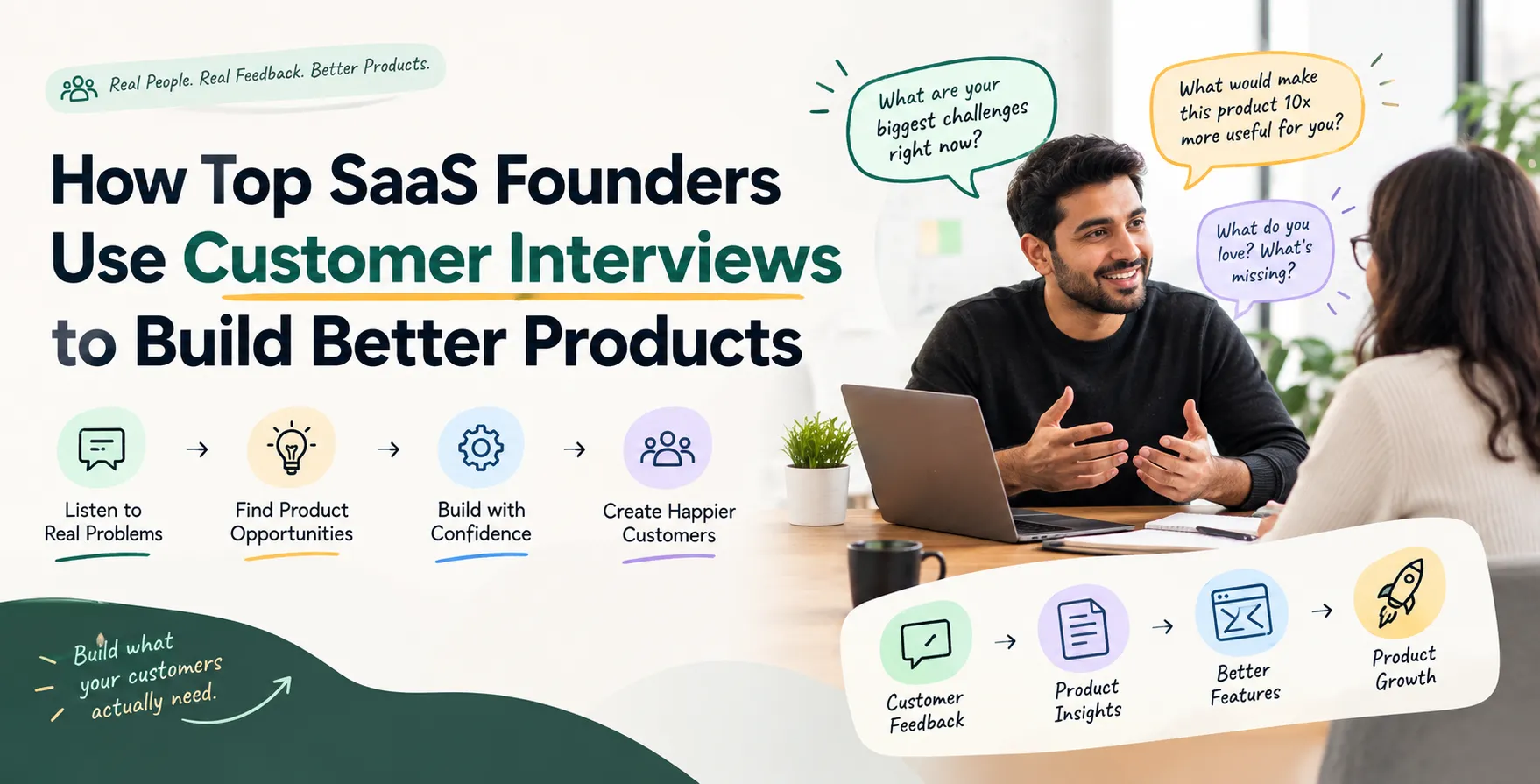
Building a successful SaaS product requires more than writing clean code and shipping fast features. Top founders succeed because they deeply understand user problems through direct conversations.
Conducting user interviews for product development helps founders build tools people actually want to buy. By talking to real users, teams avoid costly mistakes and shorten their path to product-market fit.
Why Customer Interviews Matter for SaaS
Many early startups build features based on assumptions rather than real evidence. This disconnect often leads to low user retention and high churn rates.
Regular conversations reveal hidden friction points that analytics dashboards simply miss. Direct discussions clarify why users abandon specific workflows or cancel subscriptions.
Top founders rely on direct chats to validate core assumptions early.
- Reduces wasted development effort
- Uncovers unexpected user workflows
- Identifies high-value feature requests
- Improves long-term user retention
- Validates pricing strategies early
Preparing for Customer Interviews
Preparation is critical before scheduling your first conversation with a customer. Without clear objectives, interviews easily derail into unstructured chat.
Founders must define exact learning goals before contacting users. Knowing what product decisions depend on the answers keeps discussions tightly focused.
Setting a clear agenda ensures every minute spent interviewing yields actionable insights.
Choosing the Right Customers to Interview
Not all users offer equal value during research sessions. Selecting the right audience determines the overall quality of your insights.
Power Users
Power users understand your platform thoroughly and push its limits daily. They offer deep tactical suggestions for advanced workflows.
- Highlight complex edge cases
- Suggest advanced integration needs
Recent Churned Users
Users who recently left provide raw truth about product gaps. Understanding their departure prevents future customer loss across similar cohorts.
- Expose critical product flaws
- Reveal gaps in onboarding
Asking the Right Questions
The structure of your questions dictates the honesty of user responses. Leading questions bias answers and create false validation.
Focus questions on past behavior rather than hypothetical future actions. People are generally poor predictors of what they will buy tomorrow.
Effective interview questions extract clear context and past behavior details.
- What were you using before our product?
- Can you show me how you solve this currently?
- When did you last encounter this issue?
- What failed when you tried fixing it?
Avoiding Common Interview Pitfalls
Interviews can easily mislead product decisions if conducted improperly. Founders often mistake polite compliments for actual market demand.
Learning to spot sales pitches disguised as feedback protects your roadmap. Staying silent and listening is harder than it sounds.
Watch out for these common missteps during user sessions.
- Pitching your solution mid-interview
- Asking leading questions about features
- Focusing on feature requests instead of problems
- Talking more than listening to the user
- Ignoring context around user workflows
- Relying on hypothetical pricing answers
User Research vs Unfiltered Customer Feedback
Founders must distinguish between structured user research and spontaneous SaaS customer feedback. Both sources provide valuable insights but serve different strategic purposes.
| Aspect |
User Research |
Unfiltered Customer Feedback |
| Structure |
Guided interview questions |
Unsolicited support tickets |
| Goal |
Validate core product hypotheses |
Fix immediate pain points |
| Focus |
Underlying user behaviors |
Specific bug reports or requests |
| Timing |
Scheduled proactively |
Received reactively |
| Context |
Deep workflow understanding |
Isolated single-event focus |
Structuring User Interviews for Product Development
Running consistent interviews requires a repeatable framework across your engineering team. A clear pipeline ensures insights transition smoothly into actionable backlog items.
Aligning research timing with SaaS application development keeps product teams focused on solving real problems.
Follow a structured framework to execute effective research rounds.
- Define the research objective clearly
- Recruit target user profiles
- Conduct structured conversation sessions
- Synthesize patterns into actionable tasks
Turning Interview Insights into Product Features
Raw interview notes are useless until converted into prioritized backlog items. Founders must filter individual requests to find broader user patterns.
When multiple users articulate the exact same struggle, engineering teams can prioritize a solution confidently. This approach prevents SaaS startup failure by ensuring resources support genuine market demand.
Connecting real customer feedback directly to product roadmaps creates sustainable software value over time.
Customer Feedback vs Product Analytics
Analytics show what users are doing inside your application. Customer interviews explain why they are doing it.
Combining qualitative interviews with quantitative metrics gives a complete picture of product health. Neither tool is fully effective without the other.
Balanced teams leverage both data streams together effectively.
- Analytics spot sudden drop-off points
- Interviews reveal the frustrating barrier
- Analytics measure overall adoption rates
- Interviews explain low user engagement
Scaling Customer Interviews in Growing Teams
As startups grow, founders cannot conduct every single user interview personally. Product managers and engineers must participate to stay close to customer pain.
Even solo founders benefit from documenting recurring themes systematically. Sharing findings across team channels maintains customer empathy as headcount expands.
Maintain interview momentum as your software business grows.
- Include developers in live interviews
- Store transcribed notes in central repositories
- Review user insights during sprint planning
Integrating Research into the Software Discovery Phase
Conducting interviews before writing code saves hundreds of engineering hours. Validating ideas early prevents costly rebuilds later in the development cycle.
Embedding user research directly into your software discovery phase ensures technical design aligns with market demand. Smart teams validate SaaS idea assumptions before committing resources to full implementation.
Early interviews protect early-stage development budgets effectively.
- Clarifies core feature requirements
- Eliminates unnecessary scope creep
- Validates user onboarding pathways
- Reduces early development redesigns
- Accelerates initial product launches
Conclusion
Customer interviews are the most effective tool SaaS founders have to build products people love. Listening directly to users transforms vague assumptions into concrete product strategy.
By structuring research, asking behavioral questions, and integrating findings into development, teams avoid common execution traps. Start talking to your users today to build a better SaaS product.


 In collaboration with