Table of Contents
- Introduction
- What Is a Software Discovery Phase?
- Core Objectives of Technical Discovery
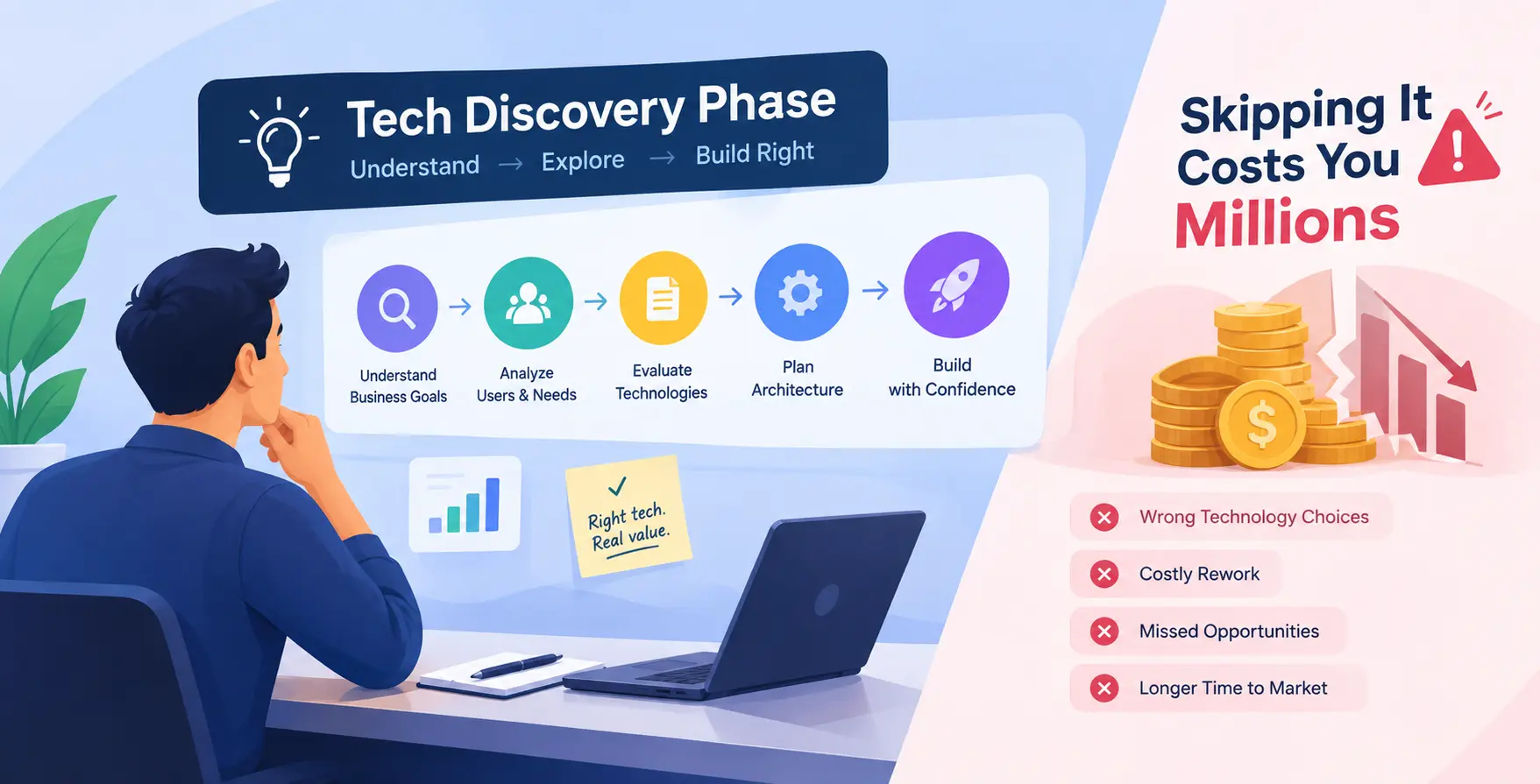
- Key Steps in the Software Project Discovery Phase
- The High Price of Skipping Discovery
- Financial Impact: Real-World Cost Overruns
- Unclear Scope vs Defined Requirements
- Mitigating Technical Debt and Architecture Risks
- Key Deliverables You Should Expect
- Who Participates in the Discovery Phase?
- Discovery Phase for Custom Software vs SaaS
- How Long Should Discovery Take?
- How Discovery Ensures Project Success
- Conclusion
Introduction
Building complex digital products without proper upfront planning is a primary cause of enterprise project failure. Many executive teams rush directly into active engineering to meet aggressive market deadlines.
Starting development without preliminary research leads to severe technical rework and bloated software budgets. Taking time to validate requirements early protects your financial capital and aligns your organization.
What Is a Software Discovery Phase?
A structured software discovery phase is the dedicated research and planning stage at the beginning of a digital product build. During this period, stakeholders evaluate business goals, user expectations, and technical feasibility.
Instead of writing production code immediately, team leaders analyze requirements and design system architecture. This foundational step connects early business vision with a predictable execution strategy.
- Aligns product vision with core business metrics
- Identifies potential technical constraints early
- Defines detailed target user personas
- Establishes accurate timeline and budget estimates
Core Objectives of Technical Discovery
The primary goal of technical research is eliminating uncertainty before committing substantial development resources. It translates high-level business ideas into technical specifications that software engineering teams can execute reliably.
In addition, discovery validates target market demand and user workflows before writing code. Evaluating market needs early ensures the proposed feature set solves real operational pain points for users.
Key Steps in the Software Project Discovery Phase
Executing a thorough software project discovery phase requires a clear, step-by-step methodology. Each stage gathers critical data that informs subsequent architectural decisions.
Following a sequential planning process prevents engineering teams from missing key security and integration requirements.
- Gathering stakeholder requirements and defining business metrics
- Conducting user research and competitive market analysis
- Mapping complete user journeys and application workflow diagrams
- Selecting technology stacks and designing cloud architecture
- Creating interactive prototypes and validating user interfaces
The High Price of Skipping Discovery
Bypassing preliminary planning to save time almost always leads to compounding friction during active development sprints. Software engineers forced to work from ambiguous specifications must rely on guesswork rather than clear requirements.
This lack of clarity results in continuous scope changes, missed milestones, and rapidly escalating development bills. Rushing directly into coding is why many digital transformation initiatives fail.
- Uncontrolled scope creep during active development sprints
- Severe project budget overruns and delayed launches
- Building unnecessary features that end users ignore
- Wasted development resources and engineering team burnout
- Flawed technical architecture that fails under load
- Incompatible third-party APIs discovered late in development
Financial Impact: Real-World Cost Overruns
Architectural modifications made mid-way through development cost significantly more than fixes made during initial research. When engineering teams must rebuild foundational modules late in the software lifecycle, labor expenses compound exponentially.
Unexpected software development pricing spikes typically result from unvetted technical dependencies and vague original requirements. Organizations often spend double their expected budget remediating preventable design flaws that proper planning would have uncovered.
Unclear Scope vs Defined Requirements
Commencing engineering without defined requirements creates confusion across cross-functional teams. Comprehensive documentation keeps developers, designers, and project managers aligned on exact deliverables.
Comparing unguided development with structured research highlights significant operational differences across critical product metrics.
| Project Aspect |
Without Discovery Phase |
With Discovery Phase |
| Scope Definition |
Vague and constantly shifting during development |
Strictly documented, vetted, and approved upfront |
| Cost Predictability |
Frequent budget overruns and unexpected costs |
Predictable milestone pricing and clear estimates |
| Development Velocity |
Frequent rework and blocked engineering tasks |
Consistent sprint progress and rapid execution |
| Risk Management |
Critical flaws discovered during production rollout |
Technical risks identified and mitigated early |
| User Adoption |
Mismatched functionality and poor user retention |
Tailored experience based on validated user research |
Mitigating Technical Debt and Architecture Risks
Making hasty technology choices creates long-term technical debt in software development. Upfront research lets senior architects test infrastructure options before locking in permanent dependencies.
Evaluating System Scalability
Engineers analyze projected traffic patterns and data throughput. They design databases and backend microservices capable of handling future growth without major refactoring.
- Prevents server bottlenecks during high traffic spikes
- Minimizes ongoing cloud infrastructure operational costs
Third-Party Integration Testing
External interfaces and vendor APIs must be thoroughly evaluated before writing production code. Identifying API limitations early prevents unexpected development delays during final assembly.
- Uncovers third-party API restrictions before coding begins
- Ensures strict data security and industry compliance
Resolving complex technical hurdles during initial planning ensures a resilient software architecture that supports long-term business goals.
Key Deliverables You Should Expect
A comprehensive software development discovery phase produces tangible assets that guide the entire build process. These items serve as a definitive manual for developers, designers, and quality assurance testers.
Having complete documentation makes managing internal engineering talent or external software vendors straightforward and transparent.
- Detailed functional and non-functional requirements document
- Interactive wireframes and polished prototype designs
- System architecture diagrams and database schemas
- Resource allocation plan and milestone development roadmap
Who Participates in the Discovery Phase?
Successful technical discovery requires structured collaboration across distinct business and technological disciplines. Business analysts define strategic objectives while technical leads assess feasibility and infrastructure limits.
Product managers facilitate discovery workshops to ensure user interface design matches core functional requirements. Solution architects analyze compliance, database structures, and cloud hosting paradigms.
Discovery Phase for Custom Software vs SaaS
Every software effort benefits from initial research, but strategic goals vary based on the delivery model. Enterprise custom software development prioritizes internal process automation and legacy database integration.
Conversely, commercial cloud applications require structured SaaS product validation to confirm market demand and feature prioritization before building minimum viable products.
- Custom internal builds focus on legacy integration
- SaaS builds prioritize rapid feature market validation
- Enterprise solutions emphasize strict data compliance
How Long Should Discovery Take?
The time needed for thorough discovery depends on project complexity and organizational scope. Simple application builds often require only two weeks of structured discovery workshops.
Complex enterprise platforms or multi-tenant software ecosystems typically require four to six weeks of deep architectural research.
- Standard web applications require two weeks
- Complex enterprise ecosystems need six weeks
How Discovery Ensures Project Success
Integrating structured discovery into your standard software development process significantly increases product success rates. It minimizes wasted engineering effort and maximizes return on technology investments.
Engineering teams build significantly faster when they work from validated functional requirements and clear visual prototypes.
- Eliminates technical ambiguity for development teams
- Protects business budgets from expensive redesign work
- Shortens time to market for production releases
- Instills stakeholder confidence with clear roadmaps
- Delivers superior end-user engagement consistently
Conclusion
Skipping preliminary planning to start development faster is a false economy that frequently leads to catastrophic project delays. The financial cost of repairing flawed software architecture in live production dwarfs the modest investment required for upfront research.
By establishing a dedicated discovery process, business leaders protect capital reserves, streamline engineering velocity, and ensure final software deliverables align with organizational goals.
Investing in thorough technical discovery remains the single most effective risk mitigation strategy for modern software initiatives.


 In collaboration with