Table of Contents
- Introduction
- The Cost of Building Too Early
- Defining Your Core Hypothesis
- Conducting Founder-Led Interviews
- Crafting the Smoke Test Landing Page
- Running Manual Concierge Services
- Evaluating Financial Commitment
- Code-First vs Validation-First Approach
- Key Metrics for SaaS Product Validation
- Analyzing User Feedback Signals
- Pivot or Proceed Decisions
- Transitioning from Validation to MVP
- Conclusion
Introduction
In today’s fast-paced software landscape, technical execution is rarely the primary failure point for new ventures. Most SaaS products fail because founders build solutions for problems that do not exist.
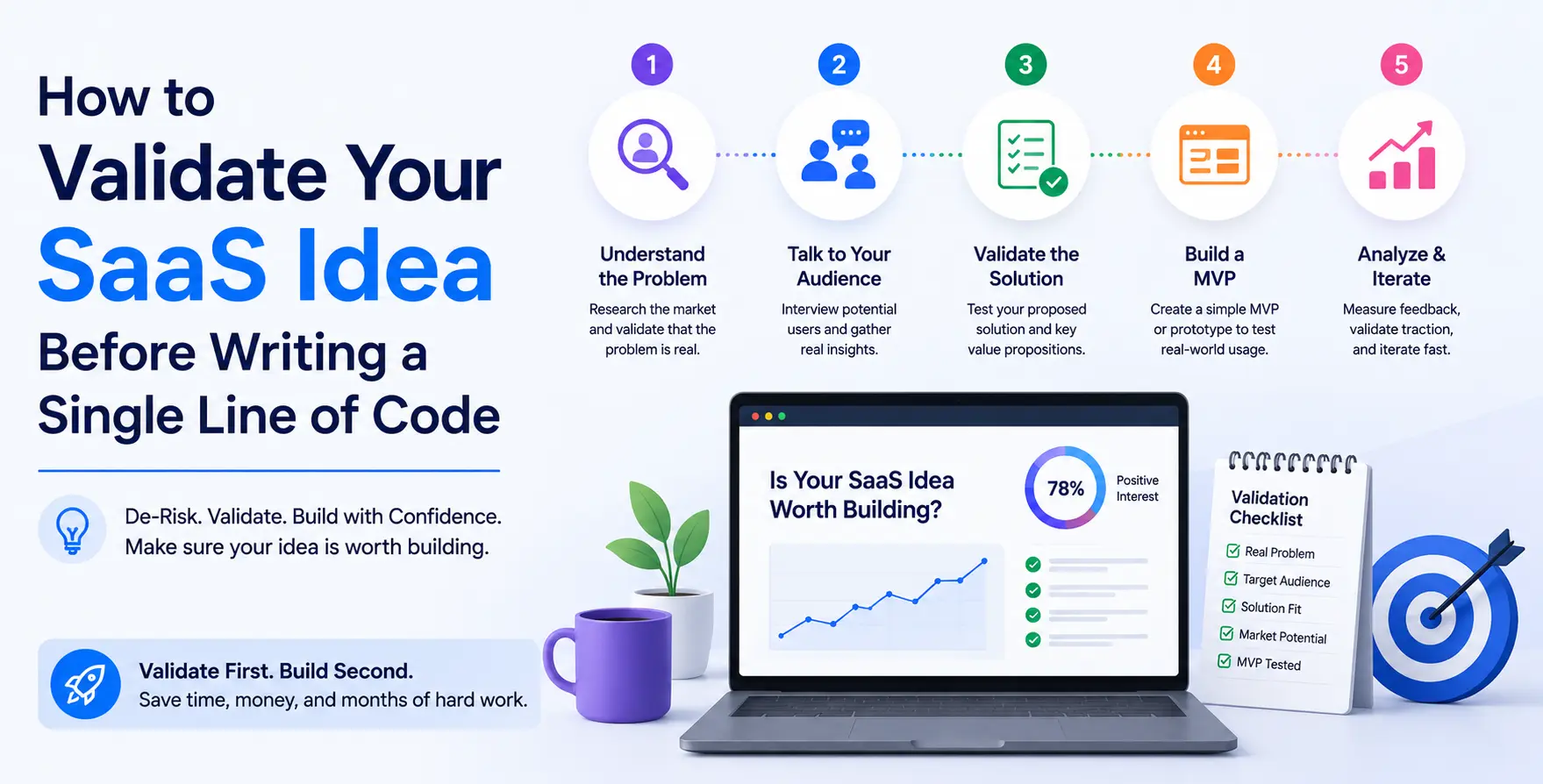
Developing software requires massive investments of time, engineering talent, and financial capital. Learning how to validate a startup idea allows founders to test demand before committing engineering resources.
By systematically validating concepts upfront, you eliminate guesswork and build software that customers want. This framework shows you how to validate SaaS idea concepts quickly and cost-effectively.
The Cost of Building Too Early
Writing code is the most expensive and time-consuming method to test a business assumption. Technical founders often retreat into development because building feels productive and measurable.
Launching an unvalidated product leads to wasted cycles, expensive technical debt, and team burnout. Every unverified feature adds unnecessary maintenance overhead to your software architecture.
Validating early protects your runway and focuses your energy on solving real user pain points efficiently.
Defining Your Core Hypothesis
Before launching outreach efforts, explicitly write down your foundational business assumptions. Every product reliance starts with key hypotheses regarding target audience pain and willingness to pay.
Formulating a precise hypothesis prevents moving goalposts when early feedback yields unexpected results.
- Target users face severe workflow friction
- Target users will pay for automated solutions
Documenting your target metrics early maintains objectivity throughout the customer discovery process.
Conducting Founder-Led Interviews
Direct conversations with prospective clients yield deep qualitative insights that quantitative surveys cannot match. Founder-led discovery uncovers subtle behavioral patterns and genuine pain points.
Asking About Past Behavior
Avoid asking prospective clients what features they would like to see in a hypothetical future. Focus exclusively on how they currently navigate their operational challenges.
- Identify current manual workaround solutions
- Uncover existing soft software budget limits
- Understand daily operational friction points
- Pinpoint actual decision making authority
- Measure recurring problem occurrence frequency
Historical user behavior remains the most reliable indicator of future purchasing decisions.
Identifying Pain Severity
Minor workflow annoyances rarely justify new enterprise software subscriptions. Look for acute operational friction that directly consumes team bandwidth or financial capital.
- Quantify daily financial loss from friction
- Evaluate immediate search urgency for tools
Pay close attention to emotional triggers when prospects describe their existing operational bottlenecks.
Crafting the Smoke Test Landing Page
A smoke test landing page presents your prospective value proposition as if the software application is already fully developed. It evaluates whether cold visitors will take action based on your messaging alone.
Direct targeted traffic from social channels or search ads to evaluate baseline visitor interest.
- Clear problem focused hero headline
- Direct high intent call to action
- Concise feature benefit highlight list
- Transparent multi tier pricing model
If target visitors decline to click your call to action, building software will not change their decision.
Running Manual Concierge Services
Delivering services manually before writing backend automation is often referred to as a wizard of oz strategy. You perform complex operations manually behind the scenes while users interact with simple frontends.
Handling workflows manually exposes real operational friction and highlights exactly where automation provides value. This hands-on experience ensures your software architecture addresses verified customer workflows accurately.
Evaluating Financial Commitment
Verbal encouragement is easy to offer, but actual financial transactions provide definitive market validation. Securing upfront financial commitment confirms true customer purchase intent.
- Collect fully refundable pre-order deposits
- Secure signed formal letters of intent
- Sell discounted annual early beta access
- Request paid design partner agreements
- Offer limited lifetime access deals early
Securing revenue before writing code proves that target customers value your solution enough to invest capital.
Code-First vs Validation-First Approach
Comparing these development methodologies illustrates why early verification is essential for modern software founders.
| Evaluation Metric |
Code-First Approach |
Validation-First Approach |
| Time to Market Feedback |
6 to 12 months |
1 to 3 weeks |
| Financial Capital Risk |
High development cost |
Minimal ad budget |
| Pivot Speed and Agility |
Slow and expensive |
Fast and seamless |
| Market Demand Proof |
Assumed until launch |
Proven before build |
| Initial Scope Focus |
Bloated feature set |
Laser focused core |
Prioritizing MVP validation before development preserves capital and dramatically improves product-market alignment probability.
Key Metrics for SaaS Product Validation
Data provides objective evidence regarding whether your value proposition resonates with prospective customers. Tracking key performance indicators across validation experiments prevents subjective bias.
- Landing page call to action conversion
- Waitlist email submission conversion rate
- Discovery interview booking response rate
- Pre-order checkout completion percentage
- Estimated customer acquisition cost metrics
- Qualitative feedback positive sentiment score
Systematic metrics tracking enables founders to make data-driven decisions regarding future engineering investments during SaaS product validation.
Analyzing User Feedback Signals
Distinguishing between polite encouragement and genuine purchase intent is critical during early feedback analysis. Prospective clients often offer compliments to avoid giving uncomfortable negative feedback.
Look for users who reach out unprompted to inquire about development timelines. Persistent follow-ups and unprompted inquiries indicate strong underlying market demand for your software.
Pivot or Proceed Decisions
Once you gather sufficient empirical data, decide whether to proceed, pivot, or abandon the business concept entirely. Successful founders remain dedicated to solving core problems rather than defending specific product features.
- Proceed when pre-orders achieve defined goals
- Pivot when problem exists but solution fails
- Abandon when market demand remains cold
Pivoting early prevents months of engineering effort dedicated to products with low market interest.
Transitioning from Validation to MVP
After establishing clear market interest, transition focus toward engineering a focused minimum viable product. Limit initial development strictly to the core capability that addresses your primary customer pain point.
- Define essential core feature requirements
- Select modular scalable framework stacks
- Maintain continuous customer feedback loops
- Establish strict MVP launch deadlines
Executing pre-code strategies gives you a clear roadmap when transitioning from validation to active software engineering.
Conclusion
Validating your software concept prior to writing code is the most effective way to build a sustainable software business. It transforms unverified hypotheses into actionable market intelligence and concrete buyer commitment.
Focus on understanding customer friction, collecting early financial commitments, and iterating quickly. When you begin writing code, you will build with complete confidence in your target market demand.


 In collaboration with