Table of Contents
- Introduction
- Understanding Business Digital Transformation
- The High Failure Rate of Enterprise Tech Shifts
- Misaligned Strategic Goals and Execution
- Cultural Resistance to Technological Change
- Legacy Architecture and Technical Debt
- Failure to Involve End Users Early
- Poor Choice of Tools and Vendors
- Core Pillar Comparison: Failure vs Success
- Essential Steps for Building a Solid Strategy
- The Role of External Expertise
- Measuring Real ROI and Progress
- Conclusion
Introduction
Modern enterprise modernization initiatives often promise immense growth and operational speed. Yet, a vast majority of these large-scale technology overhauls fail to deliver their intended value.
Engineering teams and executive boards frequently find themselves trapped in complex software migrations. Understanding why these initiatives collapse is the first step toward building resilient systems that move the business forward.
Understanding Business Digital Transformation
True business digital transformation is not simply buying new cloud infrastructure or deploying modern frameworks. It represents a fundamental shift in how an enterprise delivers continuous value to customers.
Many organizations mistake software modernization for simple IT upgrades. Moving bad operational processes to modern cloud infrastructure only accelerates internal failures.
Successful evolution requires aligning software engineering, enterprise workflows, and product design under a single unified target. Without clear alignment, technology upgrades remain expensive vanity projects.
The High Failure Rate of Enterprise Tech Shifts
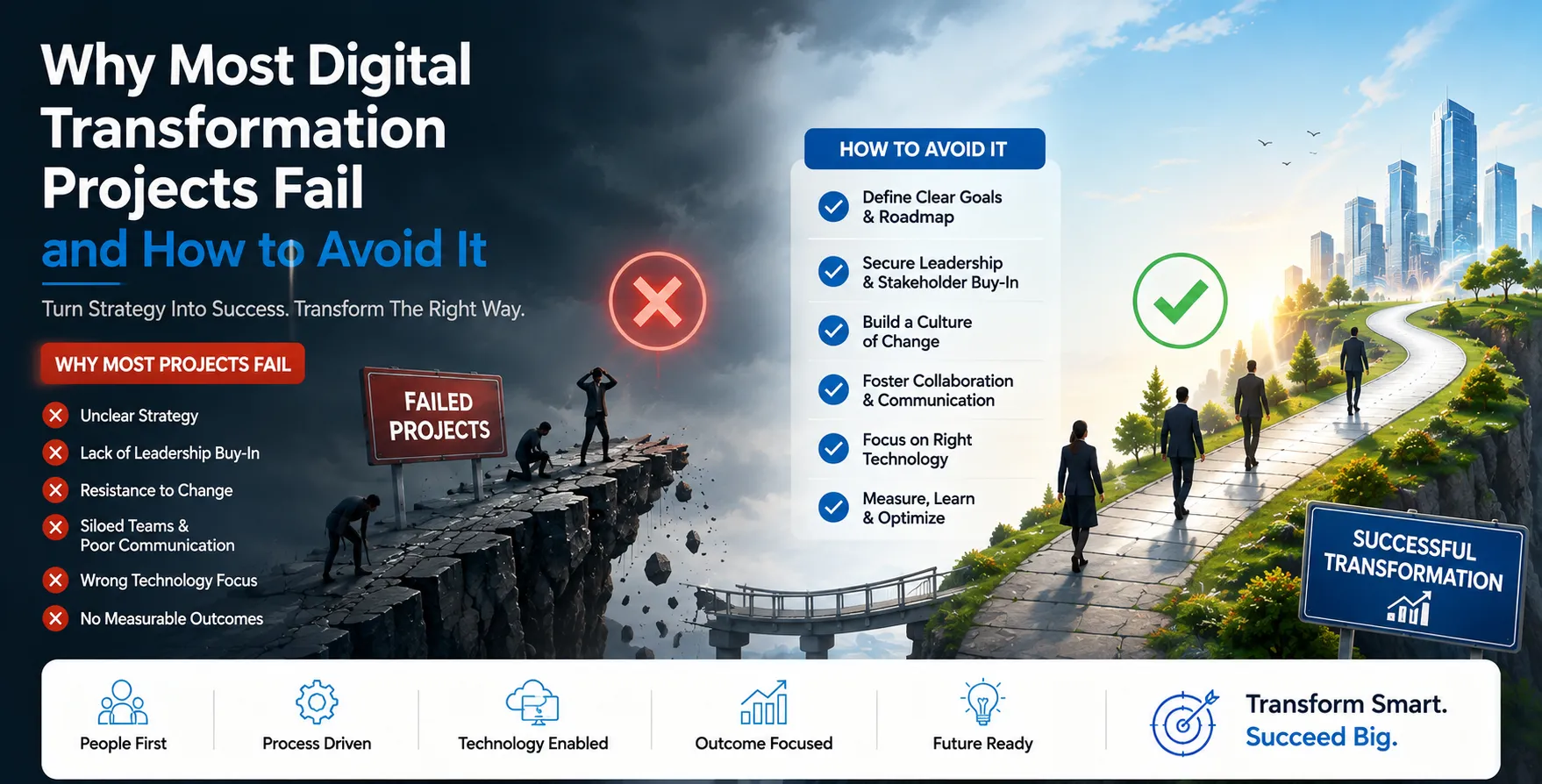
Industry surveys show that up to seventy percent of major modernization efforts fall short. Navigating complex digital transformation challenges requires identifying early warning signs before software deployment begins.
- Overestimating existing operational maturity
- Underestimating technical system dependency
- Setting unrealistic delivery timelines
- Ignoring organizational change friction
- Lacking clear governance models
When leadership ignores these early warning signs, projects stall quickly. Budgets overflow long before core features reach production systems.
Misaligned Strategic Goals and Execution
Engineering efforts frequently disconnect from actual corporate revenue goals. Developers end up building sophisticated features that bring zero real business utility to end users.
- Prioritizing technical hype over client needs
- Building isolated features without operational feedback
Cultural Resistance to Technological Change
Technology shifts fail primarily because of human friction rather than broken code. Internal teams comfortable with legacy routines often reject new tools and automated workflows.
Leadership often assumes staff will adopt new tools automatically. Without active training and change management, employees bypass new software systems entirely.
Fostering an engineering culture that values adaptability is critical. Upskilling internal teams early prevents passive rejection of modern software platforms.
Legacy Architecture and Technical Debt
Monolithic System Bottlenecks
Legacy core architectures hold back enterprise agility. Tightly coupled codebases make basic software updates risky and agonizingly slow for developers.
- Refactoring brittle source code
- Decoupling core business services
- Breaking down massive database tables
- Modernizing legacy API contracts
Resolving these bottlenecks requires phased isolation of core modules. Attempting total rewrites at once usually leads to operational disaster.
Data Silos and Integration Gaps
Data trapped in disconnected systems ruins automated reporting and workflows. Modern microservices demand reliable, real-time data flow across all enterprise applications.
- Standardizing API data structures
- Eliminating redundant manual data entries
- Automating cross-platform data pipelines
- Securing data transport protocols
Cleaning and unifying data layers early ensures smooth integration across new cloud software systems.
Failure to Involve End Users Early
Building complex software platforms in isolation guarantees usability issues. Technical architectures must solve real user friction points from day one.
- Gathering feedback during early prototyping
- Conducting interactive user testing sessions
- Tracking daily user interaction metrics
- Iterating system designs rapidly
Early user validation prevents expensive architectural redesigns late in the software development cycle.
Poor Choice of Tools and Vendors
Selecting software tools based on market hype rather than architecture fit creates vendor lock-in. Engineering teams end up paying high licensing fees for features they never use.
Off-the-shelf software often lacks the flexibility needed for custom enterprise operations. Over-customizing rigid third-party tools creates unmaintainable software implementations.
Rigorous vendor evaluation protects platform ecosystems from technical obsolescence. Teams must select tools that natively support open standards and easy data export.
Core Pillar Comparison: Failure vs Success
| Focus Area |
Failed Approach |
Successful Strategy |
| Leadership Role |
Delegates to IT entirely |
Drives cross-functional vision |
| System Architecture |
Big bang monolithic swap |
Phased modular migration |
| Team Orientation |
Siloed software teams |
Integrated product squads |
| User Adoption |
Mandated training late |
Continuous feedback integration |
| Technology Selection |
Driven by tool hypes |
Driven by business fit |
| Metrics & Success |
On-time software delivery |
Measurable business outcomes |
Essential Steps for Building a Solid Strategy
Creating a successful digital transformation strategy requires a clear, step-by-step framework that connects technical execution to business value.
- Audit current legacy tech systems
- Define clear business value targets
- Map essential user workflow paths
- Establish modular system platform standards
- Execute small phased production releases
- Measure performance and refine architecture
Following a structured sequential approach keeps software engineering initiatives manageable and scalable over long horizons.
The Role of External Expertise
Navigating modern architecture decisions can overwhelm in-house engineering teams. Bringing in targeted digital transformation consulting provides fresh insight and deep technical expertise.
- Accelerating technology architecture selection
- Uncovering hidden legacy security risks
- Training teams in cloud-native practices
- Streamlining DevOps pipeline automation
External engineering advisors help avoid predictable pitfalls and keep strategic execution moving forward without delay.
Measuring Real ROI and Progress
Tracking technical velocity alone does not guarantee business value. Executives must monitor outcome-based metrics to confirm long-term system success.
- Deployment cycle time reduction
- System uptime and resilience rates
- Customer onboarding task velocity
- Maintenance operational expense savings
- User daily platform engagement
Conclusion
Digital transformations do not fail because of flawed software frameworks or modern cloud platforms. They fail due to misaligned priorities, cultural friction, and poor architectural planning.
By focusing on user needs, addressing technical debt incrementally, and maintaining clear executive alignment, businesses can ensure lasting technical success.
Building scalable and reliable software requires patience, clear strategy, and continuous refinement across every layer of the enterprise.


 In collaboration with