Table of Contents
- Introduction
- What is GitOps?
- Core Principles of GitOps
- How GitOps Works in Practice
- GitOps vs Traditional CI/CD
- Declarative Infrastructure and GitOps
- Push-Based vs Pull-Based GitOps Models
- Comparison: Push-Based vs Pull-Based Architecture
- Key Benefits of GitOps Infrastructure Management
- Challenges When Implementing GitOps Workflow
- Best Practices for Adopting GitOps
- GitOps with Kubernetes and Platform Engineering
- Final Thoughts
Introduction
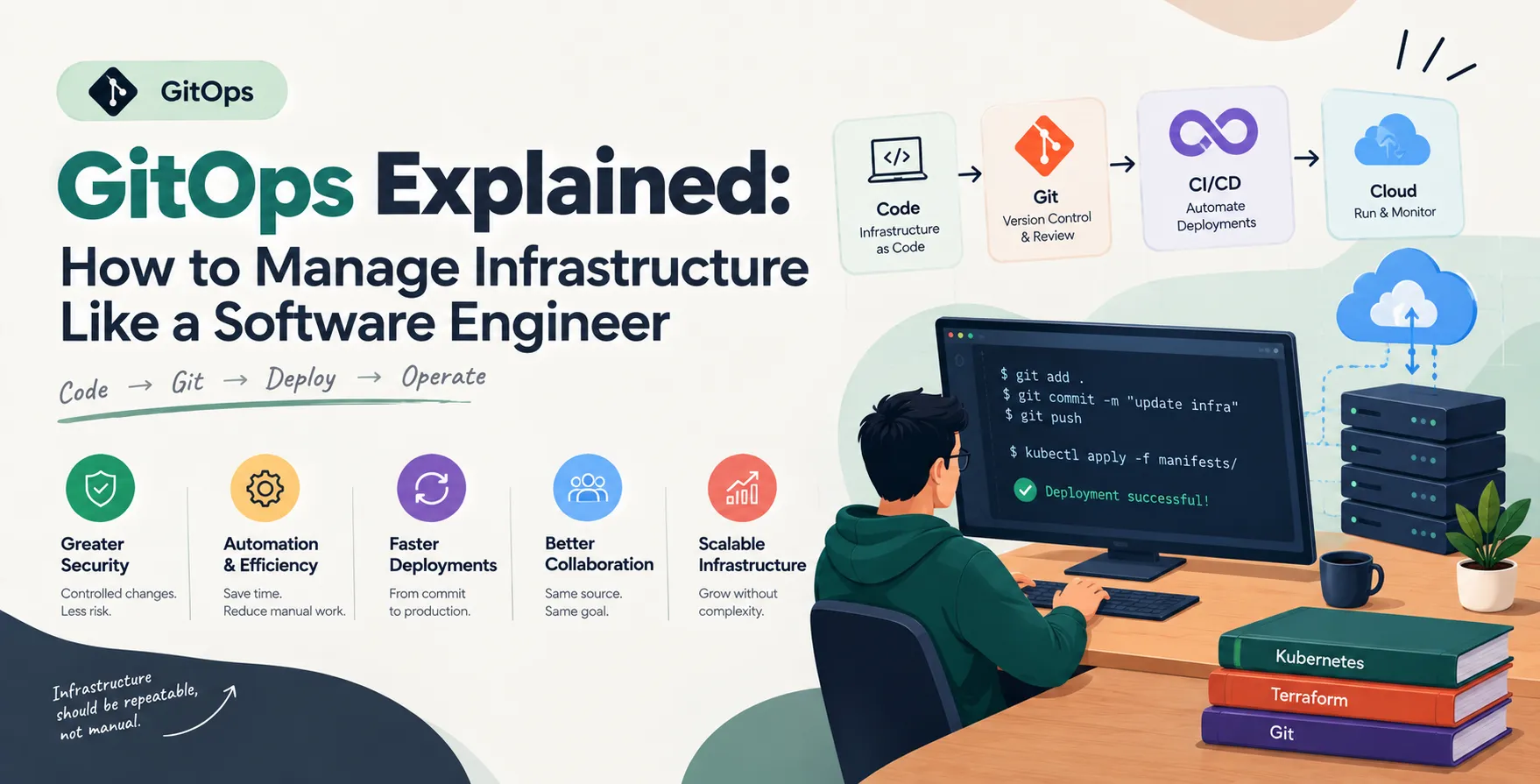
Managing modern cloud infrastructure has historically been complex and prone to manual configuration errors. Software developers solved similar release challenges years ago by adopting version control, automated testing, and continuous delivery.
GitOps brings those exact software engineering practices directly to cloud operations. By placing declarative infrastructure code inside Git repositories, infrastructure management becomes predictable and fully auditable.
- Automates cloud infrastructure updates
- Enforces strict version control
- Reduces operational downtime and risk
What is GitOps?
GitOps is an operational framework that uses Git repositories as the single source of truth for infrastructure definitions. System updates occur exclusively through pull requests and automated version control workflows.
This operational model builds upon GitOps infrastructure as code principles by ensuring environment configurations stay stored declaratively. Software operators no longer execute manual CLI commands against production servers directly.
Whether managing complex infrastructure for a microservices vs monolithic architecture or simple cloud apps, GitOps ensures consistency across environments.
Core Principles of GitOps
The GitOps model relies on four foundational rules that keep production systems synchronized with source code.
- Declarative system specifications in version control
- Canonical state defined entirely in Git
- Automated state delivery through continuous controllers
- Software agents guaranteeing continuous state reconciliation
- Immutable deployment artifacts across all environments
When engineering teams adhere to these core principles, infrastructure changes become completely transparent and trackable across every deployment.
How GitOps Works in Practice
Understanding how GitOps works requires examining how changes move from developer workstations to live clusters.
Engineers propose infrastructure changes by submitting a standard Git commit or pull request. Once peer reviewers approve the request, automated reconciliation agents apply those changes to target environments.
- Developer updates declarative YAML configuration files
- Peer review validates code changes in Git
- Automated agent detects repository commit diff
- Controller reconciles cluster state automatically
If someone manually alters production resources outside Git, the reconciliation loop automatically overwrites the drift back to the declared repository version.
GitOps vs Traditional CI/CD
Traditional continuous deployment pipelines rely on external scripts pushing changes directly to target cloud servers. This traditional approach requires granting broad administrative write permissions to external build server engines.
GitOps shifts this paradigm by pulling configuration changes from inside the targeted runtime environment. The deployment agent runs inside the cluster and monitors the Git repository for new updates continuously.
This pull model keeps sensitive credentials stored safely inside private networks while facilitating automated execution alongside standard API testing in CI/CD pipeline stages.
Declarative Infrastructure and GitOps
Imperative scripts detail step-by-step shell commands to provision cloud resources. Declarative definitions describe only the desired final end-state of target systems.
GitOps relies entirely on declarative system definitions. Automated controllers inspect live cluster states continuously and execute necessary actions to match stored repository files.
- Eliminates environment configuration drift
- Simplifies multi-region cluster disaster recovery
- Accelerates complex configuration rollbacks
Using declarative configurations ensures reproducible infrastructure across cloud platforms when deploying workloads across AWS vs Azure vs Google Cloud environments.
Push-Based vs Pull-Based GitOps Models
Push-Based Approach
In push-based setups, an external continuous integration pipeline executes deployment commands whenever changes reach the repository main branch.
- Requires external access to cluster APIs
- Easier initial setup for legacy workloads
Push-based models work well for existing application scripts and traditional infrastructure setups like Docker containers vs virtual machines running legacy server workloads.
Pull-Based Approach
Pull-based setups utilize an operator running inside the cluster that continuously polls source code repositories for declared state changes.
- Enhances overall cluster security posture
- Eliminates outbound firewall opening requirements
- Automatically repairs unauthorized live cluster drift
- Supports granular continuous cluster reconciliation
- Keeps deployment credentials inside private networks
- Provides robust state tracking inside Kubernetes
The pull-based approach offers superior security because write access credentials never leave the live execution environment.
Comparison: Push-Based vs Pull-Based Architecture
Evaluating deployment architectures helps infrastructure teams choose the right operational model for their specific cloud workloads.
| Feature |
Push-Based Architecture |
Pull-Based Architecture |
| Security Credentials |
Stored in external CI server |
Stored inside target cluster |
| Drift Correction |
Triggered on explicit pipeline execution |
Continuous background reconciliation loop |
| Network Firewalls |
Requires open inbound cluster access |
Requires only outbound repository pull |
| Operational Complexity |
Lower initial engineering setup overhead |
Requires cluster operator installation |
| Target Workloads |
Legacy VMs and traditional cloud scripts |
Modern cloud-native Kubernetes clusters |
Selecting between these approaches depends heavily on security compliance requirements and organizational operational maturity.
Key Benefits of GitOps Infrastructure Management
Adopting GitOps infrastructure management transforms cloud operations by establishing developer-centric workflows across teams.
- Improves infrastructure change auditability
- Accelerates developer onboarding time
- Enables instant single-commit rollbacks
- Enhances cloud environment security
- Increases overall system operational stability
Software development teams spend significantly less time troubleshooting manual configuration drift and more time building impactful application features.
Challenges When Implementing GitOps Workflow
Transitioning to a GitOps workflow requires adjustments in organizational culture and technical tooling. Teams must prepare for initial operational friction during early adoption phases.
Managing sensitive application secrets inside public or private Git repositories poses a major security challenge if teams do not implement proper encryption tools.
Additionally, developer adoption can stall when infrastructure repository folder structures become overly complex or lack clear governance standards.
Best Practices for Adopting GitOps
Successful GitOps adoption requires establishing clear team standards around repository structure, permission management, and release workflows.
Isolating environment configurations across dedicated Git repositories prevents accidental production updates during active development testing.
- Separate application source code from infrastructure definitions
- Encrypt secrets using SOPS or Sealed Secrets
- Enforce pull request branch protection rules
- Automate pull request validation pipelines
Establishing these foundational rules early prevents security liabilities as cloud infrastructure scales across multiple environments.
GitOps with Kubernetes and Platform Engineering
GitOps and container orchestration platforms share a natural alignment due to declarative API architectural designs.
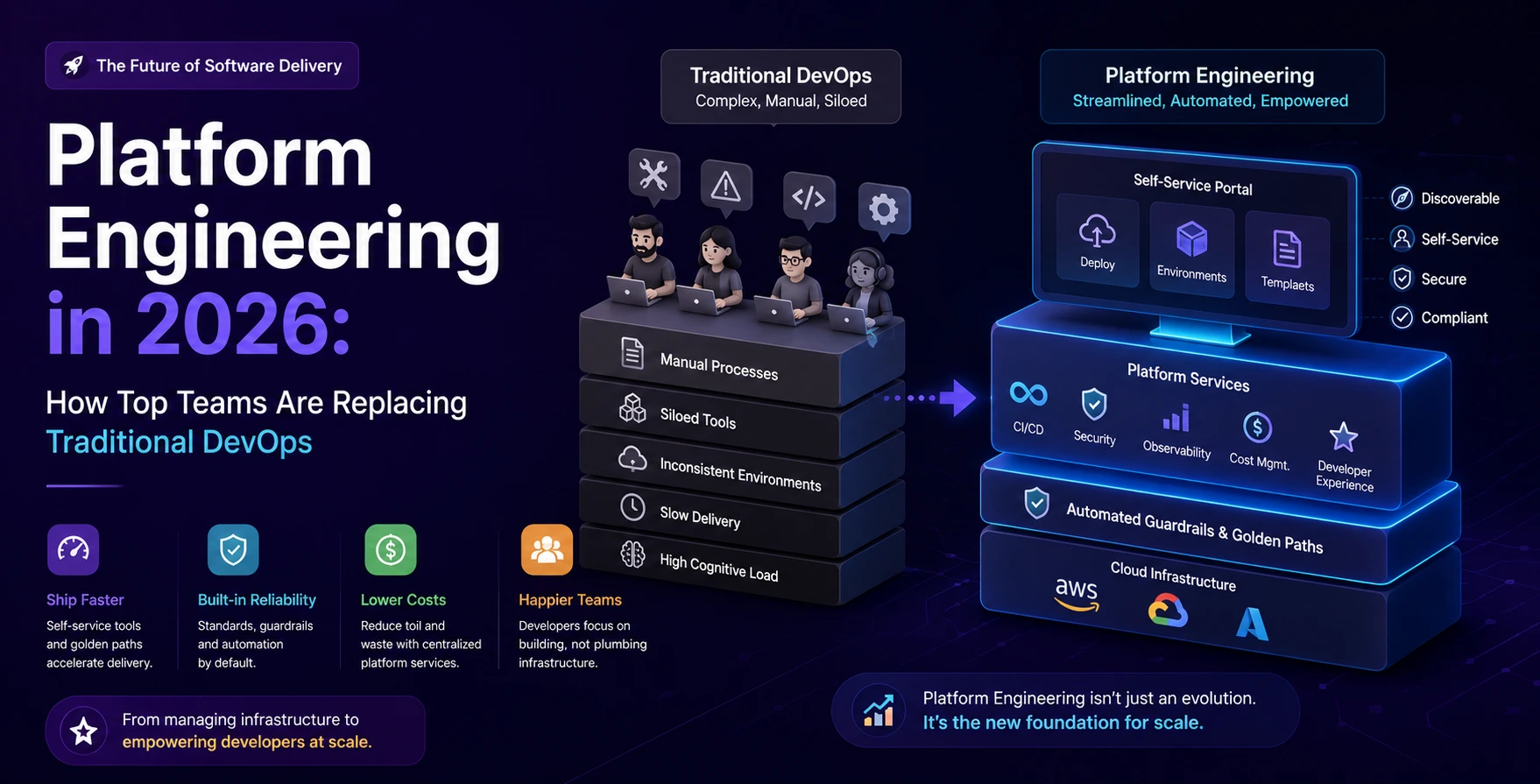
Modern Platform Engineering teams build internal developer platforms powered by GitOps reconciliation engines like ArgoCD and Flux.
- Simplifies managing Kubernetes for Microservices
- Standardizes developer environment provisioning
- Automates fleet management across multi-cluster deployments
This powerful combination empowers software engineering teams to provision infrastructure self-sufficiently while maintaining organizational security controls.
Final Thoughts
GitOps brings software engineering precision to cloud operations by treating infrastructure as code inside version control repositories. By adopting continuous automated reconciliation loops and declarative configurations, organizations achieve superior auditability, stability, and delivery speed.
Starting with non-production workloads allows teams to build operational confidence in pull-based automation before expanding GitOps across mission-critical enterprise infrastructure.


 In collaboration with