Table of Contents
- Introduction
- Understanding API Testing in CI/CD Pipeline
- Why Automation is Important
- How CI/CD Pipeline API Testing Works
- Step-by-Step Integration Process
- Practical Workflow
- Best Practices
- Common Challenges
- Conclusion
Introduction
In today’s development environment, delivering reliable software quickly is a major goal for every team. Applications are updated frequently, and even a small issue in APIs can break the entire system. This is why API testing in CI/CD pipeline has become an essential part of modern workflows.
Instead of relying on manual testing, teams now focus on automation to validate every change. This approach ensures that issues are detected early and fixed before deployment.
When implemented correctly, CI/CD pipeline API testing improves both speed and quality without increasing manual effort.
- Ensures continuous validation of APIs
- Reduces deployment risks
- Improves software reliability
Understanding API Testing in CI/CD Pipeline
API testing in CI/CD pipeline refers to validating API functionality automatically during different stages of development. Each time a developer pushes code, tests are executed to verify that APIs behave as expected.
This approach helps maintain consistency and ensures that no unexpected changes reach production.
It also removes dependency on manual verification, making the process faster and more efficient.
- Runs automatically on code updates
- Checks API responses and logic
- Prevents broken releases
Why Automation is Important
Manual testing becomes difficult as applications grow. Automation provides a scalable solution that allows teams to test frequently without slowing down development.
When you automate API testing in CI/CD, you ensure that testing becomes a continuous process instead of a final step.
This leads to better collaboration between development and operations teams.
- Provides faster feedback
- Eliminates repetitive manual work
- Improves overall efficiency
- Supports rapid development cycles
How CI/CD Pipeline API Testing Works
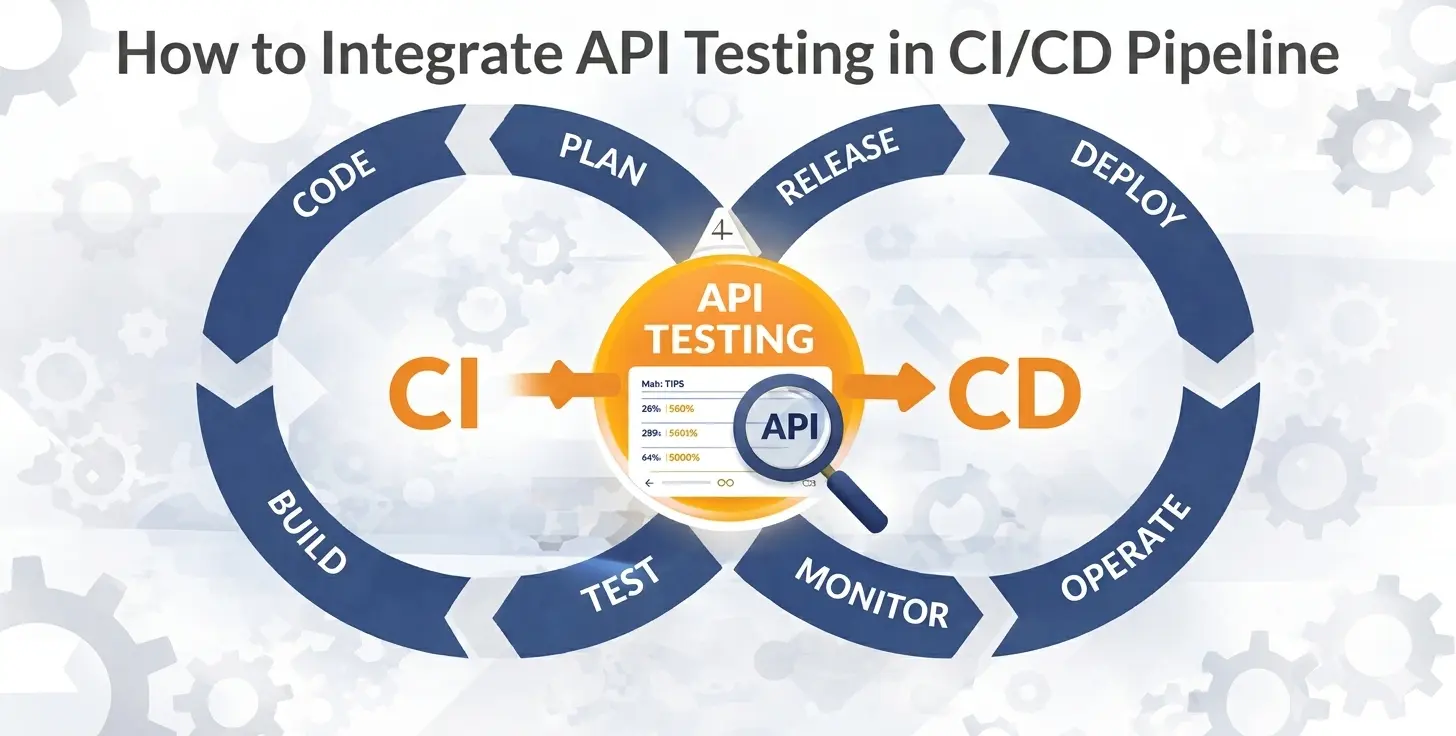
CI/CD pipeline API testing follows a structured flow where tests are executed automatically within the pipeline. Each stage is responsible for a specific task.
The process starts when code is pushed and continues until deployment.
- Code is committed to repository
- Pipeline is triggered automatically
- Build process prepares the application
- API tests are executed
- Deployment happens only if tests pass
This structured approach ensures that every change is validated properly.
Step-by-Step Integration Process
Step 1: Define Test Scenarios
Start by identifying what needs to be tested. Focus on critical API functionality and edge cases.
- Validate response status codes
- Check response data structure
- Verify authentication behavior
- Test failure scenarios
Step 2: Build Automated Tests
Once scenarios are defined, convert them into automated scripts. This is the base of an API testing automation pipeline.
Automation ensures repeatability and accuracy in testing.
- Create reusable test scripts
- Handle multiple test cases
- Validate expected outputs
Step 3: Configure Pipeline
Set up your CI/CD system to include testing as a mandatory stage. This ensures that every code change goes through validation.
- Fetch latest code
- Install required dependencies
- Prepare test environment
Step 4: Execute Tests Automatically
The pipeline should run tests automatically without manual intervention. This is where automate API testing in CI/CD becomes effective.
- Run tests on every commit
- Stop pipeline on failure
- Ensure consistent validation
Step 5: Analyze Results
After execution, analyze results to identify issues. Proper reporting helps in quick debugging.
- Track passed and failed tests
- Identify root causes
- Improve test coverage
Practical Workflow
A practical workflow for API testing in CI/CD pipeline includes multiple automated steps working together.
This workflow ensures that testing is continuous and reliable.
- Developer pushes code changes
- Pipeline is triggered instantly
- Application build is created
- API tests run automatically
- Results are generated
- Deployment proceeds if successful
This method helps maintain a stable and efficient system.
Best Practices
Following best practices improves the effectiveness of CI/CD pipeline API testing.
- Keep test cases simple and clear
- Focus on critical API functionality
- Maintain proper test coverage
- Run tests frequently
- Update tests as APIs evolve
Common Challenges
While implementing API testing automation pipeline, teams may face challenges that affect performance and reliability.
- Unstable test environments
- Slow test execution
- Dependency on external services
- Difficulty in maintaining test scripts
These challenges can be managed with proper planning and consistent improvements.
Conclusion
API testing in CI/CD pipeline is essential for building reliable and scalable applications. It ensures that every change is tested automatically and reduces the chances of failure.
By implementing CI/CD pipeline API testing, teams can improve efficiency and maintain high-quality standards.
Start small, focus on automation, and gradually build a strong API testing automation pipeline for long-term success.


 In collaboration with