Table of Contents
- Introduction
- What is an API?
- What is REST API?
- How REST API Works
- API vs REST API
- REST API Example
- Common HTTP Methods
- Benefits of REST API
- Common Mistakes
- Conclusion
Introduction
In modern web development, applications need to communicate with each other. Whether you are using a mobile app, website, or third-party service, data is constantly being exchanged in the background.
This communication happens using APIs. If you are a beginner, you might be wondering what is REST API and how it is different from a normal API.
In this guide, you will understand the basics, learn the difference between API vs REST API, and explore a simple REST API example.
What is an API?
An API (Application Programming Interface) is a way for different applications to communicate with each other. It acts like a bridge that allows systems to send and receive data.
For example, when you use a weather app, it fetches data from a server using an API. The app does not store all data locally; instead, it requests information from another system.
- Connects different systems
- Sends and receives data
- Simplifies development
What is REST API?
A REST API (Representational State Transfer API) is a type of API that follows specific rules and uses HTTP methods for communication.
When people search for what is REST API, they are usually referring to APIs that work over the internet using standard web protocols.
REST APIs are widely used because they are simple, scalable, and easy to understand.
- Uses HTTP methods like GET and POST
- Works with JSON data
- Follows a structured approach
How REST API Works
REST API works based on requests and responses. A client sends a request to the server, and the server responds with data.
Each request contains a URL and a method. The server processes the request and returns the result in a structured format, usually JSON.
- Client sends request
- Server processes request
- Server returns response
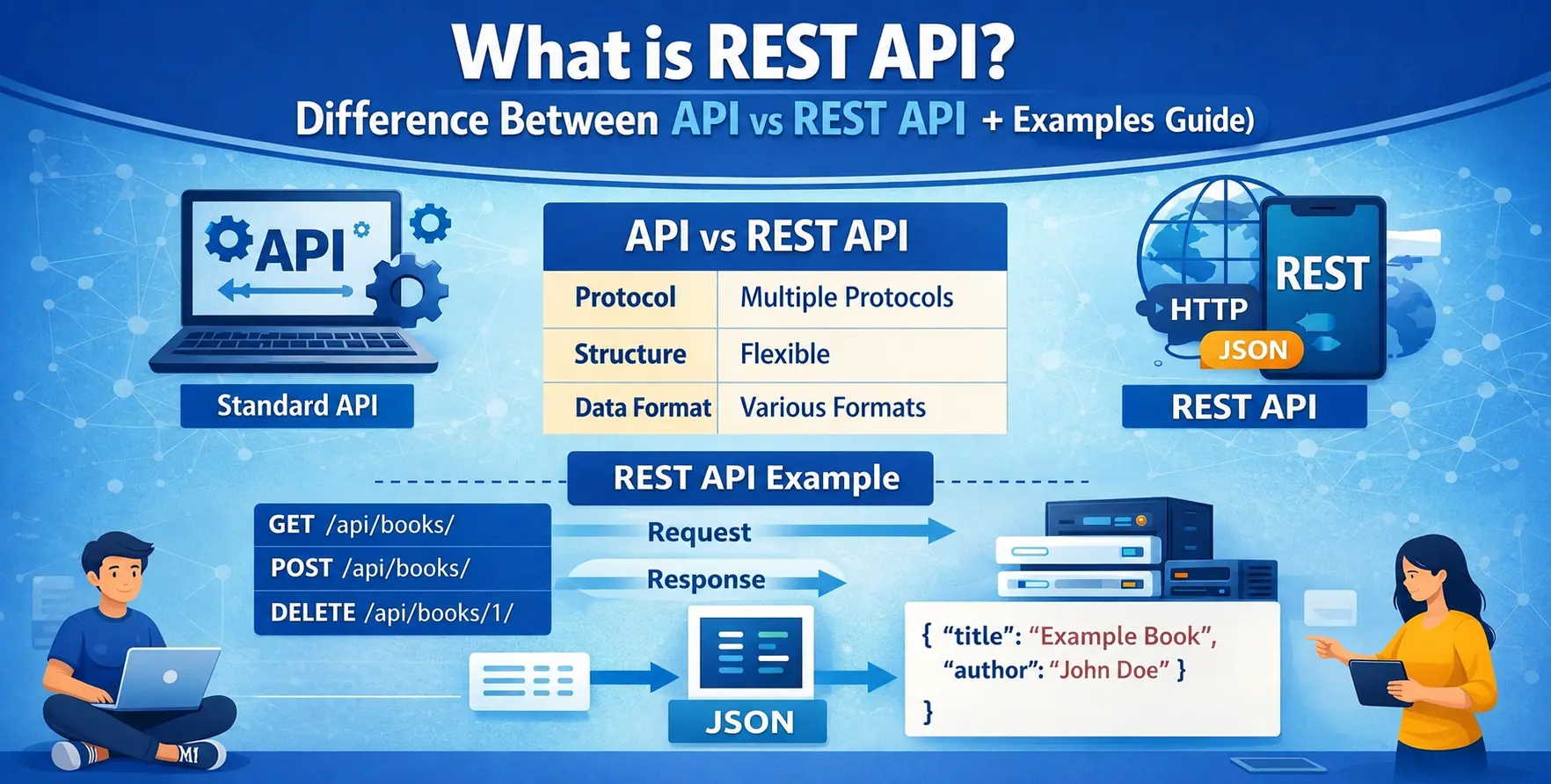
API vs REST API
Understanding API vs REST API is important for beginners. Not all APIs are REST APIs, but all REST APIs are a type of API.
| Feature |
API |
REST API |
| Definition |
General interface |
Specific type of API |
| Protocol |
Can use multiple protocols |
Uses HTTP |
| Structure |
Flexible |
Standardized |
REST API Example
Let’s look at a simple REST API example. Imagine a system that manages books.
GET /api/books/
POST /api/books/
PUT /api/books/1/
DELETE /api/books/1/
In this REST API example:
- GET retrieves data
- POST creates new data
- PUT updates data
- DELETE removes data
The server responds with JSON data, which is easy to read and use in applications.
Common HTTP Methods
REST APIs use standard HTTP methods to perform actions.
- GET: Fetch data
- POST: Create data
- PUT: Update data
- DELETE: Delete data
Benefits of REST API
REST APIs are popular because they are easy to use and highly scalable. Developers prefer them for building modern applications.
- Simple and flexible
- Works with multiple platforms
- Fast and scalable
- Easy to integrate
Common Mistakes
Beginners often make mistakes when working with APIs. Avoid these to improve your understanding.
- Confusing API vs REST API
- Not using correct HTTP methods
- Ignoring error handling
Conclusion
Now you understand what is REST API, how it works, and the key difference between API vs REST API. You also explored a simple REST API example to understand real-world usage.
REST APIs are an essential part of modern development. Once you understand the basics, you can start building your own APIs and integrate them into applications.


 In collaboration with