Table of Contents
- Introduction
- Understanding Traditional Monolithic Architecture
- Core Benefits of Monolithic Architecture
- Common Challenges of Monoliths
- Understanding Microservices Architecture
- Core Benefits of Microservices
- Key Challenges of Microservices
- Monolithic Architecture vs Microservices: Key Differences
- Strategic Factors to Consider for Your Business
- Cost Implications: Initial Setup vs Scaling
- How Technical Debt Impacts Architecture Choices
- Practical Migration Path: Monolith to Microservices
- Making the Final Decision
- Conclusion
Introduction
Choosing the right software architecture is one of the most critical decisions for any engineering team.
The debate around monolith vs microservices often creates confusion for growing businesses trying to scale efficiently.
Understanding Traditional Monolithic Architecture
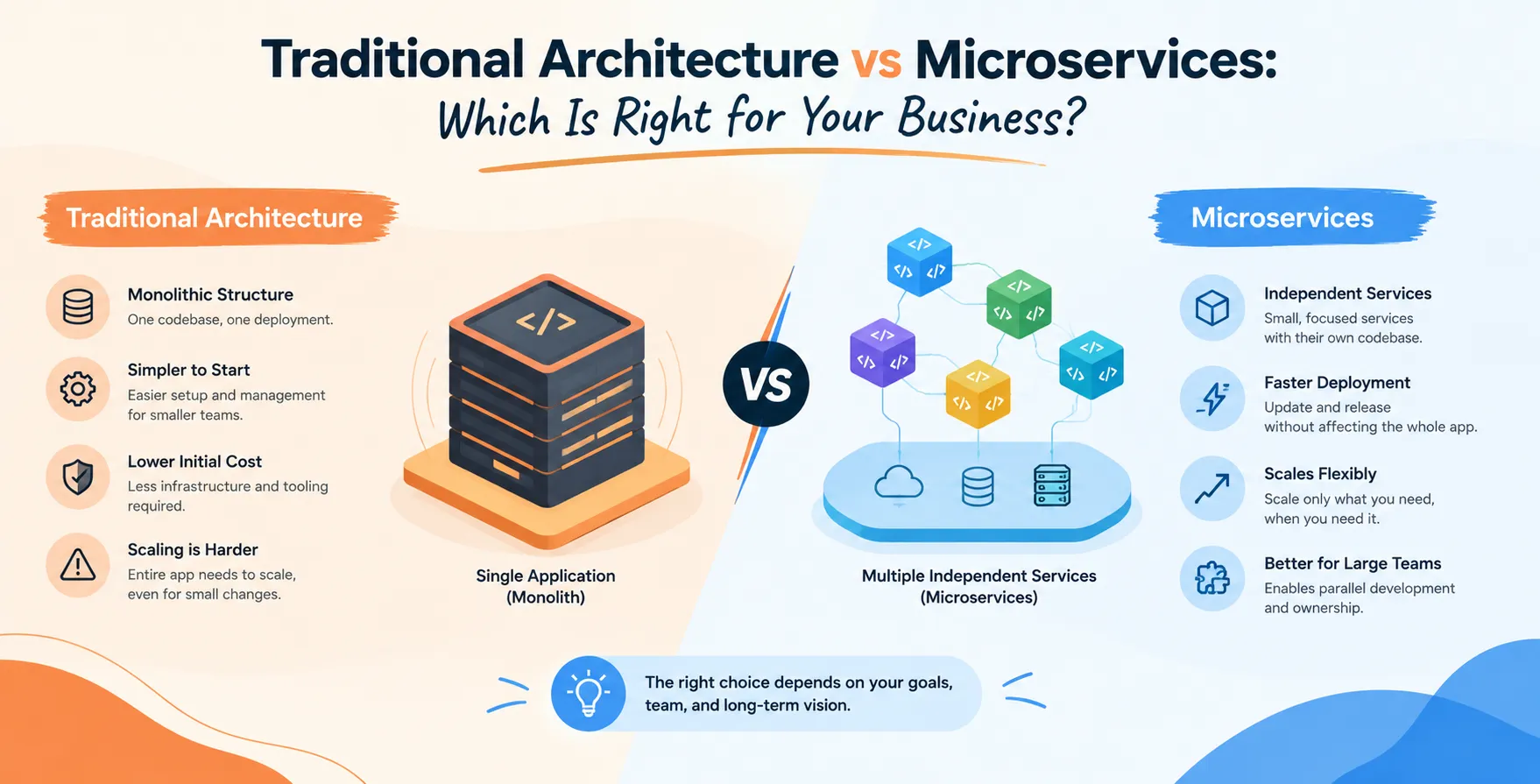
A monolithic architecture builds the entire software application as a single unified unit. All components, including database access, business logic, and user interface, live within one codebase.
This approach simplifies initial development because teams work inside a single shared environment. Standard framework tooling handles deployment, testing, and logging out of the box.
For early-stage startups building initial custom software development projects, this unified model reduces operational overhead. It allows small teams to ship features quickly without managing distributed cloud systems.
Core Benefits of Monolithic Architecture
Monoliths offer distinct operational advantages for specific team sizes and project requirements.
- Simple setup and rapid initial deployment
- Straightforward end-to-end local application testing
- Lower initial infrastructure and operational expenses
- Simplified cross-cutting concerns like logging
- Direct memory calls instead of network calls
These strengths make monoliths an excellent starting point for many newly launched organizations.
Common Challenges of Monoliths
As applications expand in scope and traffic, monolithic systems encounter severe scaling bottlenecks.
- Tightly coupled code limits independent feature scaling
- Long build and test pipeline release cycles
- Risk of single points of system failure
- High obstacle for adopting new tech stacks
Over time, these friction points reduce developer productivity and slow down software releases.
Understanding Microservices Architecture
Microservices architecture structures an application as a collection of loosely coupled, independently deployable services. Each service handles a specific business function and communicates via lightweight network protocols.
Teams can build, deploy, and scale individual services without modifying the rest of the application ecosystem. This functional isolation accelerates delivery velocity for larger engineering organizations.
Modern cloud deployment strategies often rely heavily on containerization to run individual services reliably across diverse environments.
Core Benefits of Microservices
Distributed architectures enable growing enterprises to scale operations efficiently across multiple teams.
- Independent deployment cycles for faster releases
- Granular auto-scaling based on specific service demand
- Isolated failure domains prevent total application outages
- Flexibility to choose optimal tech stacks per service
- Smaller codebases designed for specific business domains
- Better alignment with autonomous, cross-functional engineering teams
Organizationally, microservices allow engineering groups to scale output without stepping on each other.
Key Challenges of Microservices
Adopting microservices introduces operational overhead that requires specialized engineering expertise.
Deployment Complexity
Managing dozens of distinct deployment units demands robust infrastructure automation and operational tooling.
- Complex CI/CD pipeline automation requirements
- Increased network latency across remote service calls
Teams frequently adopt solutions like Kubernetes for microservices to manage container orchestration effectively across environments.
Data Consistency
Handling data across multiple databases introduces transaction management complexity.
- Distributed transactions require event-driven architecture designs
- Eventual consistency replaces immediate database consistency
- Difficult cross-service data queries and aggregate reporting
Engineers must carefully design boundaries using API first development principles to maintain system integrity.
Monolithic Architecture vs Microservices: Key Differences
Evaluating monolithic architecture vs microservices requires comparing key technical dimensions directly.
| Dimension |
Monolithic Architecture |
Microservices Architecture |
| Deployment |
Single artifact deployment |
Multiple independent service deployments |
| Scalability |
Scales entire application horizontally |
Scales specific high-demand services independently |
| Data Storage |
Single centralized database store |
Database per microservice pattern |
| Fault Tolerance |
Single bug can crash application |
Isolated failures maintain overall uptime |
| Team Structure |
Best for centralized, small teams |
Best for decentralized, autonomous teams |
| Code Coupling |
Tightly coupled component logic |
Loosely coupled, network-linked services |
Strategic Factors to Consider for Your Business
Deciding between microservices vs monolithic architecture depends heavily on team maturity and strategic goals.
- Size and structure of your engineering organization
- Expected traffic volume and scalability requirements
- Speed requirements for initial market launch
- Budget constraints for cloud and infrastructure engineering
Cost Implications: Initial Setup vs Scaling
The financial trade-offs between monolithic vs microservices architecture change significantly over a product lifecycle.
Monoliths require minimal upfront investment in infrastructure, deployment tooling, and specialized DevOps personnel. Early-stage companies save substantial capital by keeping hosting environments simple and localized.
Conversely, microservices demand high upfront infrastructure investments for monitoring, distributed tracing, and orchestration. However, microservices reduce long-term hosting waste by allowing targeted scaling of high-demand components.
How Technical Debt Impacts Architecture Choices
Unmanaged technical debt in software development often forces teams into premature architectural migrations.
- Coupled monolith codebases become difficult to modify
- Premature microservice adoption creates distributed monolith chaos
Executing a structured software discovery phase helps identify real operational bottlenecks before undertaking complex migrations.
Practical Migration Path: Monolith to Microservices
Migrating from a monolith to microservices should be an incremental process rather than a full system rewrite.
- Identify clear domain boundaries using domain-driven design
- Establish API gateways to route incoming client traffic
- Extract non-critical edge services from the monolithic codebase
- Isolate database data stores for newly separated services
- Refactor main application core components into distinct services
This gradual extraction pattern minimizes business risk and maintains uninterrupted system uptime during transition.
Making the Final Decision
If your startup is building a new product with an evolving business model, a well-structured monolith is ideal.
If your enterprise manages high transaction volume across multiple specialized engineering squads, microservices provide essential speed.
Conclusion
Neither architecture is inherently superior; both serve distinct operational scale requirements and organizational structures.
Evaluating team maturity, infrastructure budget, and long-term business goals will point you toward the correct choice.


 In collaboration with