Table of Contents
- Introduction to API Reliability
- What is API Contract Testing?
- The Core Value of Contract Testing
- API Contract Testing vs Traditional Integration Testing
- Understanding Consumer Driven Contract Testing
- How REST API Contract Testing Improves Deployment
- Essential API Contract Testing Best Practices for REST APIs
- Setting Up Your First Contract Test
- Integrating Contracts into Your CI/CD Pipeline
- Handling Versioning and Breaking Changes
- Common Pitfalls in Contract Testing
- The Role of Documentation in Contracts
- Tools for Modern API Testing
- Conclusion
Introduction to API Reliability
In modern microservices architectures, the communication between services is the backbone of your application. When one service changes its response format, it can inadvertently break everything downstream. Ensuring these systems stay synced is a primary challenge for engineering teams.
API contract testing provides a structural solution to this instability. By validating the agreements between services, you can catch integration issues before they reach production environments.
What is API Contract Testing?
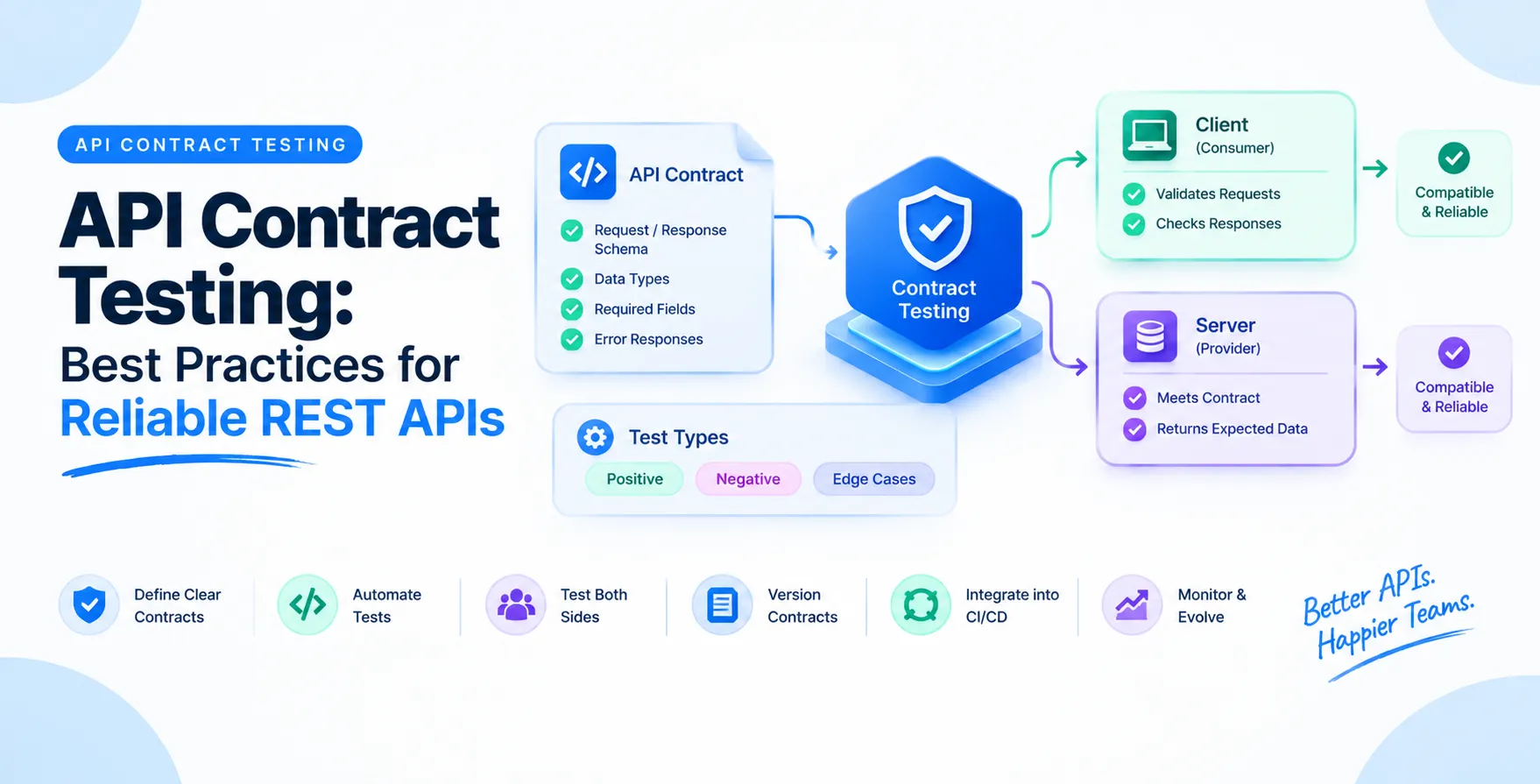
At its heart, a contract is a shared understanding between a service provider and its consumers. It defines the expected requests, response structures, and data types for an endpoint. API contract testing validates that both the provider and the consumer adhere to this defined agreement.
This approach ensures that your services remain compatible even as they evolve independently. Instead of relying on full-system integration tests, you focus on the interface itself.
The Core Value of Contract Testing
Contract testing brings a unique level of confidence to your development cycle. It effectively replaces the need for massive, fragile integration tests that are notoriously difficult to maintain.
By focusing specifically on the API interface, you can identify issues in seconds rather than minutes. This speed is critical for agile teams aiming for high deployment frequency.
- Faster feedback loops during development
- Reduced reliance on ephemeral test environments
- Clearer boundaries between microservices
- Early detection of breaking changes
API Contract Testing vs Traditional Integration Testing
Traditional integration tests often require spinning up multiple services in a staging environment. This is slow, expensive, and prone to flakiness caused by network issues or database state problems.
Contract tests, by contrast, are lightweight and isolated. They test the agreement directly, ignoring the internal implementation details of the services involved.
| Feature |
Integration Testing |
Contract Testing |
| Speed |
Slow |
Very Fast |
| Environment |
Complex |
Isolated |
| Reliability |
Flaky |
Stable |
| Feedback |
Late |
Early |
Understanding Consumer Driven Contract Testing
Consumer driven contract testing flips the traditional testing model. Instead of the provider dictating the API structure, the consumer defines what they actually need from the provider.
This ensures that the provider only builds what is necessary. It also allows consumers to evolve at their own pace without waiting for global schema updates.
- Consumer defines the specific requirements
- Provider validates against consumer needs
- Collaboration between teams is formalized
- Unused fields are easily identified
How REST API Contract Testing Improves Deployment
When you implement robust REST API contract testing, you gain the ability to deploy services with confidence. You no longer have to fear that your latest commit might break a hidden consumer dependency.
This mechanism acts as a safety net for your CI/CD pipeline. If a change violates an existing contract, the build fails immediately, preventing the defect from reaching downstream systems.
Essential API Contract Testing Best Practices for REST APIs
Implementing these tests requires a disciplined approach to API design. Start by treating your API specifications as the source of truth for all your development and testing efforts.
Focus on Key Fields
You do not need to test every single property in a JSON response. Focus on the fields that are essential for the consumer to function correctly.
- Validate mandatory status fields
- Verify data type consistency
- Check critical response codes
This keeps your test suite maintainable as your API grows.
Maintain Independent Test Suites
Keep your contract tests separate from your unit and functional tests. This prevents the test suite from becoming a monolithic, slow-running process that developers avoid.
- Run contract tests in parallel
- Separate concerns between services
Clean separation makes it easier to troubleshoot failures when they occur.
Setting Up Your First Contract Test
Begin by defining your contract in a standard format like OpenAPI. Once defined, use a tool to generate stubs for the consumer and verify the provider's implementation.
This foundational work pays off as you scale your architecture. Every new service added to the ecosystem will benefit from this established verification process.
Integrating Contracts into Your CI/CD Pipeline
Automating your testing is the only way to ensure the contracts remain valid over time. When you integrate your contract checks into the deployment pipeline, you move closer to a truly automated quality gate.
This ensures that no code is merged unless it satisfies the requirements of its consumers. It transforms quality assurance into a continuous, automated process rather than a final checklist item.
Handling Versioning and Breaking Changes
Even with strict testing, there will be times when you need to introduce breaking changes. Using proper versioning strategies is vital when you change your API structure.
Always maintain backward compatibility for as long as possible. If a major update is unavoidable, use the contract test suite to notify consumers of the upcoming failure before it happens in production.
Common Pitfalls in Contract Testing
Avoid trying to test business logic within your contracts. Contracts are for interface validation, not for verifying the accuracy of the underlying calculations or data processing.
Another common mistake is forgetting to update contracts when requirements change. Ensure that your contract definitions evolve alongside your code.
- Over-testing internal logic
- Ignoring contract updates
- Testing non-essential data
- Poor communication between teams
- Stale contract definitions
The Role of Documentation in Contracts
Your contract serves as the most accurate documentation for your API. Because it is verified by automated tests, you can be certain that the documentation is never lying to the developer.
Encourage your teams to use the contract files to generate developer portals. This bridges the gap between technical requirements and user-friendly API documentation.
Tools for Modern API Testing
The landscape of testing tools is vast, but choose ones that support contract-first development. Look for solutions that integrate well with your existing CI/CD infrastructure and provide clear, actionable feedback.
Whether you choose a popular open-source framework or a commercial platform, ensure it aligns with your team's existing workflow. The best tool is the one that your developers will actually use.
Conclusion
API contract testing is a powerful strategy for maintaining the health and reliability of your software ecosystem. By establishing clear agreements and enforcing them through automated tests, you reduce the risk of regressions and improve developer productivity.
Start small by introducing these practices to a single service. Over time, you will build a culture of safety that allows your team to innovate faster and with more confidence.


 In collaboration with