Table of Contents
- Introduction to Resource Waste
- What are gRPC Deadlines?
- Understanding gRPC Cancellation Propagation
- Why Distributed RPC Timeout Handling Matters
- How gRPC Deadlines and Cancellation How to Prevent Wasted Work Across Services
- Setting Deadlines in Client Applications
- Handling Cancellation Signals on the Server
- Integrating with API Observability
- Best Practices for Timeout Configuration
- Common Pitfalls in Cancellation Logic
- When to Use Context Propagation
- Impact on Service Mesh Traffic Management
- Monitoring Wasted Work and Resource Utilization
- Conclusion
Introduction to Resource Waste
In a distributed microservices environment, one slow service can quickly create a cascade of performance issues. When a client cancels a request, the server might keep grinding away to finish a task that no one is waiting for anymore.
This is a silent killer of infrastructure efficiency. Without proper management, your system ends up burning CPU and memory on orphaned tasks that will never be returned to the caller.
What are gRPC Deadlines?
A deadline is a point in time by which a request must complete. If the time expires, the gRPC framework automatically terminates the request attempt to free up resources.
Think of it as a hard limit on how long a client is willing to wait. By default, gRPC does not set a deadline, which can lead to hanging requests in your system.
- Prevents indefinite blocking
- Enforces service level agreements
- Allows for graceful failure
- Improves overall system resilience
Understanding gRPC Cancellation Propagation
When a client initiates a request, it carries a context that includes deadline information. If the client decides it no longer needs the data, it sends a cancellation signal to the server.
The server receives this signal and should immediately stop work. This is the core mechanism behind gRPC cancellation propagation in modern architectures.
Without this, the server keeps processing until completion. This wastes precious cycles that could be used for other active requests.
- Stops unnecessary database queries
- Releases held memory buffers
- Aborts downstream network calls
- Saves expensive compute resources
Why Distributed RPC Timeout Handling Matters
In complex systems, a single user request might touch dozens of services. If every service in the chain keeps working after a timeout, the resource waste multiplies exponentially.
Distributed RPC timeout handling ensures that a timeout at the edge is respected by every hop in the call chain. It aligns the entire system toward a single completion goal.
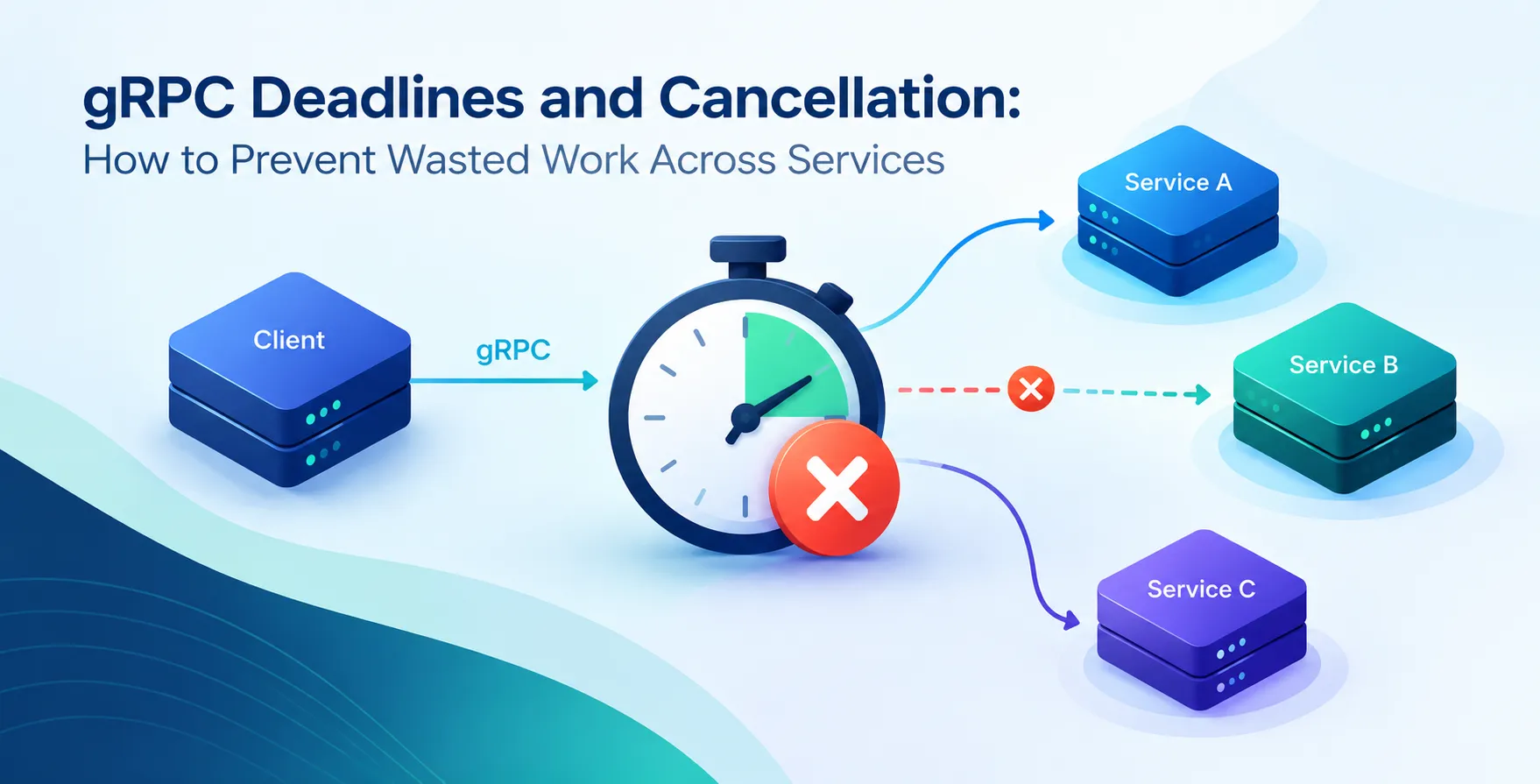
How gRPC Deadlines and Cancellation How to Prevent Wasted Work Across Services
The primary way to stop wasted work is to enforce strict deadlines at every boundary. When a client sets a timeout, that context must flow through your service chain.
If a downstream service receives an expired context, it should immediately abort its internal logic. This approach ensures that no service spends resources on a request that has already timed out at the entry point.
- Consistent deadline propagation
- Immediate server-side interruption
- Reduced infrastructure overhead
- Predictable system behavior
- Better resource utilization
- Faster failure recovery
Setting Deadlines in Client Applications
You must define timeouts explicitly on the client side for every call. If you omit this, you are effectively choosing to wait forever, which is rarely the desired outcome for production services.
Use standard context packages to attach these limits. Most client libraries make it simple to wrap a request with a specific duration.
- Define specific timeout durations
- Use context with timeout
Handling Cancellation Signals on the Server
Server-side code needs to check for cancellation signals regularly. If you are doing heavy computation or streaming data, your code should be aware of the context's state.
Ignoring these signals is a common source of resource leakage. You should proactively poll the context or pass it to blocking operations that support native cancellation.
- Check context status frequently
- Pass context to library functions
- Cleanup resources on exit
- Log cancellation events
Integrating with API Observability
Tracking how often requests are cancelled can reveal hidden bottlenecks in your architecture. If you notice a high rate of cancellation, it might indicate that your downstream services are too slow.
Proper API observability with OpenTelemetry for production helps you visualize these patterns. Seeing the lifecycle of a request from end to end is crucial for identifying where timeouts are occurring.
This data informs your tuning strategy. You can adjust your timeouts or optimize the slowest services based on real-world telemetry rather than guessing.
Best Practices for Timeout Configuration
Configuring deadlines requires a balance between patience and performance. If your deadline is too short, you will see constant timeouts for valid requests.
If your deadline is too long, you are inviting resource exhaustion during spikes. Start with realistic averages and tune based on monitoring data.
- Set distinct timeouts per service
- Account for network latency overhead
- Use global config for defaults
- Prioritize critical path requests
Common Pitfalls in Cancellation Logic
One major mistake is forgetting to pass the context down to the next service in the call chain. If you create a new context, you might be breaking the propagation of the original deadline.
Another issue is blocking operations that don't respect the context at all. You must ensure that your database drivers and third-party integrations are context-aware.
| Scenario |
Bad Practice |
Good Practice |
| Database Calls |
Ignore context |
Pass context to QueryContext |
| Service Calls |
Create new context |
Pass original context down |
| Long Processing |
Run until finished |
Poll context Done() signal |
| External API |
Wait for completion |
Use WithTimeout on request |
| Stream Handling |
Close stream only |
Check context in loops |
When to Use Context Propagation
Context propagation is mandatory for any distributed system using gRPC. It ensures that metadata and lifecycle signals travel with the request across process boundaries.
Without it, services act in isolation. They lose the ability to coordinate on shared goals like resource efficiency or request termination.
Impact on Service Mesh Traffic Management
When you use a service mesh vs API gateway approach, your traffic management needs change. A service mesh can help enforce timeouts globally, providing a layer of protection even if developers forget to set them in code.
This is a powerful safety net. However, it should not replace explicit deadline management in your own application code.
Monitoring Wasted Work and Resource Utilization
Quantify your savings by tracking the difference between total requests and finished requests. A high cancellation rate is not always bad if it means you stopped work that would have failed anyway.
Use your metrics to find services that hold resources too long. If a service is frequently cancelled, it is likely the bottleneck that needs refactoring.
Conclusion
Managing deadlines and cancellation signals is essential for any high-scale microservices architecture. By respecting these signals, you ensure your infrastructure remains healthy and responsive under load.
Take the time to audit your service boundaries for proper context propagation. The effort spent here pays off in lower infrastructure costs and higher overall system reliability.


 In collaboration with