Table of Contents
- Introduction
- Understanding OAuth 2.1
- The Evolution of PKCE
- Why PKCE Matters for SPAs
- The Authorization Code Flow with PKCE
- Step-by-Step Implementation
- Choosing the Right Libraries
- Handling Tokens Securely
- Common Security Pitfalls
- Comparison of Auth Methods
- Best Practices for SPAs
- Future-Proofing Your Auth
- Conclusion
Introduction
Securing modern web applications requires moving beyond legacy standards. As client-side applications grow more complex, the need for robust security models becomes critical.
We now rely on the OAuth 2.1 PKCE for single-page applications implementation guide to standardize how we handle identities. This approach ensures that your application remains resilient against common interception attacks.
Understanding OAuth 2.1
OAuth 2.1 is the latest iteration of the industry-standard authorization framework. It simplifies the specification by removing obsolete flows and mandating modern security practices by default.
For developers, this means the landscape is cleaner and less error-prone. The focus shifts toward secure-by-default configurations that protect user data from the start.
You will find that OAuth 2.1 provides a more predictable path for building secure integration services. It bridges the gap between complex legacy setups and the needs of modern, distributed architectures.
The Evolution of PKCE
Proof Key for Code Exchange, or PKCE, was originally designed for mobile apps. It solved the problem of secure token exchange on devices where client secrets could not be stored.
Over time, the industry recognized that single-page applications face the same risks as mobile apps. Because browser-based code is transparent to the end-user, storing secrets is impossible.
PKCE mitigates this by using dynamically generated cryptographic challenges. This ensures that even if an attacker intercepts an authorization code, they cannot exchange it for an access token without the original secret.
- Replaces static client secrets
- Prevents authorization code injection
- Strengthens browser-side security
- Standardizes token exchange processes
Why PKCE Matters for SPAs
In a standard web environment, an SPA cannot keep a client secret private. Any secret embedded in your JavaScript bundle is easily accessible to anyone who inspects the network traffic.
Using the authorization code flow PKCE ensures that the authorization server binds the token exchange to the initial request. This binding is enforced through the code challenge and verifier mechanism.
This is a fundamental shift in how we approach SPA authentication best practices. It turns the client into a trusted participant without requiring them to hold a static credential.
The Authorization Code Flow with PKCE
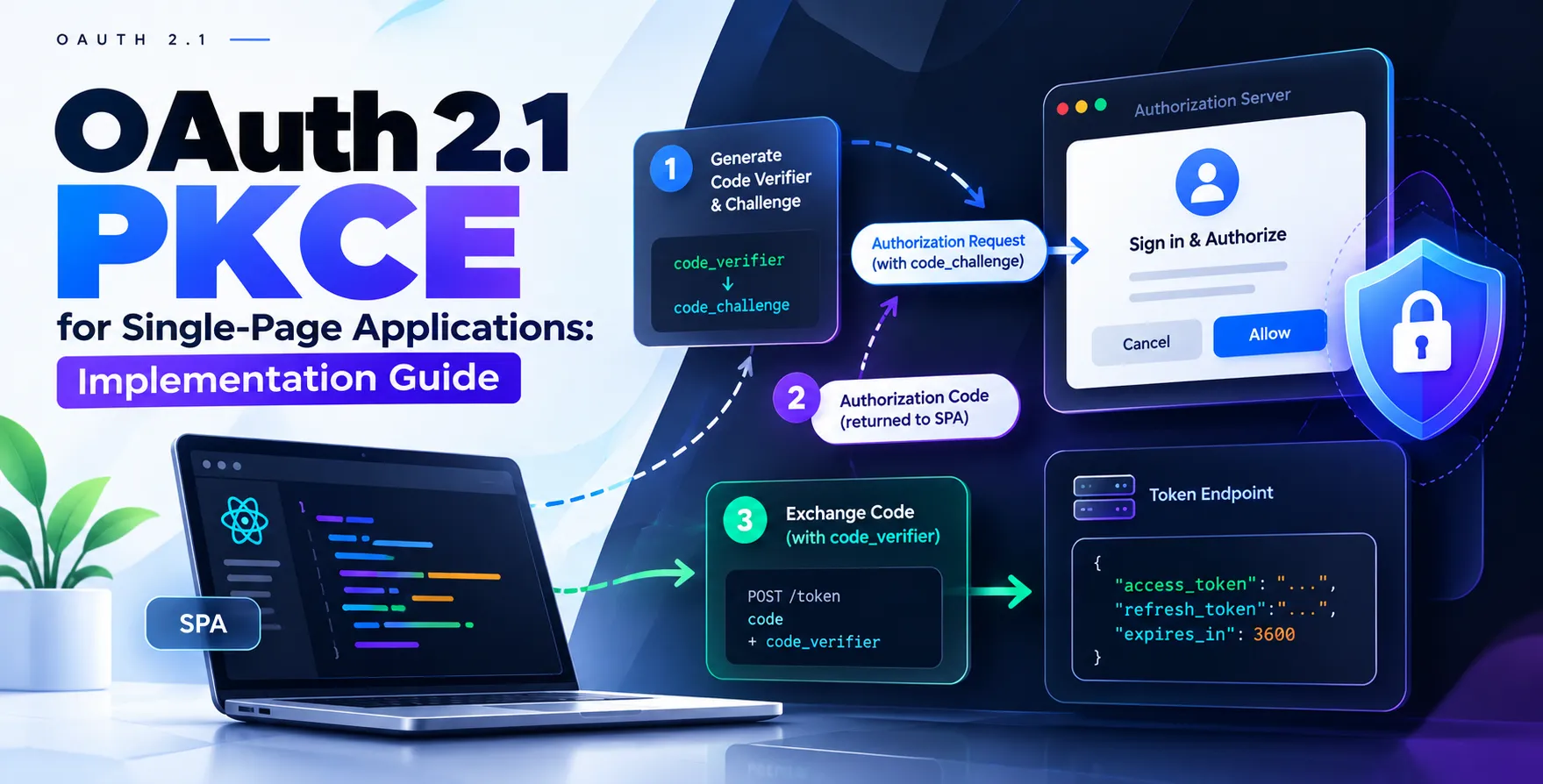
The flow begins when the client generates a random string called the code verifier. The client then transforms this into a code challenge using a hashing algorithm like SHA-256.
During the initial authorization request, the client sends this challenge to the server. The server stores it and associates it with the pending request.
When the user is redirected back to the app with a code, the client sends that code plus the original verifier. The server verifies that the hashed verifier matches the initial challenge before issuing tokens.
- Initiate authentication request
- Generate cryptographically random verifier
- Transmit code challenge to server
- Perform user login via redirect
- Exchange authorization code and verifier
- Receive tokens from authorization server
Step-by-Step Implementation
Implementing this flow requires careful attention to cryptographic standards. You must ensure that your client-side code handles the generation of the verifier securely.
Many developers start by choosing a well-vetted library rather than rolling their own crypto code. This reduces the surface area for potential implementation bugs or security oversights.
Always verify that your authorization server is configured to accept PKCE requests. Some older servers might require explicit toggles to enable these modern security flows.
Generating the Verifier
The verifier must be a cryptographically strong, random string. It should have sufficient length to prevent brute-force attacks against the hashed challenge.
- Use Web Crypto API
- Maintain sufficient entropy
- Store in session storage
Using the native browser Web Crypto API is the recommended path for production applications.
Creating the Challenge
Once you have the verifier, you must derive the challenge. This is typically done using SHA-256 to ensure standard compatibility across different identity providers.
- Apply SHA-256 hashing
- Encode using Base64URL
- Strip padding characters
This process ensures the challenge is URL-safe and fits perfectly within the OAuth redirect parameters.
Choosing the Right Libraries
While you can implement OAuth PKCE from scratch, existing SDKs are safer for most teams. They handle the heavy lifting of state management and error handling.
When evaluating libraries, look for those that support the latest standards and have active community maintenance. Avoid abandoned projects that haven't been updated in years.
Reliable libraries often include built-in helpers for token refreshing and storage. This simplifies the maintenance of user sessions across page reloads.
- High-quality documentation
- Active security patching
- Browser compatibility support
- Comprehensive error handling
- Minimal dependency footprint
Handling Tokens Securely
Once you receive your tokens, you must store them where they are protected from unauthorized access. Local storage is often discouraged due to cross-site scripting risks.
Consider using memory-only storage for access tokens or an HTTP-only secure cookie proxy. This keeps your credentials away from potentially malicious JavaScript running in the same context.
Always enforce short lifetimes for access tokens. This limits the window of opportunity if a token is ever accidentally exposed.
Common Security Pitfalls
Developers often struggle with state management during the OAuth flow. Failing to validate the state parameter can open your application to cross-site request forgery.
Another common issue is improper redirect URI validation. You must ensure that the authorization server only sends codes to pre-registered, trusted endpoints.
Finally, ensure your server-side configurations are aligned with the client-side expectations. Mismatches in the allowed flow types are a frequent source of integration frustration.
| Security Concept |
Legacy Approach |
Modern PKCE Approach |
| Secret Storage |
Client Secret in JS |
No Secret Required |
| Interception Risk |
High |
Mitigated by Challenge |
| Flow Type |
Implicit Flow |
Auth Code with PKCE |
| Security Standard |
OAuth 2.0 |
OAuth 2.1 |
Best Practices for SPAs
Always prioritize HTTPS for all traffic between your client and the authorization server. Even in development, using non-secure connections can lead to session hijacking.
Ensure your token refresh logic is robust. If a user is mid-session, they should not be forced to re-authenticate simply because a token expired.
Implement comprehensive logging and monitoring to catch failed authentication attempts. Early detection of suspicious patterns is key to maintaining a secure system.
- Enforce strict transport security
- Use short-lived access tokens
- Audit redirect URI patterns
- Limit session duration
Future-Proofing Your Auth
The move toward OAuth 2.1 is about long-term stability. By adopting these patterns now, you minimize the technical debt associated with migrating later.
Keep an eye on emerging standards like passkeys and advanced token binding. These technologies will further simplify authentication while increasing security for your end users.
Staying current with the latest RFCs and security advisories is part of being a senior developer. It ensures your systems are always protected against the newest classes of vulnerabilities.
Conclusion
Implementing OAuth 2.1 with PKCE is a standard requirement for modern web development. It effectively solves the security challenges inherent in browser-based applications.
By following these guidelines, you create a safer environment for your users. Focus on using well-tested libraries and adhering to the latest security standards to ensure your application remains resilient.
Security is an ongoing process rather than a one-time task. Keep your infrastructure updated and continue to monitor for potential threats to your authentication flow.


 In collaboration with