Table of Contents
- Introduction
- Understanding API Authentication
- What are API Keys?
- The Case for API Keys
- Understanding OAuth 2.1
- The Evolution Toward OAuth 2.1
- OAuth 2.1 vs API Keys: Core Differences
- Security Considerations
- Developer Experience and Integration
- Choosing the Right Method
- When to Use API Keys
- When to Use OAuth 2.1
- Implementation Challenges
- Conclusion
Introduction
Selecting the right security mechanism is one of the most critical decisions in API development. Whether you are building a B2B platform or a public service, your choice impacts both the safety of your users and the speed of integration.
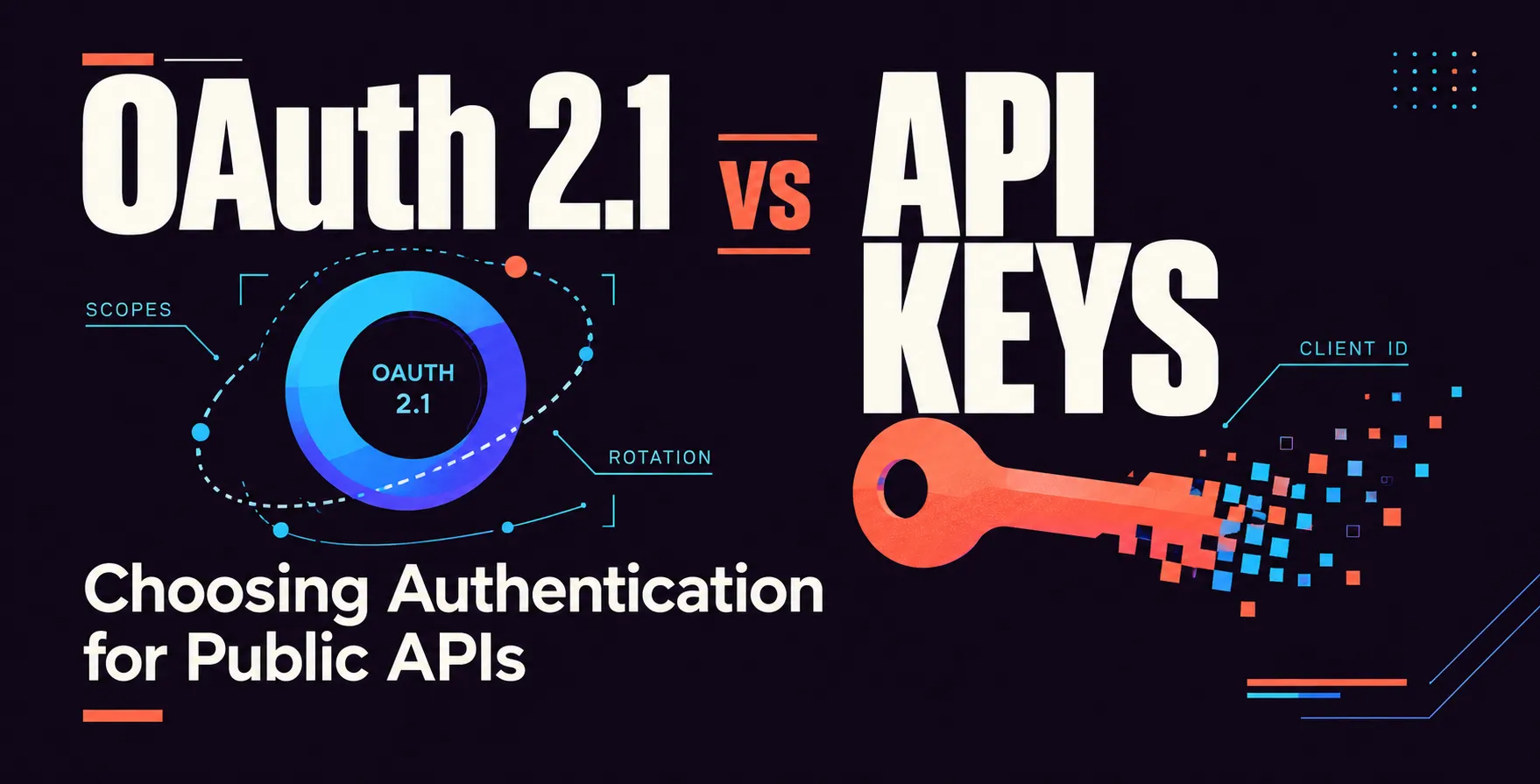
Developers often struggle when weighing OAuth 2.1 vs API keys for public APIs. While one offers simplicity, the other provides robust control over delegated access.
Your decision should align with your specific use case, security requirements, and technical team capabilities. This post explores the nuances of current API authentication methods to help you make an informed choice.
Understanding API Authentication
At its core, API authentication is the process of verifying the identity of a client. Without a reliable mechanism, your backend is vulnerable to unauthorized access and resource abuse. A well-designed security strategy prevents attackers from scraping your data or overwhelming your servers.
Most modern systems rely on either shared secrets or token-based protocols. Each approach carries different performance overheads and implementation burdens for your engineering team.
As you refine your system architecture, consider how these methods interact with your overall infrastructure. The right choice often depends on whether your API is consumed by third-party applications or first-party clients.
- Prevents unauthorized data access
- Limits exposure to malicious actors
- Ensures proper service usage tracking
- Reduces the risk of resource exhaustion
What are API Keys?
API keys are essentially long-lived strings that identify the calling application. They are passed directly in the request header or as a query parameter, making them incredibly easy to implement and consume.
Because they act as a static password, they do not inherently support user-level permissions. They are best suited for server-to-server communication where the identity of the application is enough to grant access.
Many public APIs start with this model because it removes barriers to entry for developers. However, managing the lifecycle of these keys requires dedicated tooling to prevent leakage.
The Case for API Keys
Ease of Integration
Developers appreciate the simplicity of a single header value for authentication. It reduces the boilerplate code needed to start making requests.
- Fast time to first call
- Minimal documentation overhead
- Simple client-side implementation
- Easy debugging during development
This low friction makes it an attractive choice for public-facing services that want to encourage rapid adoption.
Predictable Performance
Because API keys are static, they avoid the overhead of token exchange or validation flows. This ensures consistent response times for every request.
- Zero latency from token handshakes
- Simplified server-side validation logic
- Stateless authentication without session lookups
For high-throughput systems, this reduction in compute cost can be a major benefit.
Understanding OAuth 2.1
OAuth 2.1 is the modern consolidation of previous standards, focusing on best practices like PKCE and removing insecure flows. It is the industry standard for delegated authorization, allowing users to grant access to their data without sharing credentials.
By utilizing access tokens and refresh tokens, the protocol creates a secure environment for sensitive operations. It is designed for scenarios where a third-party application needs limited access to a user account.
Moving to this standard is a significant step toward modernizing your security posture. It requires a deeper understanding of authorization servers and token lifecycles.
The Evolution Toward OAuth 2.1
The transition toward OAuth 2.1 reflects a global push to standardize secure practices. Older versions were often implemented incorrectly, leading to vulnerabilities that the new spec explicitly prohibits.
Modern engineering teams prefer this approach because it provides fine-grained control over scopes and permissions. It is essential for any API that handles PII or financial transactions.
Adopting this standard also makes your API more compatible with enterprise requirements. It builds trust by demonstrating a commitment to industry-standard security frameworks.
OAuth 2.1 vs API Keys: Core Differences
| Feature |
API Keys |
OAuth 2.1 |
| Primary Use |
Machine-to-machine |
User-delegated access |
| Complexity |
Very low |
High |
| Security Level |
Basic |
Enterprise-grade |
| Token Lifespan |
Indefinite |
Short-lived |
| Granularity |
Application-wide |
Scope-based |
Security Considerations
The primary weakness of API keys is their static nature. If a key is hardcoded into a public repository, it remains valid until manually revoked. This makes rotation policies difficult to enforce without breaking active clients.
OAuth 2.1 mitigates this risk by using short-lived tokens. Even if an access token is intercepted, its limited lifespan reduces the window of opportunity for an attacker. Furthermore, the protocol forces developers to implement proper storage for refresh tokens.
Both approaches benefit from being paired with strong API rate limiting to prevent abuse. Regardless of your authentication choice, you should always enforce HTTPS for all traffic.
Developer Experience and Integration
Developer experience is a critical factor when choosing an authentication method. API keys win on simplicity, but OAuth 2.1 wins on capability and scalability.
If your developers are building complex integrations that require specific user permissions, the extra effort of implementing OAuth pays off. It provides a structured way to handle different levels of access, which is impossible with simple keys.
However, if your service is a simple data fetcher, forcing users through an OAuth flow might feel like overkill. Always prioritize the needs of your API consumers when deciding your strategy.
Choosing the Right Method
Your choice should be dictated by the sensitivity of the data and the type of integration. There is no single correct answer that fits every scenario across all industries.
Start by mapping out who your clients are and what they need to achieve. If you are building an internal microservice, your requirements will be vastly different from a public, third-party platform.
Consider the long-term maintenance of your chosen security model. A system that is easy to build today but impossible to secure tomorrow is a poor investment.
When to Use API Keys
API keys are perfect for simple public APIs where the identity of the client is sufficient. They excel in scenarios where there is no user involvement or where the API is read-only.
- Public weather data feeds
- Internal service-to-service communication
- Simple read-only stock market trackers
- Non-sensitive metadata services
They provide the fastest route to getting developers working with your platform. Keep them limited to non-sensitive endpoints for the best security outcomes.
When to Use OAuth 2.1
OAuth 2.1 is the mandatory choice for any API handling sensitive user information. If your application requires access to private data like emails, social media profiles, or financial accounts, this is the only responsible path.
- Social media platform integrations
- Cloud-based document editors
- Financial service connectivity
- Enterprise software portals
It creates a secure ecosystem where users maintain control over their identity. It effectively solves the problem of sharing credentials across different services.
Implementation Challenges
Implementing OAuth requires a robust infrastructure to handle token issuance, validation, and revocation. You will need an authorization server that adheres to the latest specifications.
This often means additional operational overhead and potential points of failure. Your monitoring strategy must account for these complexities to ensure high availability.
API keys are much easier to implement but require a different type of vigilance. You must build systems to detect key leaks and provide easy mechanisms for users to rotate their credentials.
Conclusion
The debate between OAuth 2.1 vs API keys for public APIs is ultimately a choice between convenience and control. API keys provide a low-barrier, high-performance solution for simple machine-to-machine tasks.
Conversely, OAuth 2.1 offers the robust, scope-driven security required for modern applications involving user data. Most mature platforms eventually implement a hybrid approach, using keys for developer access and OAuth for user-authorized tasks.
Whatever you choose, prioritize clear documentation and secure storage practices. Your API security strategy should evolve alongside your platform to meet the growing needs of your user base.


 In collaboration with