Table of Contents
- Introduction
- Understanding API Rate Limiting
- Why You Need API Throttling
- Fixed Window Counter
- Sliding Window Log
- Sliding Window Counter
- Token Bucket Algorithm
- Leaky Bucket Algorithm
- Selecting Your Strategy
- Handling Rate Limit Responses
- Distributed Rate Limiting Challenges
- Architecture and Performance Considerations
- Final Thoughts
Introduction
Building a robust application requires more than just functional code; it demands infrastructure that can survive unexpected traffic spikes. API rate limiting serves as a critical gatekeeper, ensuring that your system remains available and responsive even under heavy load.
Choosing the wrong approach can frustrate legitimate users or leave your services vulnerable to abuse. This guide explores how to choose API rate limiting strategy options that align with your specific traffic patterns and business requirements.
Understanding API Rate Limiting
At its core, **API rate limiting** is a technique used to control the volume of requests a client can make to a server within a defined timeframe. It prevents a single user or bot from monopolizing resources at the expense of others.
When implementing a REST API rate limit, the primary goal is to balance system stability with developer experience. A well-designed limit protects your backend while allowing your API consumers to maintain consistent workflows.
Without these constraints, your application is susceptible to denial-of-service attacks or cascading failures during traffic surges. Proper implementation ensures your services stay resilient against both malicious actors and accidental misconfigurations in client applications.
Why You Need API Throttling
Implementing API throttling best practices is essential for maintaining the health of your production environment. It provides a layer of defense against runaway scripts and aggressive polling mechanisms that can degrade performance for everyone.
By enforcing clear usage boundaries, you can also create tiered access levels for your customers. This allows you to monetize your API by offering higher limits to premium users while keeping costs manageable for free tiers.
- Prevent server resource exhaustion
- Ensure fair usage across consumers
- Protect against brute force attacks
- Enable monetized API service tiers
- Improve overall system stability
Fixed Window Counter
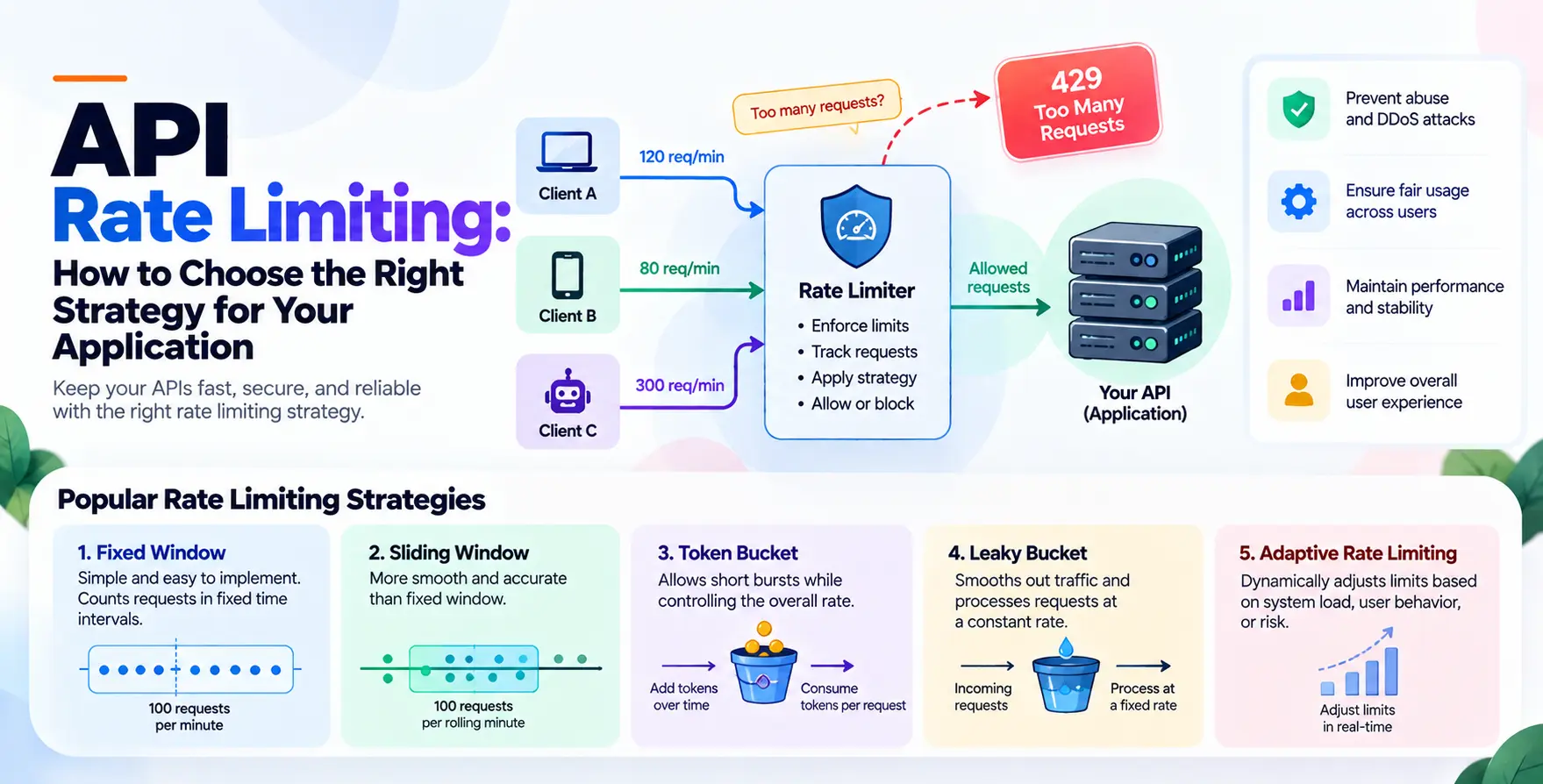
The fixed window approach is the simplest form of rate limiting. It resets the request counter at the start of every fixed time interval, such as every minute or every hour.
While easy to understand, this method has a significant flaw known as the boundary problem. Users can effectively double their quota by sending requests right before and after the window resets.
- Low memory usage
- Easy to implement
- Vulnerable to window boundary bursts
Sliding Window Log
This approach tracks a timestamped log of each request. The system calculates the number of requests in the current sliding window by discarding timestamps that fall outside the defined duration.
The precision of this algorithm is excellent because it avoids the reset issues found in fixed window approaches. However, storing every timestamp for every user can become expensive in terms of memory as your user base grows.
- High accuracy
- Complex memory management
- Resource intensive at scale
Sliding Window Counter
This hybrid approach combines the memory efficiency of fixed windows with the smoothness of the sliding window log. It calculates the request rate by weighting the previous window and the current window based on the current time.
It provides a much fairer distribution of traffic while avoiding the excessive memory overhead of logging every single request. It is often the preferred choice for high-traffic systems that need reliable, predictable limiting.
- Predictable performance
- Efficient memory usage
- Smooth traffic handling
Token Bucket Algorithm
The token bucket is a classic algorithm where a bucket holds a specific number of tokens. Each request consumes one token, and the bucket refills at a constant rate over time.
This method is highly favored because it allows for short bursts of traffic while enforcing a strict long-term average. It is perfect for applications where users occasionally need a high-speed burst followed by a period of lower activity.
- Supports traffic bursts
- Simple bucket logic
- Easy to configure for different tiers
Leaky Bucket Algorithm
The leaky bucket processes requests at a constant, steady rate, regardless of how many requests arrive at once. If the bucket overflows, the excess requests are dropped or queued.
This creates a very predictable and smooth flow of traffic to your backend services. It is ideal for systems that have strict processing capacity constraints and cannot handle any sudden variability in request volume.
- Constant output rate
- Prevents traffic spikes
- Ideal for load leveling
Selecting Your Strategy
| Strategy |
Complexity |
Burst Support |
Resource Usage |
| Fixed Window |
Low |
No |
Low |
| Sliding Log |
High |
Yes |
High |
| Sliding Counter |
Medium |
Yes |
Medium |
| Token Bucket |
Medium |
Yes |
Low |
| Leaky Bucket |
Medium |
No |
Low |
Handling Rate Limit Responses
When a client exceeds their limit, your API must respond gracefully. The standard practice involves returning a 429 Too Many Requests HTTP status code to inform the client of the situation.
Including headers such as X-RateLimit-Limit, X-RateLimit-Remaining, and Retry-After is essential for developer experience. These headers allow clients to programmatically adjust their behavior and avoid further rejections, which is crucial for modern, reliable integrations.
- Return 429 status codes
- Provide clear error messages
- Include retry headers
- Respect client backoff logic
Distributed Rate Limiting Challenges
In modern microservices architectures, tracking limits across multiple server instances is non-trivial. You need a centralized data store, such as Redis, to maintain an accurate count of requests across your entire fleet.
This introduces latency and potential points of failure that you must account for during design. Using a fast, in-memory store ensures that your rate limiting logic does not become a bottleneck for your API performance.
- Centralized state management
- Network latency overhead
- High availability requirements
Architecture and Performance Considerations
Rate limiting should ideally be handled as close to the entry point as possible. Placing this logic at the API gateway layer prevents unauthorized or excessive traffic from ever hitting your downstream business logic.
This reduces the load on your core services and simplifies your security architecture. Always ensure your limiting implementation is asynchronous or highly optimized to avoid adding overhead to valid, non-throttled requests.
Final Thoughts
Choosing the right rate limiting strategy depends entirely on your specific traffic patterns and the nature of your service. There is no one-size-fits-all solution, but the token bucket and sliding window counter are excellent starting points for most applications.
Always prioritize clear communication with your API consumers through standard HTTP headers and status codes. By balancing protection with usability, you build a sustainable foundation for your software that can scale gracefully as your user base grows.


 In collaboration with