Table of Contents
- Introduction to Scaling APIs
- What is an API Catalog?
- The Growing Need for API Governance
- Why API Inventory Management Matters
- Centralizing Documentation and Discovery
- Standardizing API Design Principles
- Automating Lifecycle Tracking
- Improving API Security Posture
- Strategies for Large Engineering Teams
- Monitoring API Performance and Usage
- Common Governance Challenges
- Integrating Governance into CI/CD
- Scaling with Effective Tooling
- Conclusion
Introduction to Scaling APIs
As organizations transition to microservices, the number of interfaces grows exponentially. Managing this complexity requires more than just good code; it requires a structured approach to oversight.
Without a clear strategy, teams often build redundant services or struggle with fragmented documentation. Establishing an API catalog is the first step toward regaining control over your ecosystem.
What is an API Catalog?
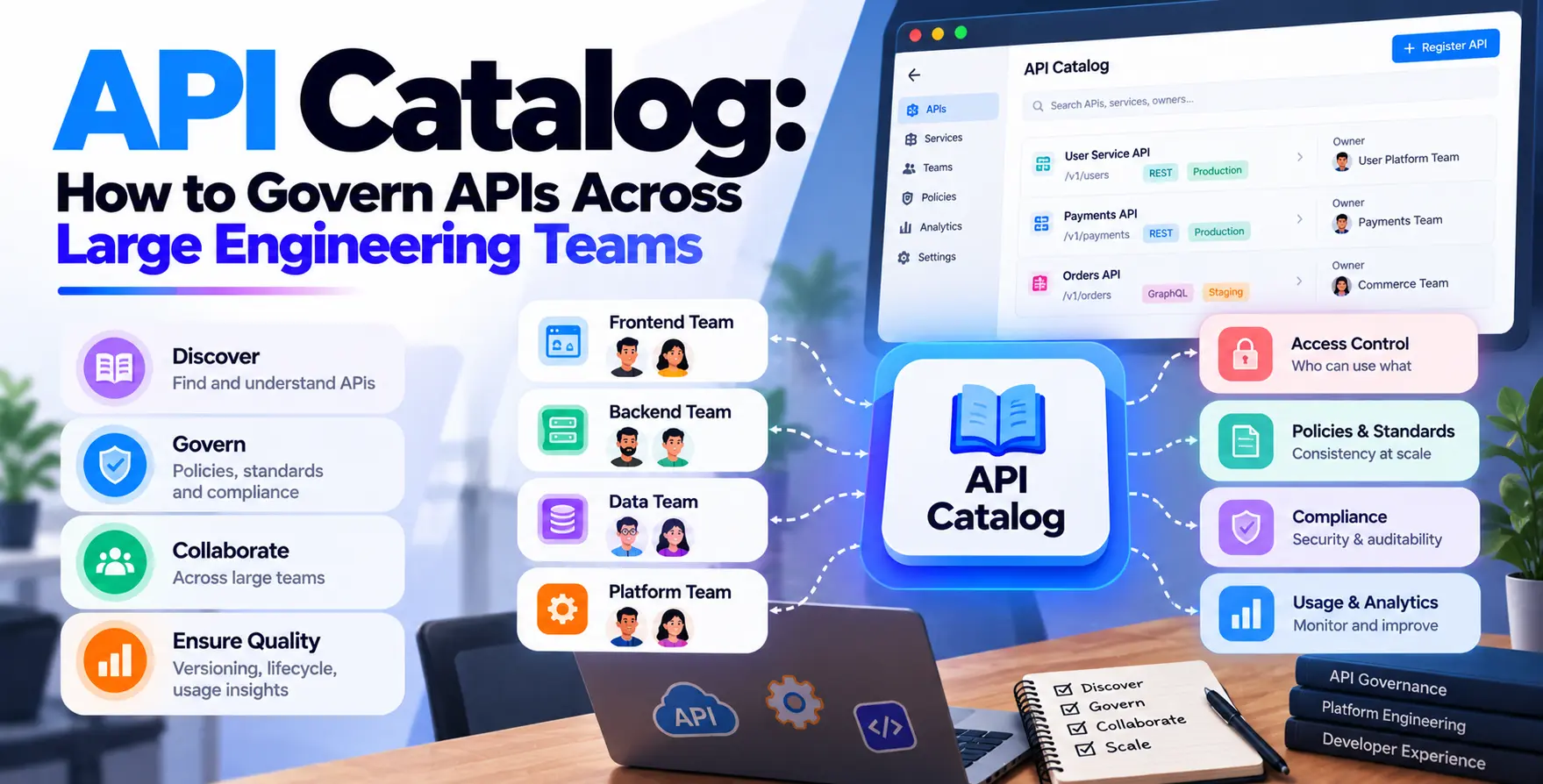
An API catalog acts as a centralized source of truth for every interface within your organization. It serves as a searchable index where developers can find existing services, understand their purpose, and view relevant documentation.
Think of it as a library for your company's software assets. Instead of asking around for an endpoint, engineers can search the portal to find exactly what they need.
- Centralized discovery for all teams
- Standardized metadata and documentation
- Clear ownership of every service
- Improved reusability across departments
- Reduced time spent on discovery
The Growing Need for API Governance
Large engineering teams often face the challenge of "shadow APIs" that operate without oversight. When teams work in silos, they frequently ignore standard authentication methods or versioning strategies.
Consistent API governance ensures that all services adhere to organizational policies. It helps prevent security vulnerabilities and ensures that every team follows the same rules for development.
Governance isn't about restricting innovation but about creating a predictable environment. It allows teams to move fast while maintaining high quality and interoperability.
Why API Inventory Management Matters
You cannot secure or govern what you cannot see. API inventory management is the foundational layer that identifies every active endpoint currently running in your production environment.
This inventory provides visibility into which services are exposed to the public internet versus those meant for internal traffic. It helps teams identify deprecated services that need decommissioning.
- Automatic detection of active endpoints
- Classification of public versus private APIs
- Tracking service ownership and contact details
- Identification of outdated or zombie services
- Visibility into API dependency graphs
Centralizing Documentation and Discovery
High-quality documentation is vital for developer adoption. An effective catalog should automatically pull information from OpenAPI specifications to ensure that docs are never stale.
When developers have access to well-structured resources, they don't need to reach out to the original authors for basic questions. This autonomy significantly increases velocity across distributed teams.
Developer Portal Best Practices
Providing a self-service experience reduces friction for new teams. A well-designed portal should act as the primary interface for your internal ecosystem.
- Searchable endpoints with filters
- Interactive sandboxes for testing
- Clear versioning history
- Code snippets in multiple languages
By investing in a developer portal, you turn your internal API suite into a product. This shift in mindset encourages teams to treat their internal consumers as valued customers.
Standardizing API Design Principles
Governance requires clear guidelines on how to build interfaces. If every team chooses a different style, the integration cost becomes prohibitively high for the rest of the organization.
Standardization covers areas like naming conventions, error handling, and data formats. It ensures that any developer can jump between projects without needing to relearn basic patterns.
Adhering to these standards early prevents technical debt from accumulating. It also makes automated testing and monitoring much easier to implement later in the lifecycle.
Automating Lifecycle Tracking
Tracking the state of an interface from design to retirement is complex. Manual tracking always fails at scale, making automation a necessity for large engineering teams.
Modern platforms integrate directly with your source control and CI/CD pipelines. This ensures the catalog updates automatically whenever a new version is pushed to production.
- Automated updates from source code
- Tracking deprecation status automatically
- Managing transition periods for breaking changes
- Alerting owners of upcoming maintenance
- Archiving obsolete services
Improving API Security Posture
Security is a primary concern when exposing internal functionality. A strong governance framework requires teams to follow specific api security best practices regarding authentication and authorization.
The catalog can enforce these standards by flagging services that lack proper security configurations. It provides a quick way to audit the entire landscape for potential weaknesses.
Authentication Standards
Consistent authentication is the bedrock of secure communication. Whether using OAuth or JWT-based schemes, the implementation must be uniform across the board.
- Mandatory TLS for all internal traffic
- Standardized OAuth 2.0 implementation
- Strict validation of incoming requests
- Regular rotation of access keys
By governing these standards through the catalog, security teams can verify compliance without manual intervention. It allows for a proactive approach to protecting sensitive data.
Strategies for Large Engineering Teams
Governance in large companies requires balancing autonomy and control. You need to provide enough freedom for teams to experiment while ensuring they remain within the guardrails.
Designating "API Champions" within each team can help propagate best practices. These individuals act as the bridge between central platform teams and individual feature squads.
Regular reviews and community sessions help keep everyone aligned. It turns governance into a collaborative effort rather than a top-down mandate.
Monitoring API Performance and Usage
Visibility into how APIs are performing is crucial for long-term reliability. Monitoring tools help identify bottlenecks or unexpected spikes in traffic that could indicate a service is being misused.
By integrating performance metrics into the catalog, you give developers immediate feedback on their service health. This data-driven approach helps teams make informed decisions about scaling.
| Metric |
Why Monitor |
Target Outcome |
| Latency |
User experience impact |
Under 200ms |
| Error Rate |
System reliability |
Under 0.1% |
| Throughput |
Resource planning |
Stable growth |
| Usage Count |
Feature adoption |
High utilization |
Common Governance Challenges
Many teams struggle with the initial setup of an API catalog. It often requires a cultural shift in how engineers think about their code and documentation.
Resistance to change is common, especially when existing workflows are disrupted. Clear communication about the benefits of visibility is essential to gain internal support.
- Resistance to adding documentation
- Difficulty in defining ownership
- Legacy code without specifications
- Fragmented tooling across teams
- Lack of executive sponsorship
Overcoming these hurdles requires persistence and a focus on incremental improvement. Start with a small pilot program to demonstrate the value before rolling it out organization-wide.
Integrating Governance into CI/CD
True automation happens within the deployment pipeline. You should integrate automated checks that validate your API specifications against your governance rules before any code is deployed.
If a service doesn't meet the requirements, the build should fail. This "shift-left" approach catches issues early in the development lifecycle when they are cheapest to fix.
Automated contract testing can further ensure that breaking changes are caught before they reach consumers. This creates a safety net that allows teams to move faster with confidence.
Scaling with Effective Tooling
Tooling plays a major role in how you govern APIs across large engineering teams. Choosing the right platform can drastically reduce the overhead required to maintain a consistent standard.
Look for tools that support native integration with your existing stack. The goal is to minimize the amount of manual work developers have to do to stay compliant.
A well-integrated toolset empowers your teams to focus on building value. It removes the administrative burden, allowing for faster delivery and higher quality software.
Conclusion
Governance is a journey that requires continuous effort and commitment from the entire organization. By implementing an API catalog, you create the visibility needed to manage complexity at scale.
Effective management improves security, fosters collaboration, and accelerates development cycles. Start by establishing your standards, automating your discovery, and empowering your teams to take ownership of their services.


 In collaboration with