Table of Contents
- Introduction to CDC with PostgreSQL
- Understanding Logical Replication
- The Role of PostgreSQL Replication Slots
- Designing Your CDC Pipeline Architecture
- Setting Up Logical Replication
- Handling Schema Changes
- Performance Considerations for Logical Replication
- Ensuring Data Consistency
- Monitoring Replication Lag
- Common Pitfalls in CDC Pipelines
- Comparing Logical Replication and Triggers
- Security Best Practices
- Final Thoughts
Introduction to CDC with PostgreSQL
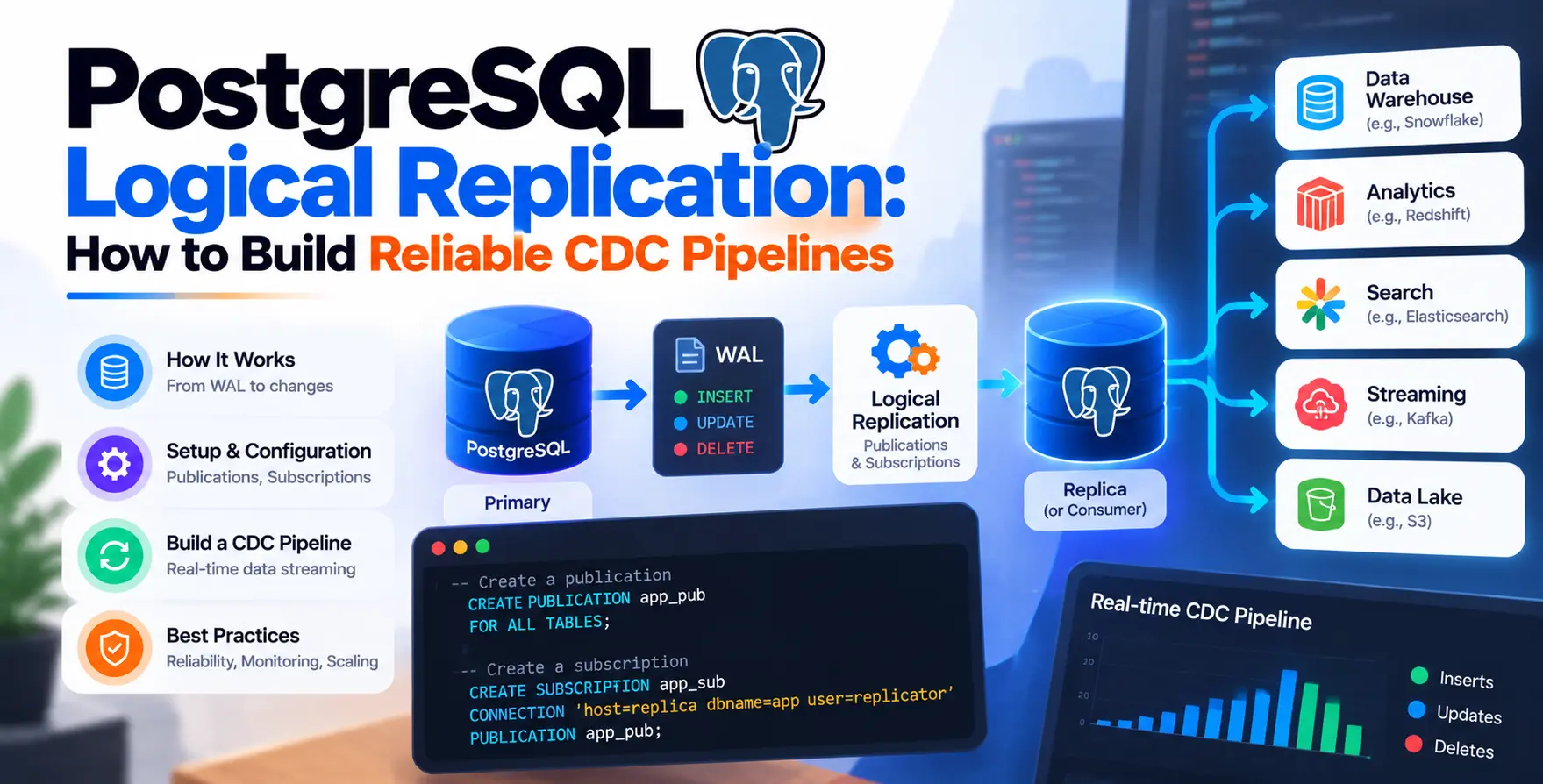
Modern data architectures rely heavily on moving data between systems in real-time. Change Data Capture, or PostgreSQL logical replication how to build reliable CDC pipelines, has become the standard for keeping downstream systems synchronized without placing excessive load on primary production databases.
By capturing row-level changes directly from the write-ahead log, you avoid the overhead of traditional polling-based approaches. This method ensures your analytical stores, search indexes, and microservices stay updated with minimal latency.
Understanding Logical Replication
Logical replication differs significantly from physical streaming replication. While physical replication copies entire database blocks, logical replication decodes individual transactions into a logical stream of changes.
This stream consists of inserts, updates, and deletes that are applied to a destination system. Because it acts at the table level, it offers granular control over which data moves where.
You can even replicate data between different major versions of the database. This flexibility makes it a powerful tool for complex deployments and cross-platform integrations.
- Granular table-level data selection
- Version-agnostic data synchronization
- Low impact on primary database
- Support for multiple subscribers
The Role of PostgreSQL Replication Slots
At the heart of PostgreSQL logical replication lies the replication slot. A slot represents a stream of data that a consumer is currently reading from the server.
The server tracks the progress of each subscriber through these slots. It prevents the database from recycling write-ahead log files until the subscriber has successfully processed them.
Without properly managed PostgreSQL replication slots, a stalled consumer could cause your primary database to run out of storage space. Always monitor your slots to ensure they remain active and healthy.
Types of Replication Slots
You can choose between different slot types based on your specific requirements. Each serves a different purpose in your data flow.
- Physical slots for block-level data
- Logical slots for row-level decoding
Choosing the correct slot type ensures your downstream consumers receive the appropriate level of detail.
Designing Your CDC Pipeline Architecture
Building a robust Postgres CDC pipeline requires careful planning of the ingestion layer. You need a reliable middleman to buffer incoming messages and ensure delivery to target destinations.
Many engineers use tools like Kafka or Debezium to handle the complexity of the stream. These tools manage offsets, handle retries, and provide an abstraction layer for your data consumers.
Designing for idempotency is critical in any distributed system. Your downstream consumers should be able to process the same message multiple times without corrupting the final state.
Setting Up Logical Replication
Configuring replication begins with updating your configuration files to enable the logical decoding feature. You must set the correct wal_level and max_replication_slots to allow the process to function.
Once configured, you create a publication on the source database to specify which tables are included. On the subscriber side, you create a subscription that connects to the publication.
The database handles the initial synchronization automatically. After the initial copy, it begins streaming changes in real-time.
| Configuration |
Action |
Purpose |
| wal_level |
logical |
Enable row-level events |
| max_replication_slots |
Set count |
Limit concurrent consumers |
| max_wal_senders |
Set count |
Manage streaming processes |
Handling Schema Changes
Schema evolution is an unavoidable reality of software development. When you add or drop columns, logical replication can sometimes break if the schema is not synchronized.
You must coordinate schema migrations carefully between your source and destination. Some advanced CDC tools automate this mapping, but manual intervention is often required for breaking changes.
Always test your migration scripts in a staging environment before applying them to production. A failure in the pipeline can quickly lead to data drift across your infrastructure.
Performance Considerations for Logical Replication
While logical replication is generally efficient, heavy write volumes can put pressure on the decoding process. The walsender process must read, decode, and transmit the changes to the subscriber.
If you notice performance degradation, investigate your PostgreSQL indexing practices. Efficient indexes on your primary tables reduce the time required to perform the lookups needed for replication.
Keep an eye on system resources like CPU and I/O wait times. A high-traffic environment might require dedicated resources for the replication processes.
Ensuring Data Consistency
Data consistency is the primary goal of any replication strategy. You must ensure that every transaction committed on the primary is accurately reflected in the downstream system.
Logical replication provides transactional guarantees for each individual transaction. However, cross-table consistency can be harder to achieve if your pipeline is partitioned or distributed.
Implement automated reconciliation checks to identify and fix discrepancies. These background jobs compare row counts or checksums between systems to detect drift early.
Monitoring Replication Lag
Lag is the most important metric for any CDC pipeline. It represents the time difference between a transaction committing on the primary and being applied to the subscriber.
A growing lag indicates that your consumer cannot keep up with the write volume. You may need to scale your infrastructure or optimize your database queries to resolve the bottleneck.
Use native monitoring tools or third-party observability platforms to track replication health. Set up alerts to notify your team when the lag exceeds your defined thresholds.
- Track byte-level replication lag
- Monitor slot activity status
- Alert on long-running transactions
- Check consumer process health
Common Pitfalls in CDC Pipelines
Many teams overlook the impact of large transactions on their replication stream. A single massive update can block the entire pipeline while the server decodes and transmits the changes.
Avoid performing large bulk operations that modify millions of rows in one go. Break these operations into smaller batches to keep the replication stream flowing smoothly.
Another common mistake is ignoring the impact of vacuuming on your replication slots. Ensure your PostgreSQL VACUUM settings are optimized to prevent bloat without interfering with long-lived transactions.
Comparing Logical Replication and Triggers
Before choosing a path, consider the alternatives. Triggers are the traditional way to capture changes, but they come with significant drawbacks.
| Method |
Pros |
Cons |
| Logical Replication |
Lower impact, native |
Requires setup |
| Triggers |
Simple to implement |
High overhead |
Triggers execute within the same transaction as the original write. This dramatically slows down your primary database under high load.
Security Best Practices
Secure your replication traffic by using encrypted connections. Use strong authentication and limit the privileges of the replication user to the minimum necessary.
Only grant the REPLICATION attribute to the specific user account performing the tasks. Monitor the access logs for any unauthorized attempts to connect to your replication slots.
Keep your database versions up to date to receive the latest security patches. Regular maintenance is essential for keeping your data safe and compliant.
Final Thoughts
Building reliable CDC pipelines with PostgreSQL is a mature and effective strategy. By leveraging logical replication, you gain the ability to scale your data architecture without compromising performance.
Focus on monitoring, proper slot management, and schema discipline to keep your systems in sync. As your data needs grow, this foundation will serve you well.
- Prioritize monitoring for lag
- Automate schema synchronization
- Test all migration paths
- Optimize for batch updates


 In collaboration with