Partnership Program




Scaling Agile With SAFe: A Simple Guide for Modern Teams

Aanal Shah
Founder of Zillion Infotech
Connect with us on social media!


Table of Contents
- Introduction
- What is Scaling Agile With SAFe?
- Why Big Companies Need SAFe
- What is AI-Native SAFe?
- PI Planning vs. PI Outcome Planning
- What is an Agile Release Train?
- Lean Portfolio Management
- Using AI Safely in SAFe
- Common Problems With SAFe
- How to Know If SAFe Is Working
- SAFe and Other Agile Frameworks
- Simple Tips to Use SAFe Better
- Conclusion
Introduction
Many companies start using agile with one small team. The team works well, delivers work faster, and improves over time.
But when the company grows, one team is not enough. Several teams may work on the same product. They may depend on each other, follow different priorities, or wait for approvals. This is when scaling agile with SAFe becomes useful.
SAFe helps many teams work in the same direction. It connects business goals, leaders, teams, and daily work. It also helps companies use AI in a safe and useful way.
- Helps teams work toward the same goal
- Improves communication between teams
- Connects business plans with daily work
What is Scaling Agile With SAFe?
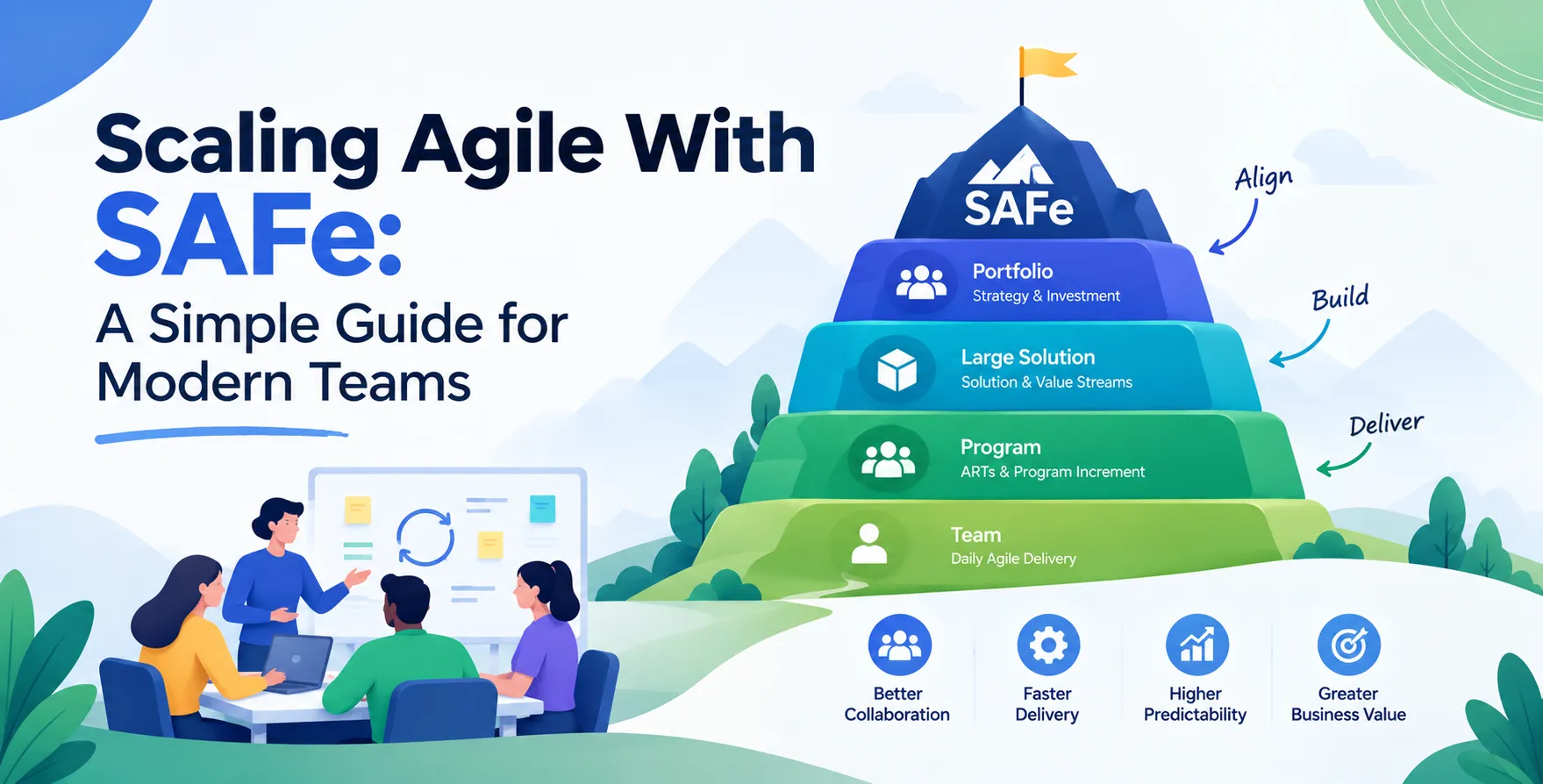
Scaling agile with SAFe means using agile methods across a whole company, not just inside one team. SAFe stands for Scaled Agile Framework.
In a small team, Scrum may be enough. But large companies often have many teams, products, managers, customers, and business goals. SAFe gives them a common way to plan, prioritize, and deliver work.
SAFe does not replace agile. It builds on agile ideas such as teamwork, feedback, continuous improvement, and delivering value in small steps.
- Helps many teams follow one plan
- Makes priorities clear
- Reduces confusion and repeated work
Why Big Companies Need SAFe
Large companies often face the same problems. Teams work hard, but leaders may not know whether the work supports business goals. Teams may also get blocked because another team has not finished an important task.
SAFe helps solve these problems by bringing people together at regular intervals. Leaders, product owners, and teams can discuss priorities, risks, dependencies, and progress.
This is similar to the challenge many companies face during digital transformation. Without clear planning and alignment, even good ideas can fail. You can read more in our guide on why most digital transformation projects fail.
- Reduces delays caused by team dependencies
- Gives leaders better visibility
- Helps teams focus on the most important work
What is AI-Native SAFe?
AI-Native SAFe is a newer way of using SAFe. It treats AI as part of how a company works, not just as a tool for writing code or creating content.
With AI-Native SAFe, teams can use AI to learn faster, test ideas, improve decisions, and deliver value sooner. But AI should support people, not replace good thinking or responsibility.
The main goal is simple: use AI to create better results for customers and the business, while keeping control over quality, safety, and risk. Before adding AI to business workflows, companies should understand why AI projects fail and how to avoid common mistakes.
Read our guide on why AI projects fail before they reach production.
- Uses AI to speed up learning and delivery
- Helps teams focus on real business results
- Keeps people responsible for important decisions
PI Planning vs. PI Outcome Planning
In SAFe, teams often plan work for a period called a Program Increment, or PI. A PI usually lasts around 8 to 12 weeks.
Traditional PI Planning brings teams together to plan the work they will do in the next PI. It helps teams understand priorities, dependencies, and risks.
PI Outcome Planning is a newer approach. Instead of focusing only on features and tasks, teams focus on the results they want to achieve. These results may include better customer experience, higher sales, lower costs, or faster delivery.
- PI Planning focuses on planned work
- PI Outcome Planning focuses on measurable results
- Outcome planning helps teams adjust quickly when things change
What is an Agile Release Train?
An Agile Release Train, or ART, is a group of teams that works together on the same product, service, or business goal.
For example, a company building a banking app may have separate teams for payments, security, mobile design, and customer support. Together, these teams can form one ART.
An ART helps teams plan together, manage dependencies, and deliver value as one group. It also gives leaders a clearer view of progress.
- Brings related teams together
- Improves coordination and planning
- Helps teams deliver a shared product or service
Lean Portfolio Management
Lean Portfolio Management helps leaders decide which projects and ideas should get time, money, and people.
Instead of funding projects only because they were planned last year, leaders can review business value, customer needs, risks, and results. This helps companies invest in work that matters.
With AI, this becomes even more important. Companies may have many AI ideas, but not every idea will create value. Lean Portfolio Management helps them choose the right ideas and stop work that is not useful.
- Helps leaders choose the right projects
- Reduces wasted time and money
- Connects investment decisions with business value
Using AI Safely in SAFe
AI can help teams work faster, but it also brings risks. Companies need rules for using AI with customer data, private business information, and important decisions.
Good AI governance means having clear rules about what AI can do, what data it can use, and when people must review its output. Teams should also check AI results for mistakes, bias, and security issues.
AI can sometimes give wrong or made-up answers. This is called an AI hallucination. To reduce this risk, companies should use clear guardrails, human review, and regular testing. Learn more in our guide on why AI hallucinates and how to reduce hallucinations.
- Set clear rules for AI use
- Protect customer and company data
- Have people review important AI decisions
Common Problems With SAFe
SAFe can help, but it does not solve every problem by itself. Some companies add too many meetings, roles, and documents. This can make work slower instead of easier.
Another common problem is using SAFe only as a process. If leaders do not change how they make decisions, teams may still face delays, unclear priorities, and too much paperwork.
- Too many meetings and processes
- Leaders do not support the change
- Teams do not understand the business goal
How to Know If SAFe Is Working
Do not measure success only by the number of features delivered. A team can deliver many features and still not help customers or the business.
Better measures include customer satisfaction, delivery speed, product quality, business value, and progress toward company goals. Teams should also check whether customers are actually using the new features.
- Customer satisfaction
- Time taken to deliver value
- Progress toward business goals
- Quality and customer feedback
SAFe and Other Agile Frameworks
SAFe is not the only way to scale agile. Other options include LeSS and Scrum@Scale.
SAFe is often useful for large companies that need more structure, planning, and governance. LeSS and Scrum@Scale may work better for companies that want a simpler approach with fewer roles and processes.
- SAFe is good for large and complex organizations
- LeSS focuses on keeping the structure simple
- Scrum@Scale extends Scrum across many teams
Simple Tips to Use SAFe Better
- Start with one team or product area
- Focus on customer and business outcomes
- Keep meetings short and useful
- Make priorities clear to everyone
- Use AI to support people, not replace them
- Review results regularly and improve
- Train leaders as well as teams
Conclusion
Scaling agile with SAFe helps companies bring many teams together and deliver work that supports real business goals. It improves planning, communication, and alignment across the organization.
With AI-Native SAFe, companies can go one step further. They can use AI to learn faster and make better decisions, while keeping people in control of important choices.
The best SAFe implementation is simple, practical, and focused on outcomes. When teams understand the goal and leaders support the change, SAFe can help a company deliver better products and grow with confidence.
Frequently Asked Questions (FAQs)

Scaling agile with SAFe means using agile methods across many teams, departments, or an entire company. It helps teams follow the same priorities, manage dependencies, and deliver work that supports business goals.