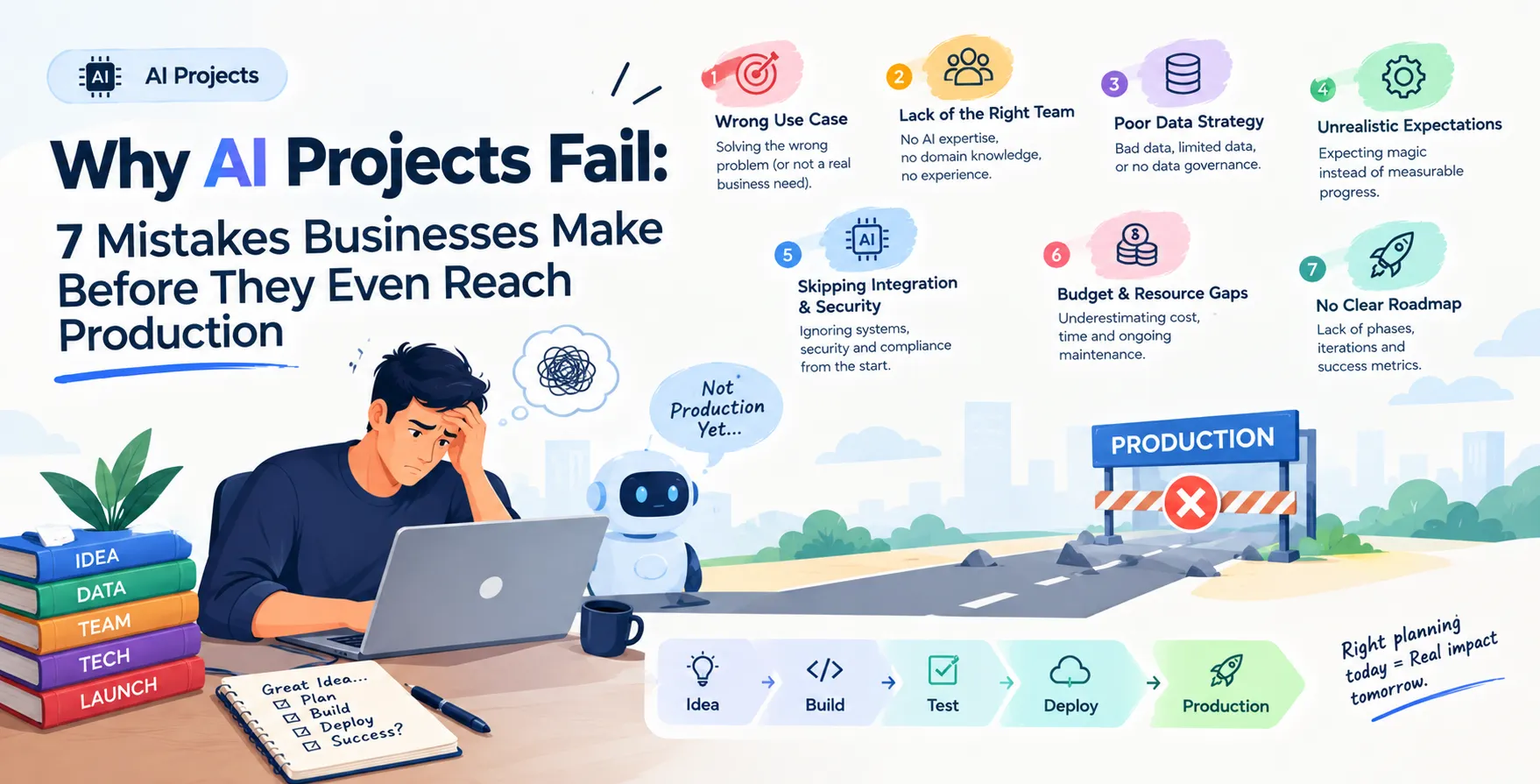
Table of Contents
- Introduction
- The Complexity of AI Development
- Ignoring Business Value
- Poor Data Preparation
- Underestimating Scalability
- Lack of Clear AI Strategy
- Technical Debt in AI
- Ignoring Model Evaluation
- Poor Talent Alignment
- The Role of MLOps
- Handling Data Quality
- Addressing AI Ethics
- Managing Stakeholder Expectations
- Conclusion
Introduction
Building high-performing intelligent systems is one of the most difficult engineering feats today. Many companies rush into AI adoption without a roadmap, leading to significant wasted investment and failed initiatives.
Understanding why AI projects fail is the first step toward building something sustainable. These projects are rarely stopped by bad code alone; they are usually halted by systemic issues in strategy, data, and organizational alignment.
The Complexity of AI Development
Developing AI is fundamentally different from traditional software engineering. You are not just writing logic; you are teaching systems to find patterns in chaotic data.
This uncertainty requires a different approach to development and testing. Teams that treat AI like a standard web application often find their systems breaking in production.
- Requires specialized infrastructure
- Demands iterative experimentation
- Needs continuous data feedback
- Relies on probabilistic outcomes
Ignoring Business Value
One of the biggest AI project mistakes is building technology for the sake of technology. If your AI does not solve a specific business problem, it will never provide a return on investment.
Stakeholders often get caught up in the hype of generative models. They fail to ask if a simpler rule-based system could solve the problem more cheaply and effectively.
Poor Data Preparation
Data is the lifeblood of any intelligent system. If you feed garbage into your models, you will inevitably receive garbage back as a result.
Many teams underestimate the time required for cleaning, labeling, and structuring their datasets. This stage is rarely glamorous, but it is the most critical for success.
- Unstructured data formats
- Missing feature values
- Bias in training sets
- Inconsistent data labeling
Underestimating Scalability
A model that works perfectly on a local developer machine often falls apart in production. Scaling to thousands of users introduces latency, throughput, and resource management issues.
Teams must consider AI inference optimization early in the design phase. Without careful planning, the costs of running the system can quickly exceed the value it provides.
Lack of Clear AI Strategy
Successful AI automation requires a cohesive vision. If different departments are running disconnected pilot programs, the organization loses focus and resources.
A strong digital transformation strategy must define the scope, expected outcomes, and metrics for success. Without this, your team will struggle to prioritize effectively.
Technical Debt in AI
AI systems accumulate technical debt much faster than traditional software. This happens when teams take shortcuts in model architecture or data pipelines during the rush to launch.
Over time, this debt makes it nearly impossible to maintain or upgrade the system. You end up spending more time patching the model than building new features.
Ignoring Model Evaluation
You cannot improve what you do not measure accurately. Many companies fail because they lack a robust framework for AI model evaluation during development.
Metric Selection
Selecting the wrong success criteria leads to misleading results. Precision and recall are often more important than raw accuracy when dealing with imbalanced datasets.
- Precision and recall trade-offs
- F1 score analysis
- False positive impact
- Data drift monitoring
Continuous Testing
Evaluation should not be a one-time event before release. You need a pipeline that tests for regressions every time the code or the data changes.
- Automated testing suites
- Scenario-based performance checks
- Model validation cycles
Poor Talent Alignment
AI development is a multidisciplinary effort. You need a mix of data scientists, ML engineers, and domain experts who understand the business context.
Some companies hire researchers when they need infrastructure engineers. This mismatch creates friction and slows down the entire delivery process.
The Role of MLOps
The most common cause of failure is the lack of a mature MLOps pipeline. Without automated deployment and monitoring, you cannot react to changes in the real world.
Machine Learning Operations ensures that your models remain reliable after they leave the lab. It bridges the gap between static code and dynamic production environments.
| Feature |
Manual Approach |
MLOps Approach |
| Deployment |
Manual scripts |
Automated CI/CD |
| Monitoring |
Logs only |
Real-time observability |
| Retraining |
Ad-hoc |
Trigger-based pipelines |
| Scalability |
Limited |
Elastic scaling |
| Environment |
Inconsistent |
Containerized |
Handling Data Quality
Data quality in machine learning is the primary driver of model performance. If your data sources are unreliable, your AI will constantly produce incorrect predictions or struggle with edge cases.
Investing in data engineering is far more valuable than spending months tweaking model hyperparameters. Clean, verified data is the strongest foundation you can build upon.
- Validation of source data
- Data lineage tracking
- Regular cleaning cycles
- Automated quality checks
- Anomaly detection in streams
Addressing AI Ethics
AI implementation challenges often revolve around compliance and safety. If you ignore the social implications of your system, you risk significant reputational damage later.
Using LLM guardrails helps ensure your output stays within safe boundaries. This is especially important in customer-facing applications where unpredictable behavior is unacceptable.
Managing Stakeholder Expectations
AI is not magic. It is a powerful tool with inherent limitations that must be clearly communicated to business leaders and end users.
When stakeholders expect perfection, every minor error feels like a project failure. Setting realistic expectations about performance and reliability is essential for long-term buy-in.
Conclusion
Avoiding common pitfalls in AI development requires a disciplined approach. You must focus on high-quality data, scalable infrastructure, and clear business objectives from day one.
By prioritizing MLOps and rigorous evaluation, you can build systems that provide lasting value. AI success is a marathon, not a sprint, and preparation is your greatest asset.


 In collaboration with