Table of Contents
- Introduction
- What is MLOps?
- Why Machine Learning is Different from Software Engineering
- Core Components of Machine Learning Operations
- Building a Robust MLOps Pipeline
- DevOps vs MLOps Comparison
- Core Benefits of Implementing MLOps
- Key MLOps Tools to Consider
- Common Challenges in Model Deployment
- How to Get Started with Machine Learning Operations
- Best Practices for AI Teams
- Conclusion
Introduction
Standard software delivery relies heavily on established deployment pipelines. Machine learning models require a continuous lifecycle management strategy to remain effective in production environments.
Without structured operations, deployed models experience rapid degradation over time. Senior developers know that writing model training code represents only a tiny fraction of the overall engineering work.
AI teams must bridge the operational gap between data science and system engineering. This discipline ensures consistent model performance across high-scale enterprise platforms.
What is MLOps?
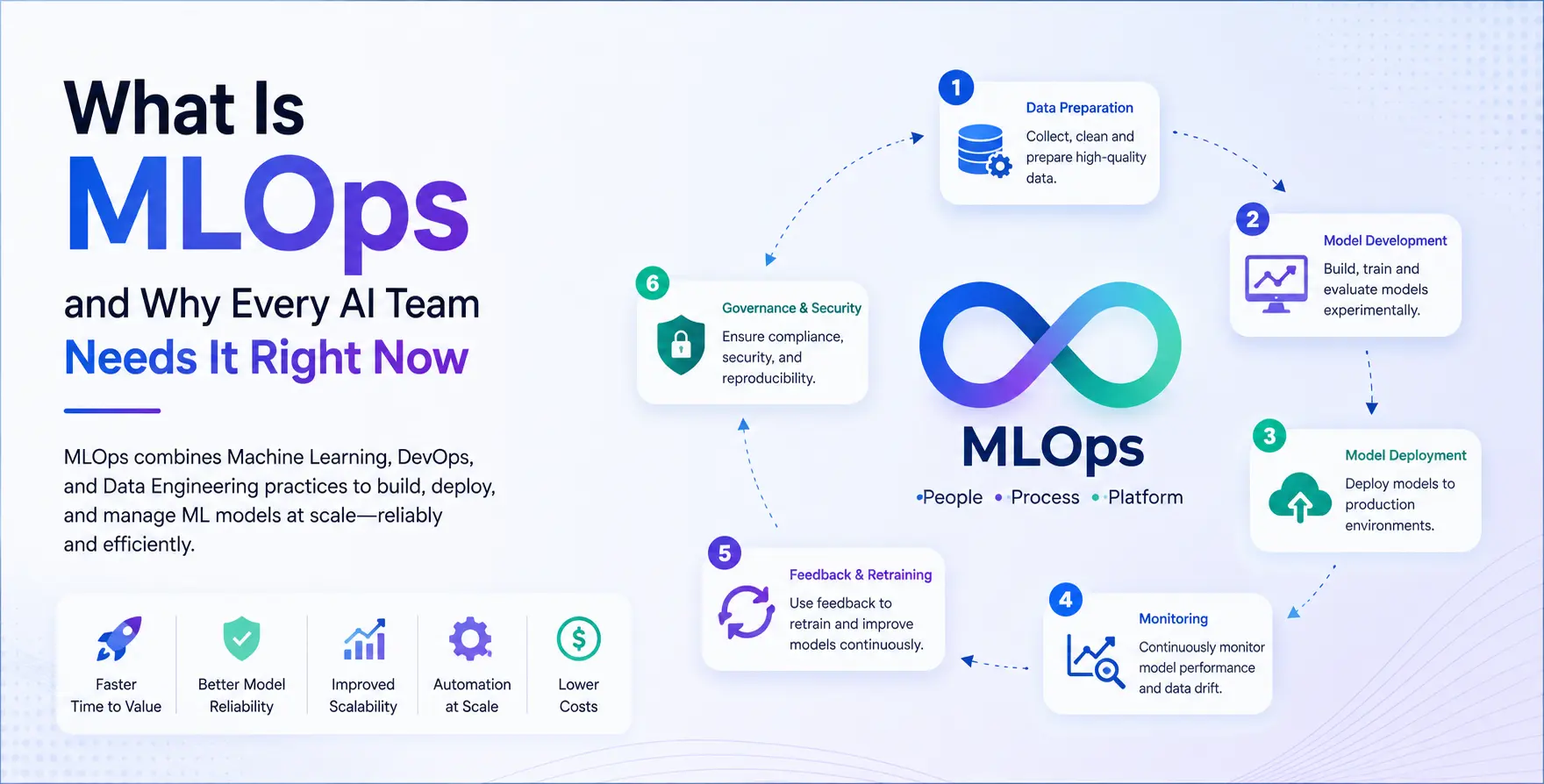
MLOps represents the intersection of machine learning systems engineering, DevOps practices, and data management. It streamlines the movement of artificial intelligence models from research sandboxes into live enterprise production environments.
- Automates operational model lifecycles
- Standardizes machine learning workflows
By standardizing these engineering workflows, technical organizations drastically reduce operational friction. Teams can deploy pipeline updates rapidly while maintaining strict operational stability.
Why Machine Learning is Different from Software Engineering
Traditional software development focuses primarily on source code logic and deterministic unit testing. Machine learning systems depend heavily on both source code and continuously shifting real-world data inputs.
When production data patterns change, model outputs degrade even if code remains completely untouched. This subtle degradation, widely known as data drift, demands continuous monitoring and scheduled automated retraining routines.
Standard debugging techniques cannot easily pinpoint operational failure modes in statistical models. Engineering teams require custom observability frameworks designed specifically for dynamic, data-driven systems.
Core Components of Machine Learning Operations
Implementing effective Machine Learning Operations requires organizing several interdependent technical disciplines. Each operational component targets a distinct stage within the continuous enterprise model lifecycle.
- Data validation and version control
- Automated training workflow orchestration
- Model registry and metadata storage
- Continuous integration and testing frameworks
- Real-time model performance monitoring
Integrating these operational layers ensures predictable system output across production deployments. Environments maintain high reliability even as underlying input distributions evolve over time.
Building a Robust MLOps Pipeline
Designing an effective MLOps pipeline guarantees repeatable, automated model releases. Engineering teams organize these execution workflows into isolated, highly reproducible phases.
Data Ingestion and Preprocessing
Incoming data requires systematic validation checks before reaching model training stages.
- Automated schema validation checking
- Feature extraction and normalization
- Data versioning using specialized repositories
- Handling missing input records systematically
Automated validation checks prevent corrupted input data from contaminating production workflows.
Automated Model Training and Evaluation
Execution pipelines train candidates automatically using pre-configured hyperparameter sets.
- Hyperparameter optimization and execution
- Cross-validation performance testing routines
- Automated regression metrics evaluation
- Model artifact packaging and metadata logging
Rigorous validation gates ensure that only top-performing artifacts reach production endpoints.
DevOps vs MLOps Comparison
Understanding how operational practices differ helps engineering leaders allocate infrastructure resources correctly.
| Aspect |
DevOps |
MLOps |
| Primary Artifacts |
Compiled code and binaries |
Code, datasets, and model weights |
| Testing Scope |
Unit and integration tests |
Data quality and predictive accuracy |
| Deployment Trigger |
Code repository commits |
Data changes and performance drift |
| Monitoring Focus |
System latency and memory usage |
Data drift and prediction distribution |
| Team Expertise |
Software and platform engineers |
Data scientists and platform engineers |
| Lifecycle Feedback |
Linear software releases |
Continuous closed-loop retraining |
Both disciplines share operational fundamentals while addressing distinctly different production artifacts.
Core Benefits of Implementing MLOps
Engineering organizations that adopt modern operational frameworks gain predictable deployment capabilities. Embracing MLOps transforms experimental artificial intelligence projects into resilient operational platforms.
- Accelerates release cycles for models
- Improves collaboration across technical teams
- Reduces operational overhead costs
- Enhances model governance and auditability
- Ensures reliable real-time prediction scaling
- Minimizes production downtime risk
These operational advantages ensure that corporate AI initiatives yield measurable, long-term commercial value.
Key MLOps Tools to Consider
Selecting appropriate MLOps tools depends heavily on an enterprise's current cloud architecture. Modern vendor software platforms provide modular components designed for experiment tracking, registry management, and real-time model hosting.
Open-source tools offer engineering teams complete flexibility when building custom platform solutions. Fully managed cloud ecosystems reduce system maintenance overhead while speeding up initial platform deployment timelines.
Technical leaders should evaluate platforms based on security compliance, API compatibility, and infrastructure scaling support. Long-term platform scalability remains the single most critical factor during tool selection processes.
Common Challenges in Model Deployment
Deploying statistical models into mission-critical systems presents unique engineering obstacles.
- Managing complex infrastructure dependencies
- Detecting subtle model performance decay
- Handling massive real-time inference loads
- Maintaining compliance with privacy regulations
Addressing these architectural challenges early prevents costly service interruptions and security incidents.
How to Get Started with Machine Learning Operations
Transitioning toward unified Machine Learning Operations requires a deliberate, step-by-step engineering roadmap.
- Audit existing data and deployment processes
- Establish automated testing for data pipelines
- Implement centralized model registry infrastructure
- Configure production monitoring and alert systems
Executing these transition steps in sequence minimizes operational friction for active engineering teams.
Best Practices for AI Teams
High-performing software teams adopt uniform engineering practices to maintain deployment quality.
- Version control all data alongside source code
- Automate deployment tests before production release
- Establish clear operational ownership across teams
Rigorous adherence to these principles results in consistent, reliable software releases over time.
Conclusion
Machine learning platforms demand modern operational frameworks to deliver ongoing business value. Establishing continuous automation bridges the gap between initial experimentation and enterprise system delivery.
Engineering leaders who invest in operational maturity will scale intelligence capabilities smoothly. Building robust pipeline architecture today guarantees stable, high-performing enterprise applications far into the future.


 In collaboration with