Table of Contents
- Introduction
- Understanding Agentic AI
- Core Concepts of Managed Agents
- Setting Up Your Environment
- Designing Your Agent Workflow
- Integrating Tools and APIs
- Managing State and Memory
- Testing and Deployment Strategies
- Security and Permissions
- Monitoring Agent Performance
- Scalability Considerations
- Best Practices for Agentic Development
- Future Trends in Agent Orchestration
- Conclusion
Introduction
The landscape of software development is shifting from static applications to autonomous systems. Developers are moving beyond simple LLM prompts toward building sophisticated, goal-oriented systems.
Understanding how to build cloud AI agents is now a critical skill for any modern engineering team. The Gemini Managed Agents API provides a robust framework to simplify this transition, allowing you to focus on logic rather than infrastructure.
Understanding Agentic AI
Agentic AI represents a fundamental shift in how we interact with technology. Unlike traditional software that follows rigid paths, agents can reason through complex problems to achieve a specified outcome.
This evolution, often described as the next big shift after ChatGPT, enables systems to plan, execute, and verify their own actions. Teams looking to implement this should grasp the core principles of what is Agentic AI to avoid common design pitfalls.
- Autonomous goal achievement
- Dynamic task planning
- Reasoning over multiple steps
- Context-aware decision making
Core Concepts of Managed Agents
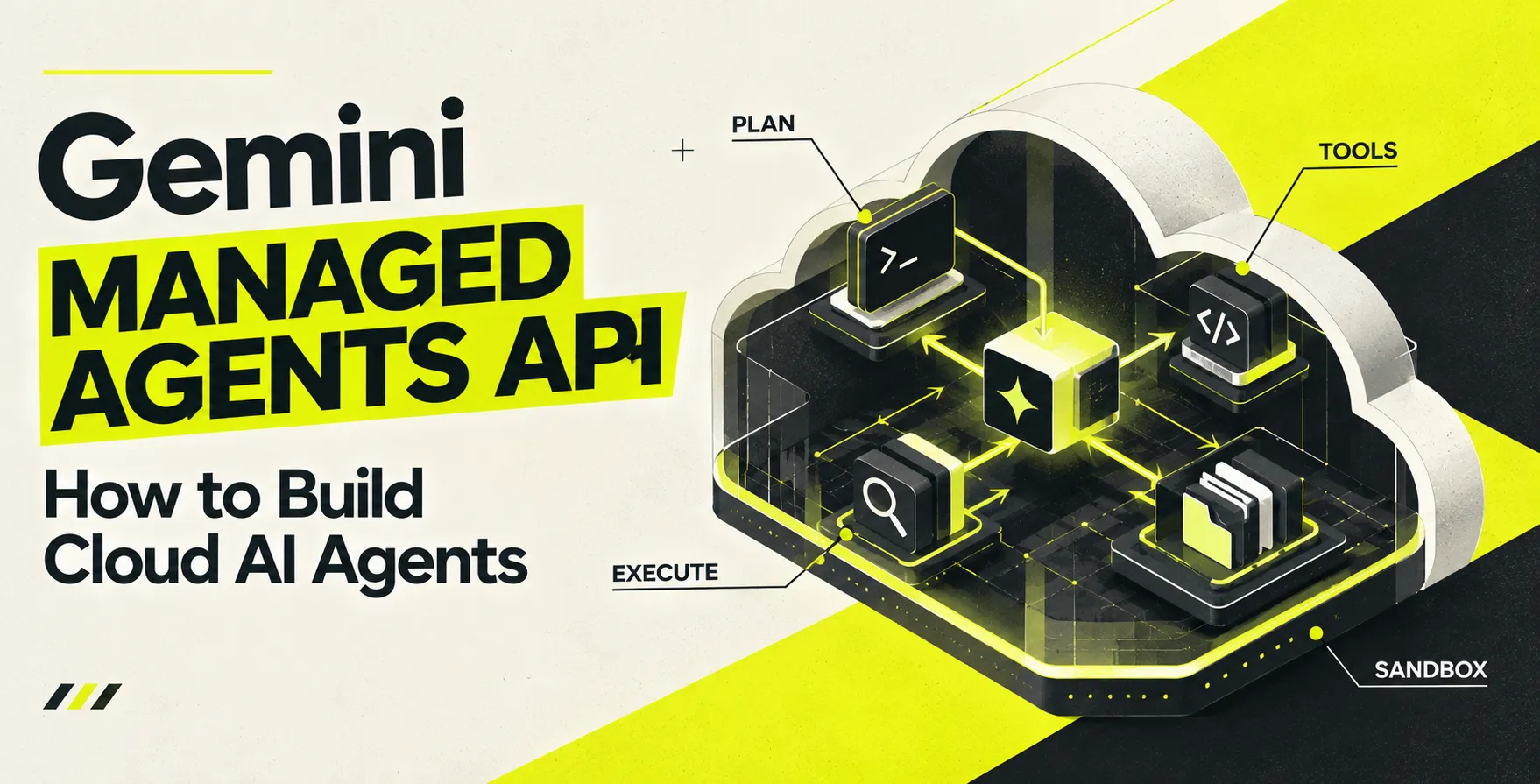
Managed agents abstract away the heavy lifting involved in managing long-running processes. When you use the Gemini Managed Agents API, you are leveraging a platform designed to handle the orchestration of model calls, tool execution, and state persistence.
This allows developers to define a clear boundary for what an agent can and cannot do. By utilizing pre-built infrastructure, your team can accelerate the time to market for complex automation projects.
Agent Architecture
The architecture of a cloud AI agent consists of several distinct layers that work in harmony. You must define a clear strategy for how these layers communicate to ensure stability.
- System instructions defining persona
- Tool definitions for external access
- Memory modules for session persistence
- Orchestration engine for task execution
Each component must be tuned to meet the specific requirements of your business logic.
Setting Up Your Environment
Before writing code, you need to configure your development environment for interaction with the API. Ensure your project has the necessary credentials and library dependencies to authenticate securely.
Most developers start by installing the official SDK, which provides high-level abstractions for common tasks. Verify that your cloud project settings permit the use of advanced AI features before proceeding to initialization.
- Install the latest Google Cloud SDK
- Configure project-level authentication
- Set up environment variables for API keys
- Initialize the agent client library
Designing Your Agent Workflow
Building a successful agent requires a well-defined workflow. You should map out the steps your agent needs to take before you begin coding the implementation.
Consider how the agent will handle failures or unexpected input scenarios. A robust design often includes clear branching logic to handle errors gracefully, ensuring the system remains functional even when individual steps fail.
Integrating Tools and APIs
The power of an agent comes from its ability to interact with the outside world. Through Gemini API agents, you can connect your systems to databases, calendars, or custom internal microservices.
Effective tool integration requires precise function declarations that the model can interpret accurately. If the model understands the intent behind a tool call, it can execute complex tasks that would otherwise require manual intervention.
- Define clear tool schemas
- Implement robust backend endpoints
- Validate all tool inputs
- Handle API rate limits
Managing State and Memory
Memory is what differentiates a simple chat interface from a true agentic system. When you learn how to build cloud AI agents, you must decide how long an agent should remember a conversation or a task history.
Proper session management ensures that an agent does not repeat mistakes or lose track of ongoing objectives. By leveraging persistent storage, your agents can maintain context across multiple user interactions over long durations.
Testing and Deployment Strategies
Deployment in a cloud environment requires rigorous testing protocols. You need to ensure that your agent behaves correctly under various conditions before exposing it to production users.
Use automated test suites to verify that tool calls execute correctly and that the agent adheres to its system instructions. This phase is critical for establishing confidence in the system's reliability and safety.
- Unit test individual tool functions
- Simulate complex user scenarios
- Conduct load testing for concurrent agents
- Implement staging environments for final checks
Security and Permissions
Security is paramount when dealing with autonomous agents that have access to sensitive data. You should follow established AI agent security best practices for autonomous AI agents to prevent unauthorized execution or data leaks.
Always adhere to the principle of least privilege. An agent should only have access to the specific resources required to complete its assigned task, limiting the potential impact of any unexpected behavior.
Monitoring Agent Performance
Once your agent is live, you need continuous visibility into its operations. Monitoring allows you to track success rates, latency, and the quality of reasoning generated by the model.
Advanced logging helps you diagnose issues when an agent fails to complete a task. By analyzing these logs, you can refine your system instructions and improve the overall efficiency of your automation workflows.
- Log all tool interaction events
- Track model usage costs
- Monitor task completion latency
- Audit agent reasoning paths
Scalability Considerations
As your user base grows, your infrastructure must handle an increasing number of concurrent agent sessions. The cloud-native approach of the Gemini Managed Agents API allows for seamless scaling without manual server management.
Ensure your backend services are optimized to handle the concurrent requests generated by your agents. A well-architected system will scale horizontally as demand increases, maintaining consistent performance for every user session.
Best Practices for Agentic Development
Development is an iterative process that requires constant refinement. Start small with simple tasks, and gradually increase the complexity of your agent's capabilities as you become more comfortable with the platform.
Collaboration between developers and domain experts is vital for creating high-quality agents. By involving stakeholders early, you ensure the agent solves real-world problems while maintaining alignment with business objectives.
- Keep system instructions concise
- Use structured output formats
- Test with diverse user inputs
- Document all tool dependencies
Future Trends in Agent Orchestration
The field is moving toward multi-agent systems where specialized agents collaborate on complex projects. This modular approach allows teams to build highly specific agents that excel at singular functions, coordinated by a master orchestrator.
As these systems become more capable, the barrier to creating advanced automation will continue to drop. Staying updated on the latest platform features will ensure your team remains at the forefront of this technological shift.
Conclusion
Building with the Gemini Managed Agents API opens up new possibilities for automation and intelligence. By focusing on clear workflows, tool integration, and security, you can build reliable agents that deliver real business value.
Start by experimenting with simple tasks and build toward more complex, autonomous systems. The tools are ready, and the potential for innovation is limited only by your design choices.


 In collaboration with