Table of Contents
- Introduction to OpenAI Agents
- Understanding the Architecture
- Core Components of Agentic Systems
- Setting Up Your Development Environment
- How to Integrate External Tools
- Implementing Persistent Memory
- Designing Effective Agent Loops
- Managing State and Context
- Handling Errors and Guardrails
- Testing and Debugging Agents
- Scaling Your Agent Infrastructure
- Best Practices for Agent Design
- Conclusion
Introduction to OpenAI Agents
The landscape of software development is shifting toward more autonomous systems that do more than just generate text. Developers are now looking for robust ways to build applications that can interact with the real world.
This is where the OpenAI Agents API becomes essential for modern engineering teams. It provides the foundation for creating systems that reason, plan, and execute tasks across multiple steps.
Understanding the Architecture
Building high-performance systems requires a clear understanding of how these components interact at scale. You are essentially creating a loop that allows an LLM to decide which actions to take next.
This loop relies on the model receiving clear feedback from its environment after every action. The goal is to move beyond simple request-response patterns toward a truly interactive experience.
- Models process incoming task requirements
- Tools provide external capabilities to the model
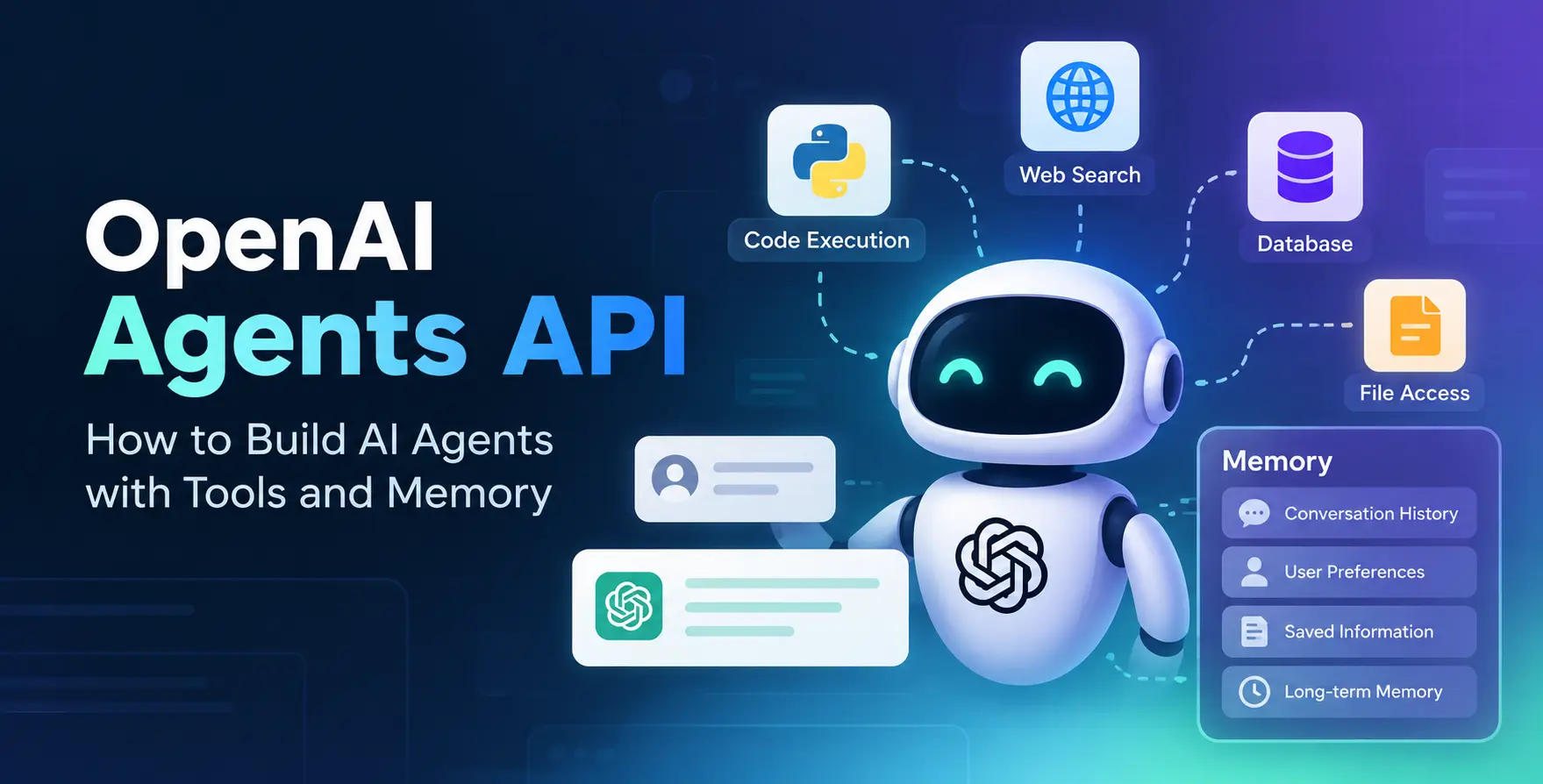
- Memory stores past interactions and data
- Loops handle iterative reasoning and adjustment
Core Components of Agentic Systems
To succeed in OpenAI agent development, you must balance reasoning capabilities with reliable tool execution. Each agent requires a persona, a set of defined functions, and a structured way to recall previous steps.
Memory acts as the bridge between disconnected sessions. Without it, your agent is limited to the immediate context window provided in the current prompt.
- Task planning modules
- Tool definition schemas
- State management systems
- External API connectivity
Setting Up Your Development Environment
Before you start coding, ensure your environment is configured for asynchronous operations. Most agentic workflows perform best when handling I/O-bound tasks in parallel.
You will need the latest SDK versions to access the features required for complex tool calling. Always use environment variables to manage your API keys securely.
- Install the latest OpenAI Python SDK
- Set up your secure configuration files
- Initialize your logging and observability tools
- Verify connectivity to the primary model endpoints
How to Integrate External Tools
Defining Tool Schemas
The model needs precise definitions to understand how to interact with your code. You must describe your function parameters with high clarity so the agent knows exactly what to provide.
- Function name and purpose
- Detailed parameter descriptions
- Expected output data structures
- Error handling for failed calls
By providing structured definitions, you ensure the agent can reliably trigger your custom logic.
Executing Tool Calls
Once the model identifies a need, it generates a structured request for the tool. Your application must intercept this request, execute the code, and return the result back to the LLM.
- Intercept model-generated tool calls
- Execute backend logic safely
- Validate input against schema rules
- Format results for the LLM
This cycle is the backbone of successful tool-based automation.
Implementing Persistent Memory
True intelligence requires the ability to learn from previous interactions. When exploring AI agent tools and memory, you should implement a database layer that persists state across different sessions.
Vector databases are often used to store long-term semantic context. This allows the agent to retrieve relevant information from weeks ago, rather than just the last few messages.
| Memory Type |
Purpose |
Storage Strategy |
| Short-term |
Active conversation context |
Session RAM |
| Long-term |
Historical user preferences |
Vector Database |
| Episodic |
Specific task milestones |
Relational DB |
| Working |
Current reasoning state |
Threaded storage |
Designing Effective Agent Loops
The quality of your agent often comes down to how you structure the feedback loop. Poorly designed loops lead to infinite cycles or off-track reasoning.
Engineers must implement strict termination conditions to prevent cost spikes. Always include a maximum step count for every autonomous task cycle.
- Define clear exit criteria
- Implement step-count limits
- Monitor reasoning logs constantly
- Validate tool execution safety
Managing State and Context
State management is the most challenging aspect of building complex agents. You must ensure the agent understands where it stands in a multi-stage workflow at all times.
Consider using a central state machine to track progress. This keeps the agent focused on the next objective rather than repeating previous mistakes.
Handling Errors and Guardrails
When dealing with LLMs, unexpected behavior is a reality of the development process. You should enforce strict boundaries to keep the agent within safe operational parameters.
Use output validation to ensure the agent does not perform unauthorized actions. Implement retry logic for transient API failures to maintain system stability.
- Sanitize all incoming tool outputs
- Implement rate limiting for APIs
- Filter sensitive user data
- Log all agent decisions
Testing and Debugging Agents
Traditional unit testing is often insufficient for non-deterministic agent behavior. You need to build evaluation frameworks that assess the agent's performance across various scenarios.
Simulate complex user inputs to see how the agent handles ambiguity. This reveals flaws in your prompt structure or tool definitions before they reach production.
Scaling Your Agent Infrastructure
As your application grows, you will need to handle multiple concurrent agent sessions. This requires a distributed architecture that can handle load balancing and state persistence across multiple nodes.
Think about how your system will scale during peak usage hours. Decoupling the reasoning engine from the task execution layer is a proven way to increase throughput.
Best Practices for Agent Design
Start with simple, focused agents rather than trying to build a general-purpose model immediately. This approach allows you to iterate faster and understand where the bottlenecks exist.
Always prioritize transparency in your logs. When an agent fails, you need to be able to reconstruct the exact chain of thought that led to that failure.
- Keep agent scopes narrow
- Document all tool capabilities
- Maintain transparent audit logs
- Iterate based on performance data
- Focus on high-value use cases
Conclusion
Learning how to build AI agents with OpenAI Agents API opens up massive potential for automation. By combining precise tool definitions with reliable memory layers, you can create systems that solve real business problems effectively.
Focus on building robust loops and maintaining clear state management throughout your development lifecycle. As the technology matures, your foundation in these core principles will ensure your systems remain scalable and reliable.


 In collaboration with