Table of Contents
- Introduction to Model Selection
- Understanding Model Architecture
- Claude Haiku 5.5 vs Sonnet 5.5 Cost Analysis
- Latency Benchmarks in Production
- When to Use Haiku 5.5
- When to Use Sonnet 5.5
- Infrastructure and Scalability
- AI Inference Optimization
- The Role of Model Evaluation
- Managing API Rate Limits
- Cost-Effective Implementation Strategies
- Deployment Considerations
- Final Thoughts
Introduction to Model Selection
Selecting the right language model for your production environment is rarely about picking the smartest model available. Instead, it is a strategic balancing act between intelligence, response speed, and operational budget.
As teams scale their AI-driven features, they often find that using the most powerful model for every task is inefficient. Understanding the nuances of Claude Haiku 5.5 vs Sonnet 5.5 is critical for maintaining a competitive edge in your software architecture.
Understanding Model Architecture
The architecture of these two models dictates how they handle complex tasks versus simple, repetitive operations. Sonnet is designed as a balanced powerhouse, capable of nuanced reasoning and complex instruction following.
Haiku is optimized for extreme efficiency and speed. It sacrifices some depth of reasoning to achieve a significantly smaller footprint, which directly impacts how fast it can serve a request.
Choosing between them requires a clear understanding of your specific application's requirements. Not every user interaction needs the heavy compute power of a full-scale reasoning model.
- Haiku focuses on high-throughput tasks
- Sonnet excels at complex reasoning
- Architecture determines inference speed
- Resource allocation scales with model size
Claude Haiku 5.5 vs Sonnet 5.5 Cost Analysis
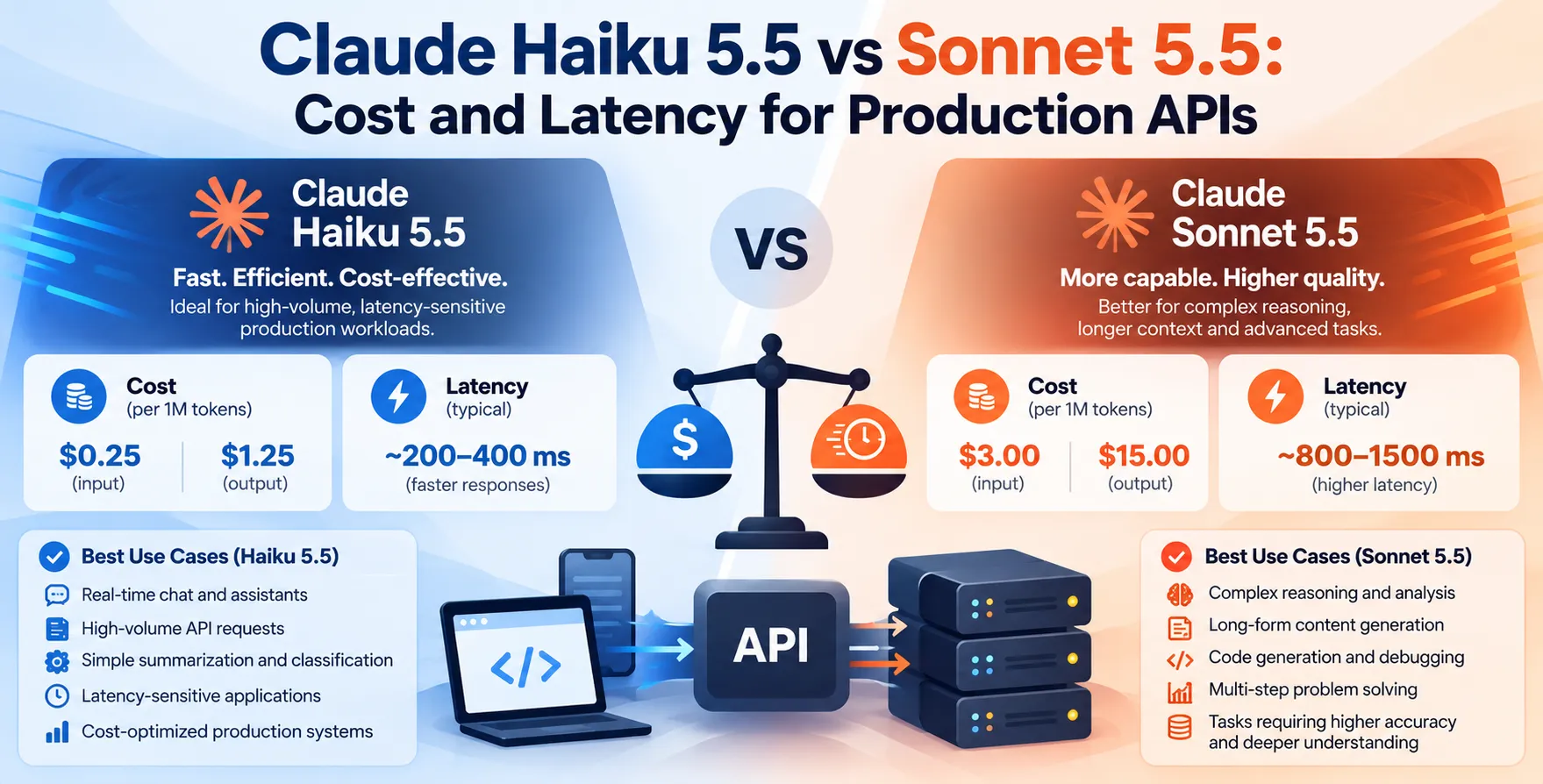
When evaluating Claude Haiku 5.5 vs Sonnet 5.5 cost and latency for production APIs, the price per million tokens is the most immediate metric to consider. Haiku is priced significantly lower, making it the preferred choice for massive, high-volume workloads.
Sonnet carries a higher cost, reflecting the increased compute resources needed for every token generated. For many developers, the Claude Haiku 5.5 API pricing structure offers the most predictable path to scaling AI features without ballooning infrastructure bills.
However, if the cost of re-processing failed outputs due to lower model intelligence exceeds the savings, the cheaper model becomes a liability. Always weigh the total cost of ownership rather than just the token price.
| Metric |
Haiku 5.5 |
Sonnet 5.5 |
| Input Cost |
Low |
Medium |
| Output Cost |
Low |
High |
| Throughput |
High |
Moderate |
| Efficiency |
High |
Balanced |
| Ideal Use |
High-volume simple tasks |
Complex logic |
Latency Benchmarks in Production
Latency is often the primary bottleneck for real-time applications. A Claude model latency comparison reveals that Haiku provides a snappier experience, which is vital for chat interfaces and live data processing.
Sonnet naturally has a longer time-to-first-token because it must navigate more complex parameter weights to generate an output. For applications requiring sub-second responses, this difference can make or break the user experience.
Engineers should perform their own latency testing based on their specific prompt lengths and system architecture. Local network conditions and API request overhead will also influence these benchmarks in a real-world setting.
- Haiku reduces time-to-first-token
- Sonnet requires more compute time
- Network overhead impacts real-world latency
- Asynchronous processing can mask delays
When to Use Haiku 5.5
Haiku is the ideal candidate for tasks where speed and volume are the primary constraints. It handles classification, simple summarization, and data extraction with remarkable consistency.
By leveraging its high throughput, you can build responsive UI components that feel nearly instant to the user. It is particularly effective for background processing where you need to handle millions of records without incurring massive costs.
If your application performs repetitive text transformations or basic entity recognition, Haiku is likely your best fit. It allows you to maintain high performance without compromising your budget.
- Data classification tasks
- Simple sentiment analysis
- High-volume text extraction
- Real-time chat interfaces
- Background data processing
When to Use Sonnet 5.5
Sonnet is the engine you reach for when the quality of reasoning is non-negotiable. It handles nuanced instructions, creative writing, and complex multi-step logical tasks with far more reliability than smaller models.
If your application provides technical support, code generation, or deep analytical insights, the cost of Sonnet is usually justified. A failure in logic on these tasks is much more expensive than the difference in token costs.
Think of Sonnet as a precision instrument. It provides the depth needed to handle edge cases that might confuse a smaller, faster model.
Infrastructure and Scalability
Scalability relies on how efficiently your code manages API requests. Implementing robust AI inference optimization ensures that you are not wasting cycles on redundant calls or inefficient prompt structures.
Caching frequent responses can significantly reduce the load on your API endpoints. By implementing an intelligent layer that routes queries based on complexity, you can mix and match both models to optimize both performance and cost.
The Role of Model Evaluation
Effective AI model evaluation is the only way to know if you are making the right choice for your specific use cases. Without rigorous testing, you are simply guessing at performance metrics.
Use a representative sample of your production data to test both models against your core requirements. Track latency, output quality, and cost per task to create a data-driven decision matrix.
If your application involves high-stakes decision making, consider building a validation pipeline to catch errors early. This is a standard part of any professional AI lifecycle.
Managing API Rate Limits
Every API has hard limits on how many requests you can send in a given timeframe. Understanding how to choose the right API rate limiting strategy is essential for ensuring your application remains stable during traffic spikes.
Implement exponential backoff and retry logic in your client-side code. This ensures that transient network issues or temporary rate limit hits do not crash your entire production system.
Monitoring your usage patterns will help you predict when you need to request higher quotas. Proactive management prevents unexpected downtime during critical business hours.
Deployment Considerations
When moving from development to production, ensure that your environment variables and API keys are stored securely. Never hardcode credentials in your repository or expose them in client-side code.
Use environment-specific configurations to switch between model versions during testing. This allows you to upgrade or downgrade models without changing your core application logic.
Finally, always keep a fallback mechanism in place. If your primary model experiences an outage, your application should be resilient enough to handle the disruption gracefully.
Final Thoughts
The choice between Claude Haiku 5.5 and Sonnet 5.5 should always be driven by your specific product requirements. There is no one-size-fits-all solution in modern AI engineering.
By carefully analyzing your cost-to-latency ratio, you can build scalable systems that are both fast and intelligent. Keep testing, keep measuring, and let your data dictate your model selection strategy.
- Prioritize speed for UX
- Prioritize reasoning for quality
- Monitor usage consistently
- Optimize your prompt engineering
- Scale with confidence


 In collaboration with