Table of Contents
- Introduction to AI Models
- What are Large Language Models?
- What are Small Language Models?
- SLM vs LLM: Key Differences
- Benefits of Small Language Models
- Challenges of Implementing SLMs
- Enterprise AI Models: Trends and Adoption
- Private AI Models: Security and Privacy
- Real-World Applications of SLMs
- Comparison of SLM and LLM Performance
- Future of AI Models in Business
- Conclusion
Introduction to AI Models
Artificial intelligence has revolutionized the way businesses operate. One key aspect of AI is language models.
These models enable machines to understand and generate human-like language. However, they come in different sizes and capabilities.
The choice between Large Language Models (LLMs) and Small Language Models (SLMs) depends on various factors.
What are Large Language Models?
LLMs are complex AI models designed to process and generate vast amounts of human-like language. They are trained on massive datasets.
These models are powerful but require significant computational resources and data.
They are often used in applications where high accuracy and complexity are crucial.
- Highly accurate in language understanding and generation
- Require large datasets for training
- Need significant computational power
What are Small Language Models?
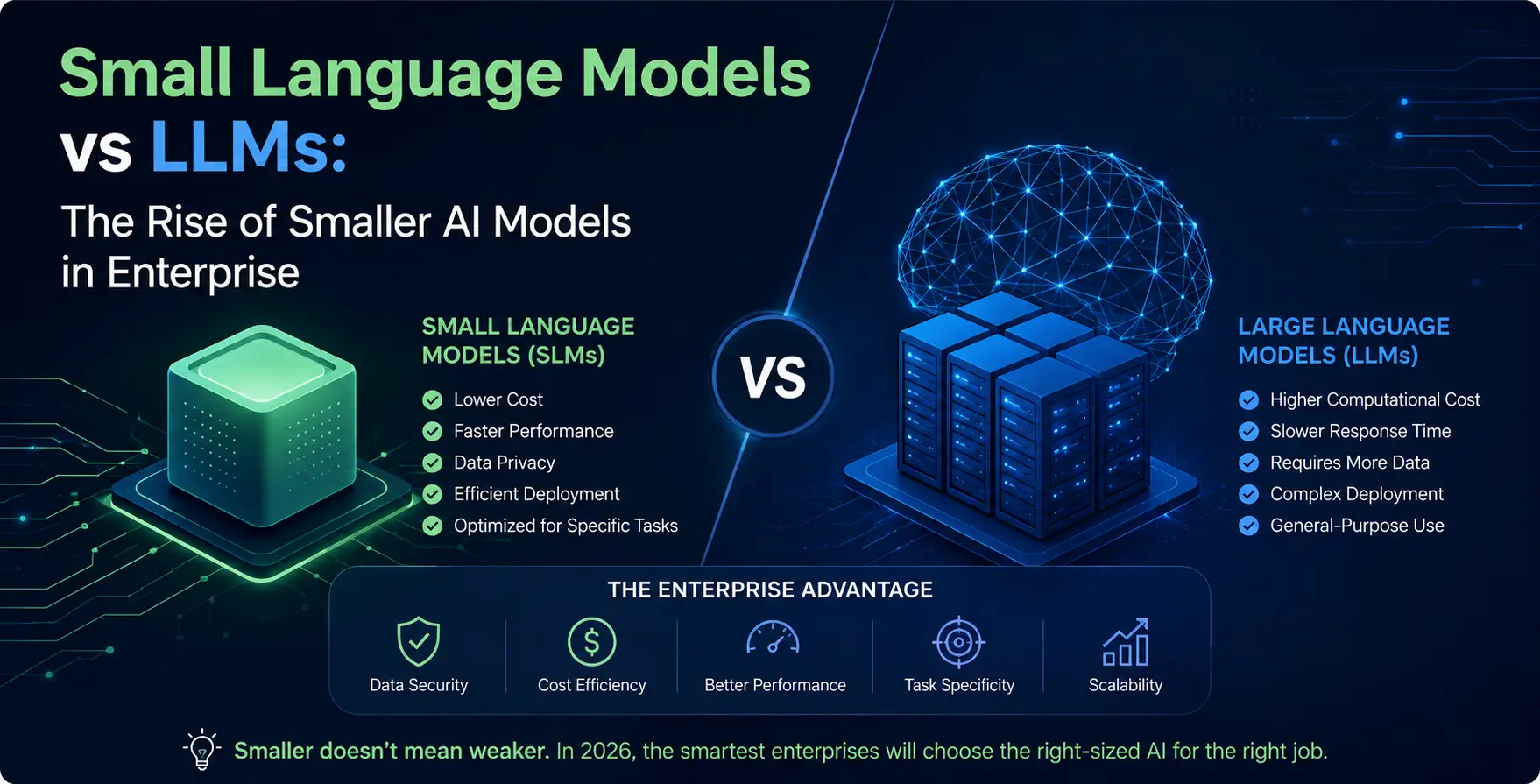
SLMs, on the other hand, are less complex and require fewer resources. They are designed for efficiency and cost-effectiveness.
These models are ideal for applications where resources are limited, or speed is a priority.
SLMs are gaining popularity in enterprise settings due to their practicality.
- Efficient and cost-effective
- Require less computational power and data
- Ideal for real-time applications
SLM vs LLM: Key Differences
The main difference between SLMs and LLMs lies in their complexity, resource requirements, and application suitability.
While LLMs excel in high-accuracy tasks, SLMs offer efficiency and speed.
The choice between the two depends on the specific needs of the business.
| Characteristic |
SLMs |
LLMs |
| Complexity |
Less complex |
Highly complex |
| Resource Requirements |
Lower |
Higher |
| Application Suitability |
Real-time, efficient applications |
High-accuracy, complex tasks |
Benefits of Small Language Models
SLMs offer several benefits, including efficiency, cost-effectiveness, and speed. They are ideal for businesses looking to implement AI without high resource investment.
Additionally, SLMs can be more privacy-friendly since they require less data.
This makes them suitable for applications where data privacy is a concern.
- Efficient use of resources
- Cost-effective
- Fast deployment and response times
- Privacy-friendly
Challenges of Implementing SLMs
Despite their benefits, SLMs also present challenges. One of the main challenges is achieving high accuracy with limited complexity.
Additionally, SLMs may not perform as well as LLMs in certain tasks.
However, advancements in AI technology are continually improving the capabilities of SLMs.
- Lower accuracy in complex tasks
- May not perform as well as LLMs in certain applications
- Require careful model selection and training
Enterprise AI Models: Trends and Adoption
In the enterprise sector, there is a growing trend towards adopting smaller, more efficient AI models. This is driven by the need for cost-effectiveness and speed.
Businesses are looking for AI solutions that can be quickly deployed and provide tangible benefits.
SLMs fit this requirement, making them an attractive option for enterprise AI models.
Private AI Models: Security and Privacy
Private AI models, including SLMs, are designed with security and privacy in mind. They offer a more controlled environment for AI deployment.
This is particularly important for businesses handling sensitive data.
Private AI models ensure that data privacy is maintained while still benefiting from AI capabilities.
Real-World Applications of SLMs
SLMs have a wide range of real-world applications, from customer service chatbots to language translation tools.
They are used in any scenario where efficient and fast language processing is necessary.
SLMs are also used in conjunction with other AI models to enhance their capabilities.
- Customer service chatbots
- Language translation tools
- Text summarization
- Speech recognition
Comparison of SLM and LLM Performance
A direct comparison between SLM and LLM performance shows that while LLMs excel in high-accuracy tasks, SLMs offer better efficiency and speed.
The choice between the two ultimately depends on the specific requirements of the application.
Both SLMs and LLMs have their place in the AI landscape.
| Model Type |
Accuracy |
Efficiency |
Speed |
| SLM |
Good |
High |
Fast |
| LLM |
Excellent |
Low |
Slow |
Future of AI Models in Business
The future of AI in business looks promising, with SLMs playing a significant role. As technology advances, the capabilities of SLMs will continue to improve.
More businesses will adopt SLMs for their efficiency, cost-effectiveness, and privacy benefits.
The use of SLMs will become more widespread, leading to further innovation in AI applications.
Conclusion
In conclusion, Small Language Models are gaining popularity in the business world due to their efficiency, cost-effectiveness, and ability to provide fast and accurate results.
While they may not offer the same level of complexity as Large Language Models, SLMs are ideal for applications where speed and privacy are crucial.
As AI technology continues to evolve, the role of SLMs in enterprise settings will only continue to grow.


 In collaboration with