Table of Contents
- Introduction
- Understanding AI Reasoning Models
- OpenAI o3 Architecture and Capabilities
- Anthropic Claude 3.5 Sonnet and Opus
- Google Gemini Ultra Infrastructure
- AI Reasoning Models Comparison
- Code Generation Benchmark Performance
- Mathematical and Logical Reasoning
- Multimodal Reasoning and Vision Tasks
- Enterprise Deployment and API Latency
- Cost Efficiency and Token Economics
- Choosing the Best AI Reasoning Model 2026
- Conclusion
Introduction
Selecting the right artificial intelligence model for complex enterprise tasks has become a critical strategic decision. As frontier models evolve beyond simple text prediction, deliberate planning capabilities now define high-performance software engineering.
This evaluation examines leading platforms across core benchmarks, real-world development workflows, and operational costs. We analyze how these systems perform when solving multi-step logic problems.
Understanding AI Reasoning Models
Next-generation software systems rely on extended deliberate thought before generating final outputs. Advanced inference-time compute allows models to test hypothesis chains internally before answering.
Traditional architectural patterns relied heavily on pattern matching from training data. Modern reasoning architectures actively verify logic steps to reduce hallucinatory outputs during critical operations.
This structural shift enables automated root-cause analysis in software development. Developers now deploy these tools for deep system refactoring and verification tasks.
OpenAI o3 Architecture and Capabilities
The release of OpenAI o3 represents a massive evolution in deliberate chain-of-thought processing. The framework spends extra compute during inference to thoroughly evaluate multiple solution paths.
Key technical innovations within this architecture include several distinct features:
- Dynamic chain-of-thought expansion during generation
- Self-correction loops prior to output rendering
- Deep integration with terminal environments
- Advanced mathematical proof generation tools
- Reinforcement learning optimized for code synthesis
These capabilities allow the model to tackle engineering challenges that previously halted earlier generations. Systems engineers report significantly higher success rates on long-context tasks.
Anthropic Claude 3.5 Sonnet and Opus
Anthropic has focused heavily on refined context comprehension and precise instruction following. The Claude family excels at handling massive codebase navigation without losing structural coherence.
Developers frequently select Sonnet and Opus for complex software architectural reviews. The models maintain context fidelity across extensive conversation histories without losing track of original parameters.
This stability makes Claude a preferred driver for autonomous coding agents. Its predictable style adherence simplifies team adoption across enterprise engineering workflows.
Google Gemini Ultra Infrastructure
Google designed Gemini Ultra with native multimodality built directly into its core transformer layers. The platform processes video, audio, code, and text inputs simultaneously without requiring separate specialized encoders.
The system excels across two primary enterprise dimensions:
- Native processing of massive context windows
- Deep integration with cloud infrastructure services
This architecture allows engineering teams to analyze entire documentation repositories alongside live codebases. Deep ecosystem ties streamline backend deployment across cloud infrastructure.
AI Reasoning Models Comparison
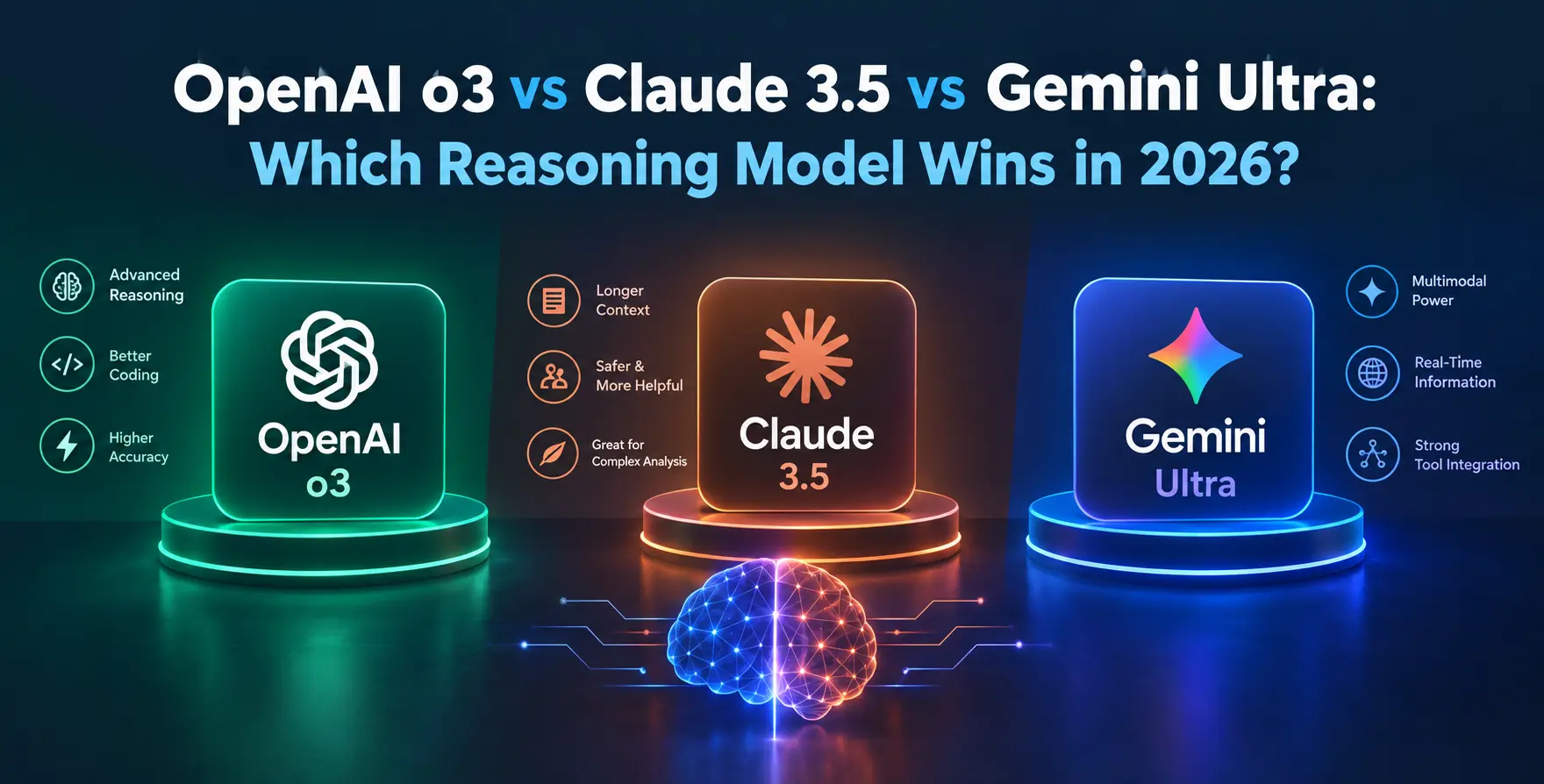
Comparing these systems requires evaluating raw logic power alongside execution efficiency. The following breakdown highlights key operational differences across the top platforms.
| Evaluation Metric |
OpenAI o3 |
Claude 3.5 |
Gemini Ultra |
| Primary Strength |
Deep logical chain planning |
Code context retention |
Native multimodal synthesis |
| Inference Cost Strategy |
Higher compute allocation |
Balanced token pricing |
Scale-optimized tiering |
| Code Verification |
Internal execution simulation |
Precise syntax adherence |
Ecosystem integration testing |
| Context Window |
200K tokens |
200K tokens |
2 Million tokens |
| Ideal Use Case |
Complex math and algorithm design |
Repository refactoring |
Video and doc analysis |
Code Generation Benchmark Performance
Software development efficiency relies heavily on accurate code output and minimal debugging loops. Evaluating OpenAI o3 vs Claude vs Gemini reveals distinct engineering advantages for specific developer workflows.
Core benchmarking observations across automated programming suites highlight clear differences:
- Superior handling of complex recursive algorithms
- Precise execution of strict typing constraints
- Rapid refactoring of legacy frameworks
- Automated generation of exhaustive unit tests
- Accurate implementation of API specifications
- Reduced syntax errors in generated functions
Mathematical and Logical Reasoning
Chain-of-Thought Execution
Complex logic requires structured multi-step verification before delivering results. Advanced models allocate additional compute cycles to parse obscure edge cases efficiently.
- Step-by-step mathematical proof generation
- Detection of hidden edge cases
- Formal logic verification protocols
- Algorithmic complexity optimization
Complex Problem Solving
When solving enterprise logic problems, models must evaluate competing constraints. High performance requires balancing efficiency against precision.
- Multi-variable optimization modeling
- Root cause error isolation
- System topology analysis
- Automated architectural decision making
Multimodal Reasoning and Vision Tasks
Modern engineering workflows frequently require processing non-text inputs such as architectural diagrams, UI mockups, and database schemas. Advanced multimodal processing transforms raw visual data into functional system architecture.
Models that natively handle visual logic allow engineers to convert wireframes directly into front-end code. This capability reduces the friction between product design teams and software developers.
Evaluating image comprehension alongside text reasoning provides a clearer picture of full-stack capabilities. Gemini Ultra and Claude lead in structured visual data extractions.
Enterprise Deployment and API Latency
Deploying models into production environments requires balancing raw accuracy against response speed. Teams evaluating o3 vs Claude reasoning must account for variable latency caused by internal chain-of-thought calculation time.
Key deployment considerations include several backend operational metrics:
- Time to first token response
- Overall query completion duration
- Rate limiting and concurrency caps
- SLA guarantees for enterprise endpoints
Higher deliberate reasoning depth naturally increases latency during complex query processing. Teams must implement asynchronous queuing architectures to maintain smooth user interfaces.
Cost Efficiency and Token Economics
Financial viability dictates how broadly organizations can deploy AI reasoning agents across their infrastructure. Selecting the best AI reasoning model 2026 requires calculating total cost of ownership rather than baseline prompt pricing.
Cost structures vary based on several workload characteristics:
- Input token volume per prompt
- Output token depth during reasoning
- Inference compute multiplier scaling
- Cached prompt discount structures
- Batch API processing availability
Choosing the Best AI Reasoning Model 2026
Selecting the optimal model depends on your team's specific workload demands and infrastructure requirements. Performing a thorough AI reasoning models comparison helps align technical capabilities with business goals.
Consider these core decision parameters before finalizing your stack:
- Dominant task type in daily workflows
- Latency constraints for end users
- Budget allocation per developer seat
- Required context window size
Most enterprise engineering teams adopt a multi-model router approach. Routing simple tasks to lightweight endpoints and reserving heavy reasoning models for complex refactoring maximizes efficiency.
Conclusion
The competition between OpenAI, Anthropic, and Google has produced remarkably capable models for enterprise engineering. Each platform offers specialized strengths, from deep logical deduction to massive context handling.
Understanding your team's primary bottlenecks allows you to select the model that yields the highest productivity gains. As reasoning capabilities advance, integrating these systems into daily developer pipelines will remain a key competitive advantage.


 In collaboration with