Table of Contents
- Introduction to Agentic AI
- What is Agentic AI?
- Agentic AI vs Generative AI
- Understanding AI Agents
- How Agentic AI Works
- Benefits of Agentic AI
- Challenges in Developing Agentic AI
- Real-World Applications of Agentic AI
- Future of Agentic AI
- Comparison of Agentic AI and Generative AI
- Role of AI Agents in Agentic AI
- Conclusion
Introduction to Agentic AI
Agentic AI is a new paradigm in artificial intelligence that focuses on creating autonomous agents capable of making decisions and taking actions.
This shift towards agentic behavior marks a significant departure from traditional AI approaches that primarily focused on processing and generating data.
With Agentic AI, the potential for AI systems to interact with their environment in a more proactive and adaptive manner is vast.
What is Agentic AI?
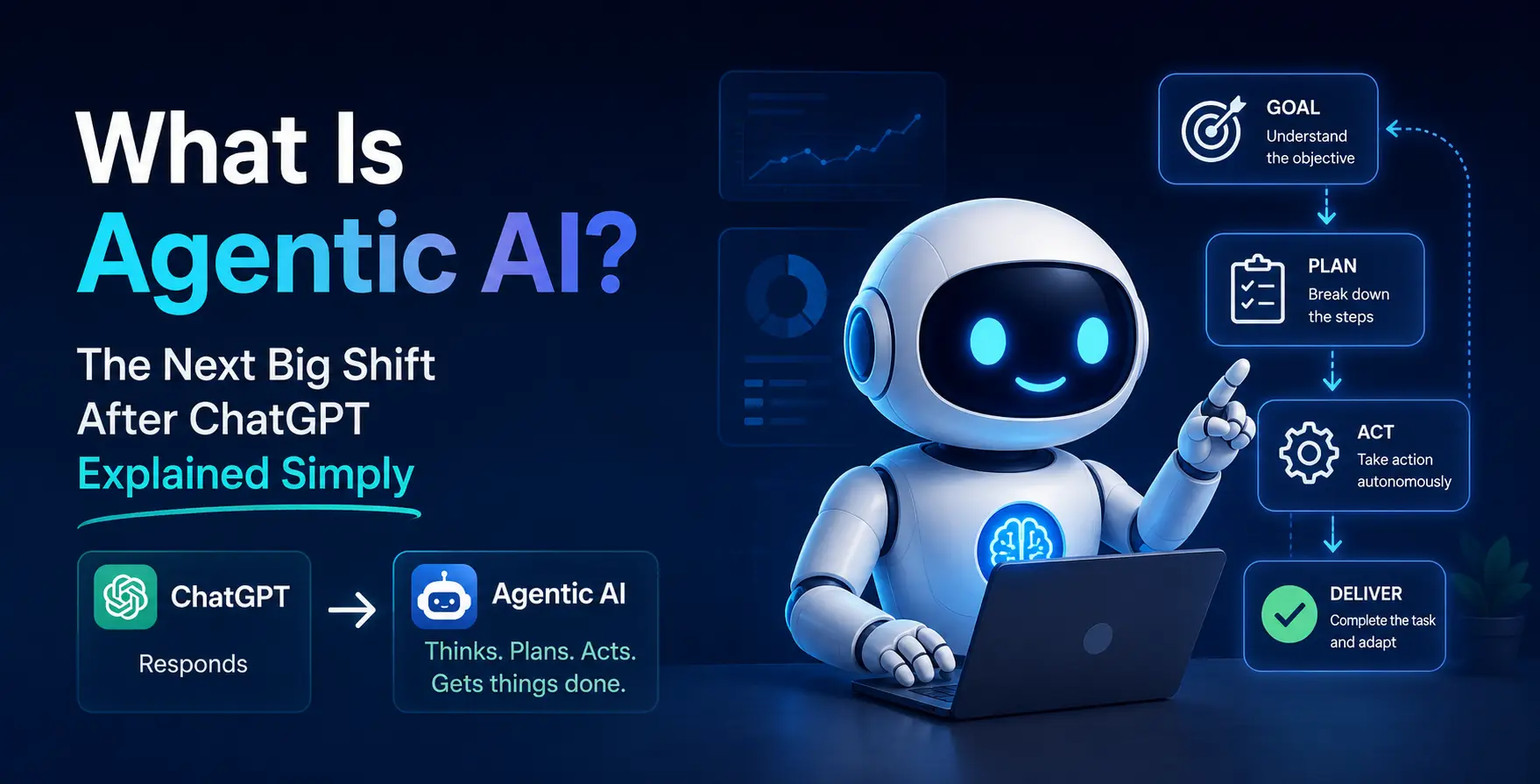
Agentic AI refers to the development of artificial intelligence systems that can act independently, making decisions based on their goals and environment.
These systems are designed to learn from their interactions and adapt to new situations, much like humans do.
The concept of What is Agentic AI encompasses not just the technology but also the ethical and societal implications of creating such autonomous entities.
Agentic AI vs Generative AI
While Generative AI focuses on creating content, such as text or images, Agentic AI vs Generative AI highlights a fundamental difference in their purposes and capabilities.
Agentic AI is about action and decision-making, whereas Generative AI is about creation and generation.
This distinction is crucial for understanding the potential applications and limitations of each type of AI.
- Different goals: Agentic AI aims for autonomy, while Generative AI focuses on creation.
- Distinct capabilities: Agentic AI involves decision-making, whereas Generative AI involves generation.
- Varying applications: Agentic AI can be used in robotics and autonomous vehicles, whereas Generative AI is used in content creation and data augmentation.
Understanding AI Agents
AI Agents are software programs that can perceive their environment and take actions to achieve their goals.
These agents can be simple, reacting to predefined rules, or complex, using machine learning to adapt to new situations.
The development of AI Agents is central to the advancement of Agentic AI, as they form the backbone of autonomous systems.
How Agentic AI Works
Agentic AI systems operate by continuously interacting with their environment, learning from these interactions, and adjusting their behavior accordingly.
This process involves complex algorithms that enable the AI to perceive, reason, and act upon its perceptions.
The effectiveness of Agentic AI depends on its ability to balance exploration and exploitation, ensuring it learns from new experiences without compromising its performance.
- Perception: The AI agent observes its environment.
- Reasoning: The AI interprets its observations and decides on actions.
- Action: The AI executes its decisions, affecting the environment.
- Learning: The AI adjusts its behavior based on the outcomes of its actions.
Benefits of Agentic AI
Agentic AI offers several benefits, including enhanced autonomy, improved decision-making, and increased efficiency.
By automating complex tasks and enabling systems to adapt to changing conditions, Agentic AI can significantly impact various industries.
Moreover, the potential for Agentic AI to assist in fields like healthcare, finance, and education is substantial, promising more personalized and responsive services.
Challenges in Developing Agentic AI
Despite its promises, developing Agentic AI poses significant challenges, including ensuring safety, addressing ethical concerns, and overcoming technical hurdles.
Creating AI systems that can act autonomously while aligning with human values and avoiding harm is a complex task.
Moreover, the reliability and transparency of Agentic AI decision-making processes are crucial issues that need to be addressed.
- Safety and control: Ensuring AI systems do not pose risks to humans or the environment.
- Ethical considerations: Aligning AI goals with human values and ethics.
- Technical challenges: Overcoming the complexities of creating autonomous, adaptive systems.
- Transparency and explainability: Understanding how AI makes its decisions.
- Regulation and governance: Establishing frameworks for the development and deployment of Agentic AI.
Real-World Applications of Agentic AI
Agentic AI has the potential to transform various sectors, from robotics and manufacturing to healthcare and finance.
By enabling systems to act autonomously and make decisions in real-time, Agentic AI can improve efficiency, reduce costs, and enhance customer experiences.
However, the successful integration of Agentic AI into real-world applications will depend on addressing the challenges associated with its development.
Future of Agentic AI
The future of Agentic AI is promising, with potential applications ranging from smart homes and cities to autonomous transportation systems.
As technology advances, we can expect to see more sophisticated AI agents capable of complex decision-making and adaptation.
However, this future also raises important questions about the role of humans in an increasingly automated world and the need for ethical guidelines in AI development.
Comparison of Agentic AI and Generative AI
| Agentic AI |
Generative AI |
| Focuses on autonomy and decision-making |
Focuses on content generation |
| Enables real-time adaptation and action |
Produces static or dynamic content based on input |
| Has applications in robotics, autonomous vehicles, and complex systems |
Has applications in content creation, data augmentation, and artistic expression |
Role of AI Agents in Agentic AI
AI Agents play a central role in Agentic AI, serving as the fundamental units of autonomous decision-making and action.
These agents can operate individually or collectively, forming complex systems that interact with their environment and each other.
The development of sophisticated AI Agents is key to unlocking the full potential of Agentic AI and realizing its applications across various domains.
Conclusion
Agentic AI represents a significant shift in the field of artificial intelligence, focusing on the development of autonomous, adaptive systems.
Understanding What is Agentic AI and its distinction from Generative AI is essential for grasping the potential and challenges of this emerging technology.
As Agentic AI continues to evolve, its impact on society, economy, and human life will be profound, necessitating careful consideration of its ethical, safety, and governance implications.


 In collaboration with