Table of Contents
- Introduction
- What Are AI Hallucinations?
- What Causes AI Hallucinations?
- Token Prediction Mechanics
- Overfitting and Pattern Matching
- Impact of AI Hallucinations in Production
- How to Reduce AI Hallucinations
- Retrieval-Augmented Generation
- Effective Prompt Engineering
- Model Evaluation and Observability
- RAG vs Traditional Prompting
- Best Practices for Developers
- Conclusion
Introduction
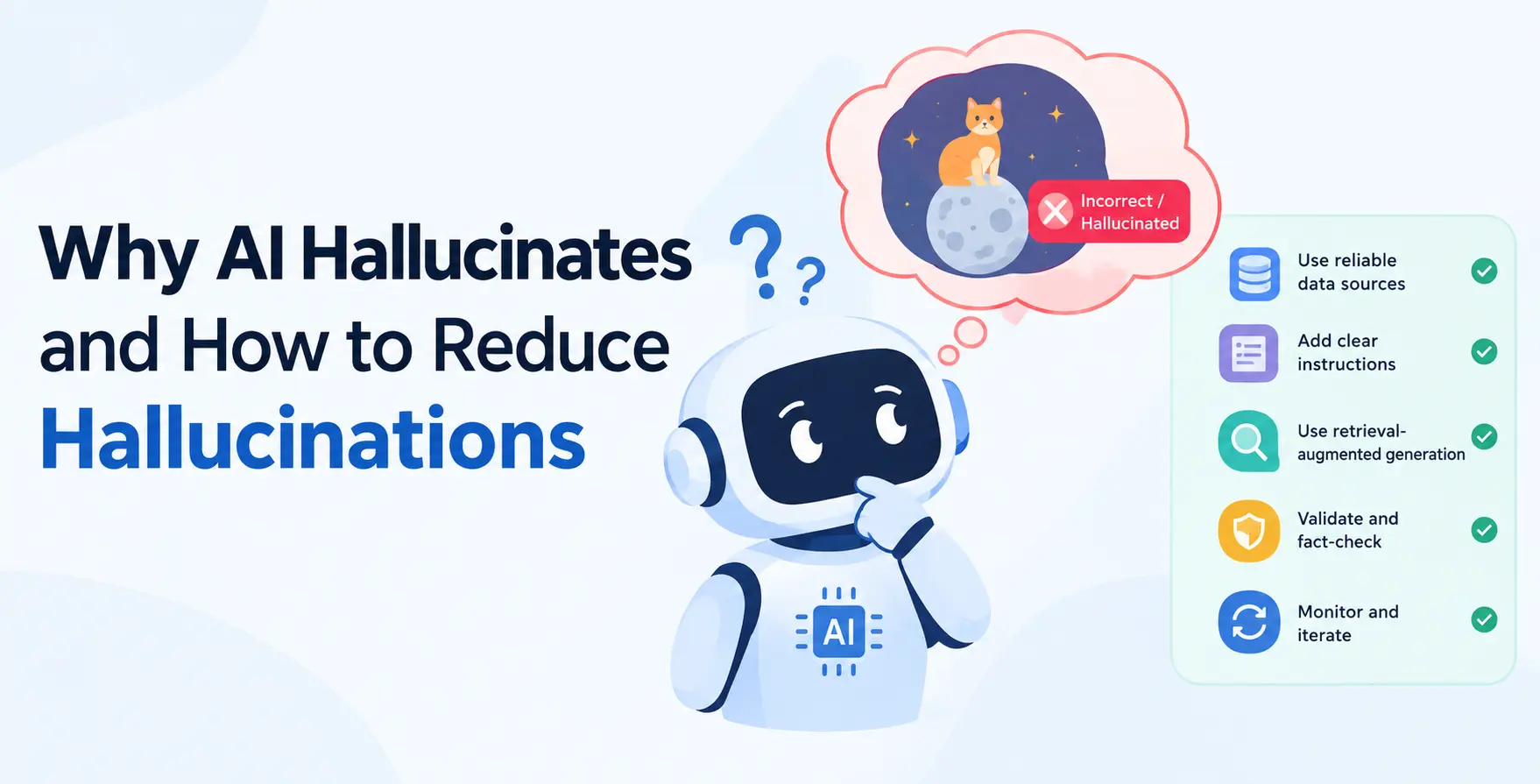
Large language models produce impressive results, but they sometimes generate confident falsehoods. Engineers and enterprise teams refer to these ungrounded responses as AI hallucinations.
Understanding why models make up facts is critical for deploying reliable software. In this guide, we explore the primary causes of generated errors and practical engineering techniques to prevent them.
What Are AI Hallucinations?
An AI hallucination occurs when a generative model outputs inaccurate or completely fictional information while presenting it as factual truth. The system speaks with absolute confidence regardless of whether its output is correct.
Unlike traditional software bugs caused by logic flaws, these failures stem from the probabilistic nature of neural networks. Modern large language models predict language without maintaining an internal record of ground truth.
Because these architectures lack explicit reasoning, they can invent non-existent citations, generate broken code, or state false historical facts. Detecting these errors requires systematic oversight.
What Causes AI Hallucinations?
To fix inaccurate model responses, engineering teams must first ask: What Causes AI Hallucinations?
Training Data Quality and Gaps
Generative models learn from massive Web-scale datasets that naturally contain outdated, contradictory, or incorrect facts.
- Outdated dataset entries
- Incomplete domain coverage
Next-Token Prediction Mechanics
Language models do not query structured databases to fetch facts during generation.
- Predicting probable word sequences
- Plausible wording over factual truth
- Cumulative error propagation in sequences
- Lack of real-time ground truth validation
Token Prediction Mechanics
Generative AI operates by calculating the statistical probability of the next word token in a sequence. When reliable context is missing, the algorithm selects words that simply sound plausible in context.
This core design explains why does AI hallucinate during technical explanations or complex reasoning tasks.
Understanding these underlying probabilistic behaviors helps developers anticipate where models are most likely to make mistakes.
- Probability distributions favor common phrasing
- Context windows lose long-range attention focus
- Sampling temperature introduces random variation
- Attention mechanisms prioritize output fluency
- Decoders complete phrases without checking validity
Because outputs are optimized for linguistic fluency, generated text often sounds convincing even when entirely incorrect.
Overfitting and Pattern Matching
When models overfit on specialized training data, they mirror superficial patterns rather than actual logic. They resolve user queries using familiar syntactic structures instead of verifying factual relationships.
Unlike traditional NLP models that relied on rigid linguistic rules, transformer models depend entirely on learned associations. This makes internal factual verification difficult without external search tools.
Impact of AI Hallucinations in Production
Deploying uncalibrated models into enterprise software workflows creates substantial technical and operational risks.
- Generated code introduces hidden security flaws
- Support chatbots deliver inaccurate customer policies
- Medical reference tools suggest invalid treatments
- Legal assistance tools reference nonexistent court cases
- Financial workflows process incorrect transaction data
- User trust degrades rapidly after errors
Mitigating these operational risks requires multi-layered application guardrails and continuous validation.
How to Reduce AI Hallucinations
Engineering teams often wonder how to reduce AI hallucinations effectively across modern software applications.
The solution requires moving beyond basic prompts toward systematic architecture-level interventions. Modern systems combine external context retrieval, structural limits, and automated monitoring tools.
Applying structured software engineering practices allows teams to ground generative outputs in verifiable enterprise data.
Retrieval-Augmented Generation
Connecting models directly to enterprise databases before generating text provides necessary factual context. Supplying verified documentation prevents the model from guessing missing details.
- Queries fetch relevant internal documents
- Context injection grounds answer generation
- Source attribution builds user trust
- Vector databases streamline relevant document search
Building a robust RAG pipeline ensures that system outputs reflect factual corporate knowledge rather than probabilistic guesses.
Effective Prompt Engineering
Clear system instructions restrict model behavior and discourage ungrounded creative guesses.
Applying proven prompt engineering strategies helps limit speculative outputs across complex queries.
- Explicitly instruct models to state unknown
- Provide few-shot examples of valid outputs
- Set temperature parameters closer to zero
- Enforce structured JSON output schemas
- Use step-by-step reasoning instructions
Model Evaluation and Observability
Production environments require continuous tracking to catch inaccurate responses before they reach end users.
Implementing rigorous AI model evaluation helps teams measure hallucination rates across application updates.
- Automated test suites track factual accuracy
- Telemetry catches low-confidence generations
- AI observability tools log hallucinated phrases
- Human feedback loops flag subtle errors
Systematic monitoring ensures that application updates improve overall accuracy without introducing regression errors.
RAG vs Traditional Prompting
Choosing between real-time data retrieval and standalone prompt execution significantly affects system factual accuracy.
| Feature |
Traditional Prompting |
RAG Architecture |
| Data Source |
Static model weights |
Dynamic external databases |
| Factual Accuracy |
Moderate to low |
High ground truth precision |
| Hallucination Risk |
High for specific facts |
Low when retrieval succeeds |
| Setup Effort |
Minimal API configuration |
Requires database indexing |
| Data Freshness |
Limited by training cutoff |
Updated in real time |
Best Practices for Developers
Developers building production AI applications should combine multiple architectural guardrails to maintain safety.
- Implement strict system instruction constraints
- Deploy small language models for targeted tasks
- Apply AI agent loop engineering patterns
- Cross-check outputs with validation models
- Restrict output formats using JSON schemas
- Fallback to human review on low confidence
Conclusion
Generative models offer immense capabilities, but their probabilistic architecture creates an inherent risk of hallucinations. Understanding these root causes empowers engineers to design systems that minimize ungrounded outputs.
By combining retrieval systems, structured prompts, and active model monitoring, organizations can confidently ship reliable AI software. Reducing hallucinations is an continuous process that requires disciplined software architecture.


 In collaboration with