Table of Contents
- Introduction to AI Engineering
- What is Prompt Engineering?
- What is Loop Engineering?
- Key Differences Between Prompt and Loop Engineering
- Benefits of Prompt Engineering
- Benefits of Loop Engineering
- Challenges in Implementing Loop Engineering
- Real-World Applications of Prompt and Loop Engineering
- Comparison of Prompt and Loop Engineering
- Best Practices for Implementing AI Agent Loop Engineering
- Prompt Engineering for AI Agents: Tips and Tricks
- Future of AI Engineering: Prompt vs. Loop
- Conclusion
Introduction to AI Engineering
AI engineering involves designing and developing intelligent systems. Two key approaches are Prompt Engineering and Loop Engineering.
Prompt Engineering focuses on crafting effective prompts. Loop Engineering involves creating loops for continuous improvement.
Understanding these concepts is crucial for AI development.
What is Prompt Engineering?
Prompt Engineering is the process of designing and optimizing text prompts. It aims to elicit specific responses from AI models.
This approach is essential for natural language processing tasks. Effective prompts can significantly improve model performance.
- Improves model accuracy
- Enhances response relevance
- Increases efficiency
What is Loop Engineering?
Loop Engineering, also known as AI Agent Loop Engineering, involves creating feedback loops. These loops enable AI agents to learn and adapt continuously.
This approach is vital for developing autonomous systems. It allows agents to refine their performance over time.
- Enables continuous learning
- Improves agent performance
- Enhances autonomy
Key Differences Between Prompt and Loop Engineering
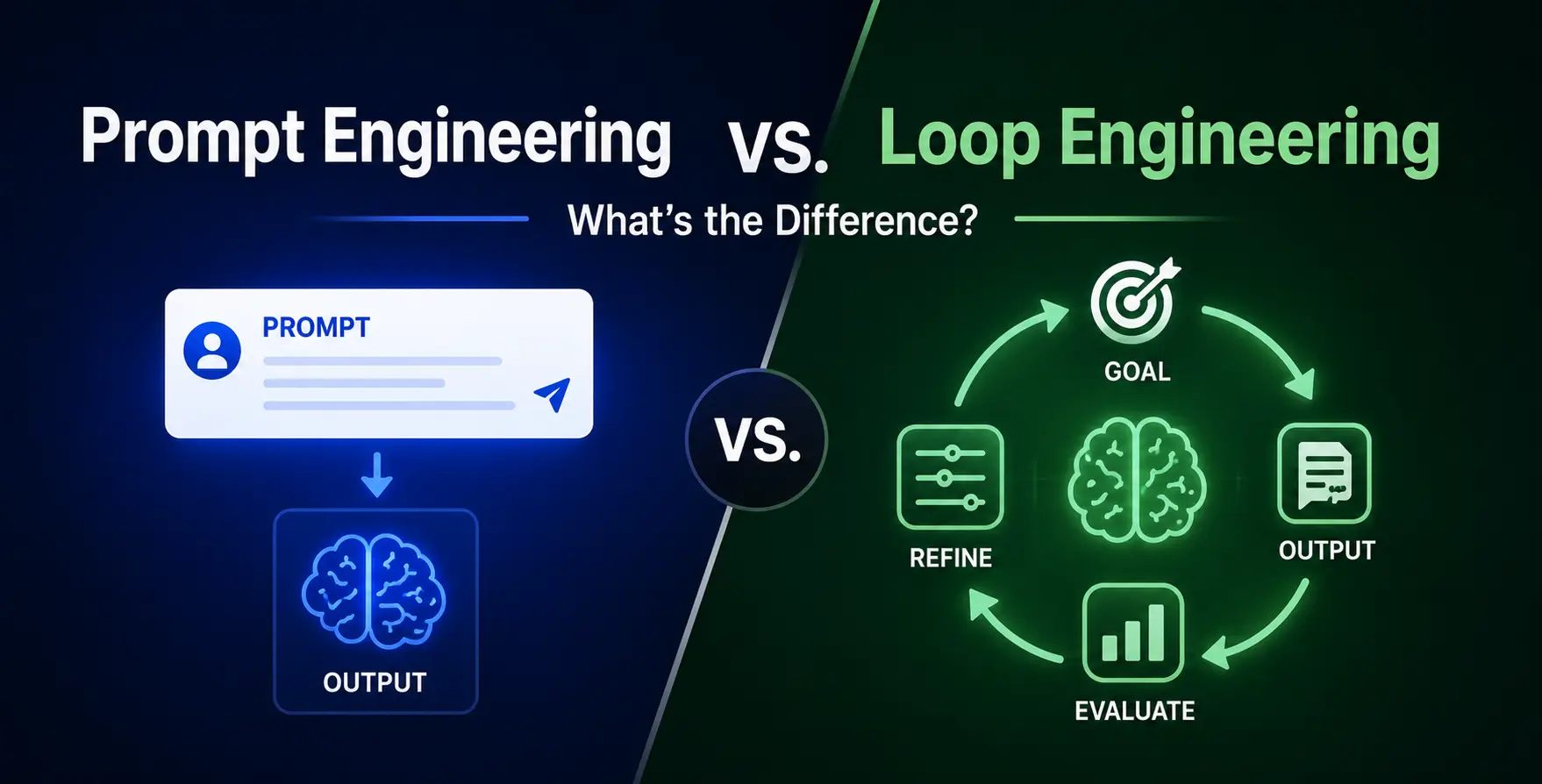
Prompt Engineering focuses on static prompts. Loop Engineering involves dynamic feedback loops.
Prompt Engineering is primarily used for discrete tasks. Loop Engineering is used for continuous improvement.
- Prompt Engineering: static, discrete tasks
- Loop Engineering: dynamic, continuous improvement
Benefits of Prompt Engineering
Prompt Engineering offers several benefits. It improves model accuracy, enhances response relevance, and increases efficiency.
Effective prompts can also reduce the need for extensive training data.
- Improves model accuracy
- Enhances response relevance
- Increases efficiency
- Reduces training data requirements
Benefits of Loop Engineering
Loop Engineering provides several benefits. It enables continuous learning, improves agent performance, and enhances autonomy.
This approach also allows for real-time adaptation to changing environments.
- Enables continuous learning
- Improves agent performance
- Enhances autonomy
- Allows for real-time adaptation
Challenges in Implementing Loop Engineering
Implementing Loop Engineering can be challenging. It requires careful design of feedback loops and continuous monitoring.
Additionally, Loop Engineering can be computationally intensive.
- Requires careful loop design
- Needs continuous monitoring
- Can be computationally intensive
Real-World Applications of Prompt and Loop Engineering
Prompt and Loop Engineering have various real-world applications. They are used in natural language processing, computer vision, and robotics.
These approaches can improve the performance of AI systems in these domains.
- Natural language processing
- Computer vision
- Robotics
Comparison of Prompt and Loop Engineering
| Prompt Engineering |
Loop Engineering |
| Static prompts |
Dynamic feedback loops |
| Discrete tasks |
Continuous improvement |
| Improves model accuracy |
Enables continuous learning |
Best Practices for Implementing AI Agent Loop Engineering
When implementing AI Agent Loop Engineering, it is essential to follow best practices. These include careful loop design, continuous monitoring, and real-time adaptation.
Additionally, it is crucial to consider the computational intensity of Loop Engineering.
- Careful loop design
- Continuous monitoring
- Real-time adaptation
- Consider computational intensity
Prompt Engineering for AI Agents: Tips and Tricks
Prompt Engineering for AI Agents requires careful consideration of prompt design. It is essential to craft effective prompts that elicit specific responses.
Additionally, it is crucial to continuously evaluate and refine prompts.
- Craft effective prompts
- Continuously evaluate prompts
- Refine prompts over time
Future of AI Engineering: Prompt vs. Loop
The future of AI engineering will likely involve a combination of Prompt and Loop Engineering. Both approaches have their strengths and weaknesses.
By understanding these approaches, developers can create more effective AI systems.
Conclusion
In conclusion, Prompt Engineering and Loop Engineering are two essential approaches in AI development. Understanding the differences between these approaches is crucial for effective AI engineering.
By following best practices and considering the strengths and weaknesses of each approach, developers can create more efficient and effective AI systems.


 In collaboration with