Table of Contents
- Introduction
- The Limitations of First-Generation RAG
- Defining RAG 2.0 Architectural Paradigm
- Fine-Tuning Embeddings and Generators Jointly
- Modern Contextual Chunking Techniques
- Vector vs Vectorless RAG Approaches
- RAG vs Traditional RAG Comparison
- Agentic Workflows in Advanced Retrieval
- Latency and Cost Optimization Strategies
- Enterprise Deployment Use Cases
- Monitoring and AI Observability
- Implementation Guidelines for Developers
- Conclusion
Introduction
Enterprise retrieval systems have evolved far beyond basic document keyword search.
Modern generative AI applications demand real-time access to accurate contextual data.
This shift in enterprise standards led directly to the creation of RAG 2.0.
First-generation architectures solved baseline information retrieval problems but created severe accuracy bottlenecks.
Upgrading your infrastructure ensures higher accuracy and significantly lower operational costs.
Here are the primary benefits driving this architectural shift:
- Unifies retrieval and generation seamlessly
- Reduces hallucination rates significantly
- Improves contextual precision for enterprises
- Optimizes system inference latency
The Limitations of First-Generation RAG
Early retrieval architectures connected static vector databases directly to off-the-shelf language models.
While this naive approach worked for basic semantic search, it failed in production enterprise environments.
Decoupled systems could not align retrieved documents with model preferences.
Decoupled Pipeline Bottlenecks
The primary issue was that the retriever and generator operated as completely isolated services.
Because the retriever did not understand generator output requirements, context windows filled with redundant text.
This disconnection produced high hallucination rates and inflated inference token costs.
Defining RAG 2.0 Architectural Paradigm
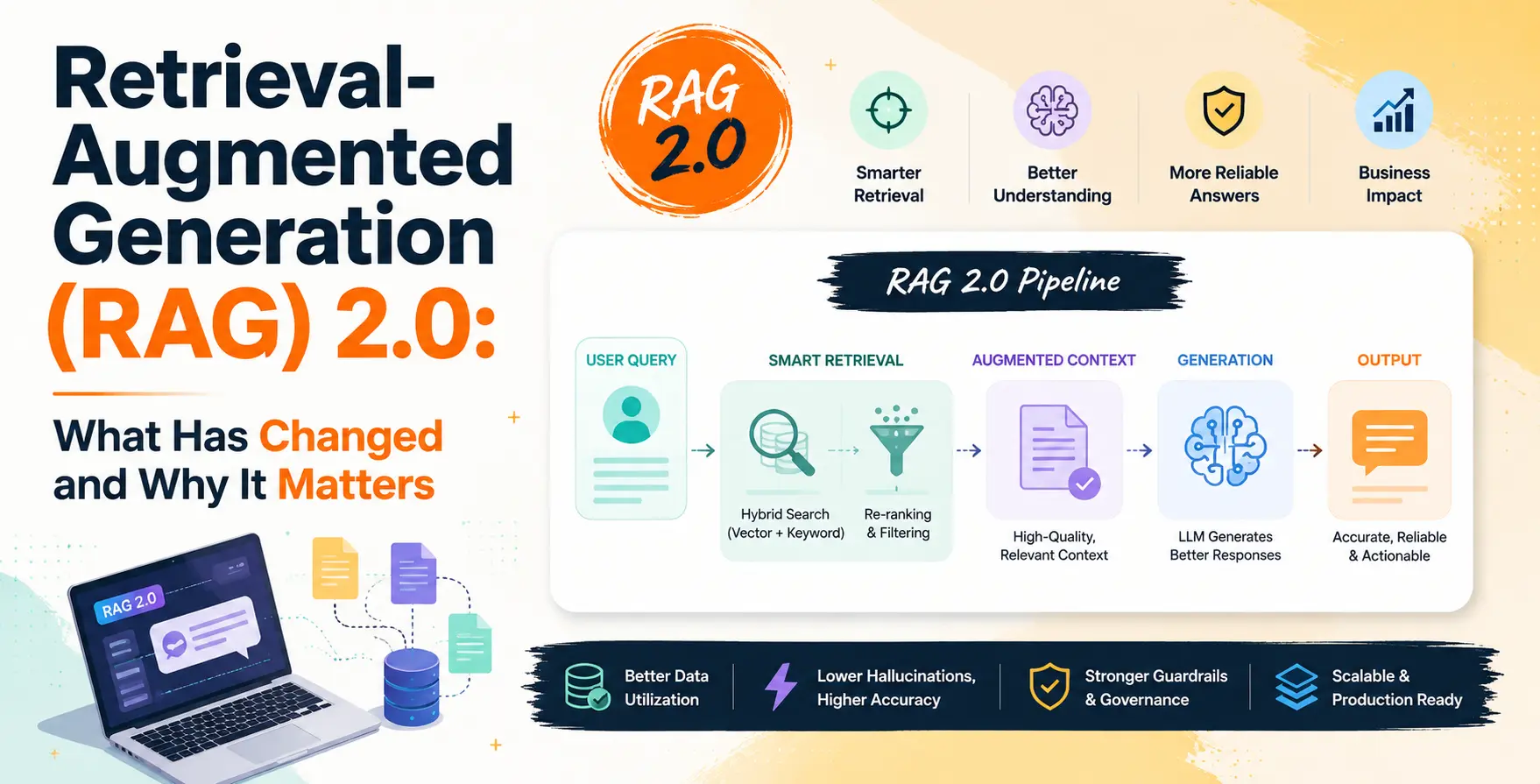
RAG 2.0 fundamentally changes how AI systems retrieve and synthesize contextual information.
Instead of treating document lookup as a static preprocessing step, the engine optimizes retrieval dynamic flows.
This modern architecture introduces essential system improvements:
- Joint optimization of embedding and generation models
- Dynamic retrieval during token generation
- Native support for structured enterprise data sources
- Integrated context reranking mechanisms
- Reduced computational overhead during inference
Fine-Tuning Embeddings and Generators Jointly
Building an effective modern RAG pipeline requires moving past generic pre-trained embedding models.
When embeddings and generators train together, backpropagation update signals pass across both neural networks.
This co-optimization aligns vector representations directly with text generation needs.
Mutual Component Alignment
Co-trained embeddings prioritize passages that directly improve generation accuracy.
As a result, language models receive focused inputs and produce far fewer factual errors.
This structural alignment is essential for high-stakes enterprise applications.
Modern Contextual Chunking Techniques
Traditional chunking strategies rely on rigid character counts or basic paragraph line breaks.
Implementing advanced RAG requires semantic-aware document splitting that preserves narrative context across chunk boundaries.
Key chunking methodologies include:
- Semantic boundary detection using density scores
- Hierarchical parent-child chunk associations
- Document tree structure preservation
- Overlapping dynamic context windows
Vector vs Vectorless RAG Approaches
Vector databases excel at capturing general semantic similarity across large unstructured text documents.
However, pure vector lookup struggles with exact code matching and structured table queries.
Incorporating vectorless RAG techniques allows systems to query relational databases directly alongside dense vectors.
This hybrid retrieval approach delivers distinct operational advantages:
- Higher accuracy for exact product code searches
- Direct integration with SQL enterprise data stores
RAG vs Traditional RAG Comparison
Understanding the difference between RAG vs traditional RAG helps teams make informed architectural decisions.
The structural changes between generations directly impact system precision, latency, and operational expenditure.
The comparison table below details these major architectural differences:
| Dimension |
Traditional RAG |
RAG 2.0 |
| Optimization Strategy |
Decoupled independent pipelines |
End-to-end joint training |
| Retrieval Speed |
High latency search spikes |
Streaming dynamic retrieval |
| Context Quality |
Frequent top-k passage noise |
Contextual reranking filtering |
| Data Processing |
Static text chunk splitting |
Hierarchical dynamic chunking |
| Hallucination Rate |
Moderate to high occurrence |
Significantly reduced errors |
Upgrading to modern patterns directly solves traditional throughput and context relevance problems.
Agentic Workflows in Advanced Retrieval
Modern retrieval architectures increasingly leverage agentic AI to solve complex multi-step user queries.
Rather than executing a single vector search, autonomous logic determines search strategies dynamically.
Dynamic Query Decomposition
Complex prompts break down into targeted sub-queries sent to specialized data indexes.
Here are the key planning phases:
- Deconstructing complex prompts into sub-tasks
- Selecting relevant tools and data indexes
- Filtering retrieved outputs sequentially
- Synthesizing answers across sources
Iterative Retrieval Cycles
If initial lookup results are insufficient, agents adjust search parameters automatically.
This loop improves output completeness through clear verification steps:
- Evaluating answer coverage after lookup
- Generating targeted follow-up queries
- Resolving conflicting source records
- Verifying source credibility dynamically
Latency and Cost Optimization Strategies
Inference costs and user-perceived delay remain major adoption barriers for high-volume enterprise systems.
Applying AI model latency optimization strategies drastically improves API throughput while cutting compute costs.
High-throughput platforms require aggressive context caching and model compression.
Caching and Model Quantization
Semantic caching stores prior retrieval results to serve identical contextual queries instantly.
Combining semantic caches with quantized embedding models minimizes memory consumption under peak loads.
These operational savings allow platforms to scale without linear cost increases.
Enterprise Deployment Use Cases
Production adoption spans financial analysis, medical research, and automated customer support platforms.
Organizations deploy advanced retrieval pipelines to handle critical enterprise automation needs:
- Automated regulatory document compliance audit
- Real-time financial statement reconciliation
- Clinical trial protocol lookup systems
- Multi-tenant enterprise knowledge search
- Technical software documentation assistance
Monitoring and AI Observability
Deploying models into production requires continuous performance evaluation and metric tracking.
Implementing full stack AI observability ensures software engineers catch context drift and accuracy degradation early.
Key operational metrics include:
- Context relevance and grounding scores
- Retrieval latency per pipeline step
- Vector index hit rate tracking
- Token consumption and cost tracking
Implementation Guidelines for Developers
Transitioning legacy codebases requires careful planning and systematic evaluation across all data tiers.
Engineers should establish continuous AI model evaluation pipelines before deploying architectural changes.
Follow these core engineering steps during implementation:
- Audit current chunking strategy efficiency
- Evaluate domain-specific fine-tuned embeddings
- Implement hybrid keyword-vector search indexes
- Add lightweight re-ranking model layers
- Integrate telemetry for latency tracking
- Test edge cases with automated benchmarks
Conclusion
RAG 2.0 represents a crucial shift from loosely coupled retrieval scripts to unified intelligence engines.
By combining end-to-end training, dynamic chunking, and intelligent routing, organizations unlock unprecedented accuracy.
Adopting these advanced patterns ensures your enterprise AI applications remain fast, reliable, and cost-effective.


 In collaboration with