Table of Contents
- Introduction
- What Is AI Observability?
- Traditional Software Monitoring vs AI Observability
- Why Machine Learning Models Fail in Production
- Core Components of AI Observability
- Understanding Concept Drift and Data Drift
- Monitoring Model Performance Metrics
- Tracking Operational Infrastructure
- Step-by-Step AI Model Monitoring Workflow
- Selecting the Right AI Observability Platform
- Integrating AI Observability into MLOps
- Best Practices for Production AI Systems
- Conclusion
Introduction
Shipping a machine learning model to production is only the beginning of its lifecycle.
Unlike traditional software, AI systems degrade silently as real-world data changes over time.
Without continuous oversight, silent failures can lead to poor business decisions and degraded user experiences.
Deploying models into production environments requires continuous tracking of data inputs, predictions, and underlying system health.
Modern engineering teams rely on specialized tools to maintain visibility into complex model behaviors.
What Is AI Observability?
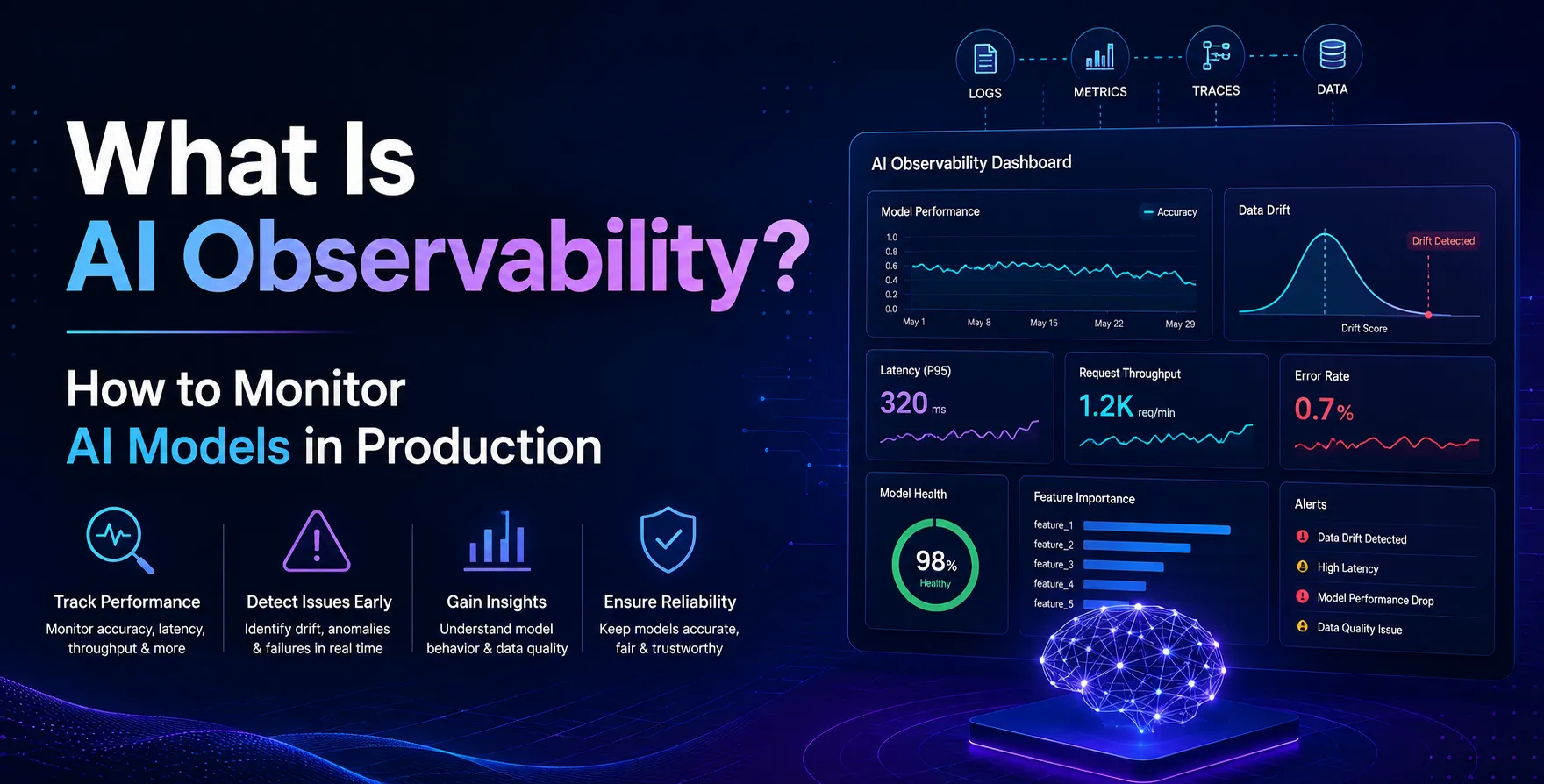
AI observability is the practice of tracking, diagnosing, and understanding the health of machine learning models in production environments.
It goes beyond basic system uptime by analyzing inputs, internal model behaviors, and output accuracy over time.
- Tracks data drift and schema changes in real time
- Provides deep insight into prediction distribution patterns
By capturing detailed telemetry, teams can quickly troubleshoot unexpected model behaviors and prevent silent system failures.
Traditional Software Monitoring vs AI Observability
Traditional monitoring tracks infrastructure metrics like CPU usage, memory consumption, and API response latency.
While essential, these metrics fail to show whether a model is making correct predictions on incoming data.
| Metric Focus |
Traditional Monitoring |
AI Observability |
| Primary Target |
Server health and application uptime |
Model quality, data inputs, and outputs |
| Failure Mode |
System crashes and explicit error codes |
Silent quality degradation and drift |
| Data Tracing |
HTTP requests and database queries |
Feature distributions and model embeddings |
| Root Cause Analysis |
Log traces and stack traces |
Data drift analysis and feature attribution |
| Key Stakeholders |
DevOps and Site Reliability Engineers |
Data Scientists and Machine Learning Engineers |
Implementing deep observability ensures teams catch behavioral issues before end users experience degraded model outputs.
Why Machine Learning Models Fail in Production
Machine learning models depend heavily on the environment where they operate.
When real-world conditions shift, the assumptions made during model training quickly become invalid.
Changes in user behavior, market trends, or upstream data pipelines can instantly degrade model quality.
Code errors are usually easy to spot because they throw explicit exception errors.
Model failures are much harder to detect because the application continues to run normally while generating low-quality outputs.
Core Components of AI Observability
Building a resilient system requires deep visibility across every layer of the machine learning pipeline.
- Input feature distribution monitoring
- Model prediction distribution tracking
- Data quality and schema validation
- Actual ground truth alignment
- Operational infrastructure performance metrics
Understanding Concept Drift and Data Drift
Data Drift
Data drift occurs when the statistical properties of input features change over time.
- Upstream software pipeline updates
- Seasonal changes in consumer behavior
- Sensors or hardware calibration shifts
- Changes in target audience demographics
Detecting input shifts early helps engineering teams update data processing pipelines before outputs degrade.
Concept Drift
Concept drift happens when the statistical relationship between input features and target labels changes.
- Macroeconomic economic structural shifts
- Evolving fraud patterns in financial applications
- Sudden changes in user intent trends
- Regulatory policy updates changing classifications
When concept drift occurs, models must be retrained using fresh dataset samples.
Monitoring Model Performance Metrics
Evaluating models in production requires tracking metrics that align directly with real business outcomes.
Standard production model evaluation involves monitoring output distributions against historical baselines to flag anomalies early.
In many real-world tasks, evaluating precision vs recall provides a clearer picture of failure modes than raw accuracy alone.
When ground truth labels are delayed, teams rely on proxy metrics to estimate model health in real time.
Tracking Operational Infrastructure
High model accuracy is useless if the inference pipeline cannot deliver responses within acceptable latency limits.
- Inference latency per request
- GPU and TPU hardware utilization
- Memory consumption bottlenecks
- API request throughput volume
- Batch job execution durations
- Token consumption and generation speed
Applying AI inference optimization techniques helps real-time AI systems maintain low latency under heavy traffic spikes.
Step-by-Step AI Model Monitoring Workflow
Establishing an effective AI monitoring strategy requires a systematic operational workflow across your deployment pipeline.
- Collect incoming input features and output predictions during live inference runs
- Calculate statistical distance metrics against baseline datasets from training runs
- Trigger automated alerts when feature drift crosses pre-configured threshold limits
- Root-cause performance drops by isolating failing features or specific data slices
Selecting the Right AI Observability Platform
Selecting an enterprise AI observability platform depends on your stack complexity, security needs, and dataset scale.
- Support for structured and unstructured datasets
- Automated baseline profiling capabilities
- Out-of-the-box integration with current pipelines
- Customizable alerting thresholds and notification routes
Choosing a tool that integrates smoothly with existing developer tooling reduces friction for engineering teams.
Integrating AI Observability into MLOps
Observability should never be an afterthought bolted onto a production system after deployment.
It must be embedded directly into your automated MLOps pipeline to enable continuous monitoring and automated retraining.
- Automates retraining triggers based on drift alerts
- Logs feature stats during CI/CD test runs
- Enables seamless model rollback mechanisms
- Maintains full lineage audit logs for compliance
Connecting telemetry directly to automated workflows ensures continuous reliability without requiring manual intervention.
Best Practices for Production AI Systems
Maintaining reliable machine learning systems in production requires clear operational guidelines.
Start by setting baseline metrics during training and validation phases before pushing models live.
- Establish clear baseline reference datasets
- Monitor inputs, outputs, and infrastructure simultaneously
- Set actionable alerting thresholds to avoid alert fatigue
- Automate model fallback to rule-based backups
- Review drift logs regularly during team triage
Following structured operational standards ensures long-term stability and high system availability.
Conclusion
Maintaining production machine learning systems requires continuous monitoring across data pipelines, model predictions, and infrastructure performance.
Implementing comprehensive AI observability enables engineering teams to catch data drift, prevent silent model failures, and ensure consistent business value.


 In collaboration with