Table of Contents
- Introduction
- The Transformer Foundation
- What is BERT?
- How BERT Works
- BERT Training Objectives
- Strengths of BERT
- Limitations of BERT
- What is GPT?
- How GPT Works
- GPT Training Objective
- Strengths of GPT
- Limitations of GPT
- BERT vs GPT: Architecture Comparison
- Example: BERT vs GPT
- Real-World Applications of BERT
- Real-World Applications of GPT
- The Evolution of GPT
- The Evolution of BERT
- Which Model Should You Choose?
- Future of Language Models
- Conclusion
Introduction
Over the last few years, Artificial Intelligence has undergone a massive transformation, primarily due to the emergence of large language models (LLMs). Among the most influential architectures are BERT (Bidirectional Encoder Representations from Transformers) and GPT (Generative Pre-trained Transformer). Both models are built upon the Transformer architecture, yet they serve fundamentally different purposes.
BERT excels at understanding language, while GPT specializes in generating language. Understanding the differences between these architectures is essential for developers, data scientists, and AI enthusiasts who want to select the right model for their use cases.
- BERT focuses on language understanding.
- GPT focuses on language generation.
- Both are based on Transformer architecture.
The Transformer Foundation
Before understanding BERT and GPT, it is important to understand the Transformer architecture. Traditional NLP models relied on RNNs and LSTMs, which struggled with long-range dependencies and parallel processing.
The Transformer introduced self-attention, allowing models to understand relationships between words regardless of their positions in a sentence.
- Processes sequences in parallel.
- Captures long-range dependencies.
- Uses self-attention mechanisms.
The Transformer consists of two main components:
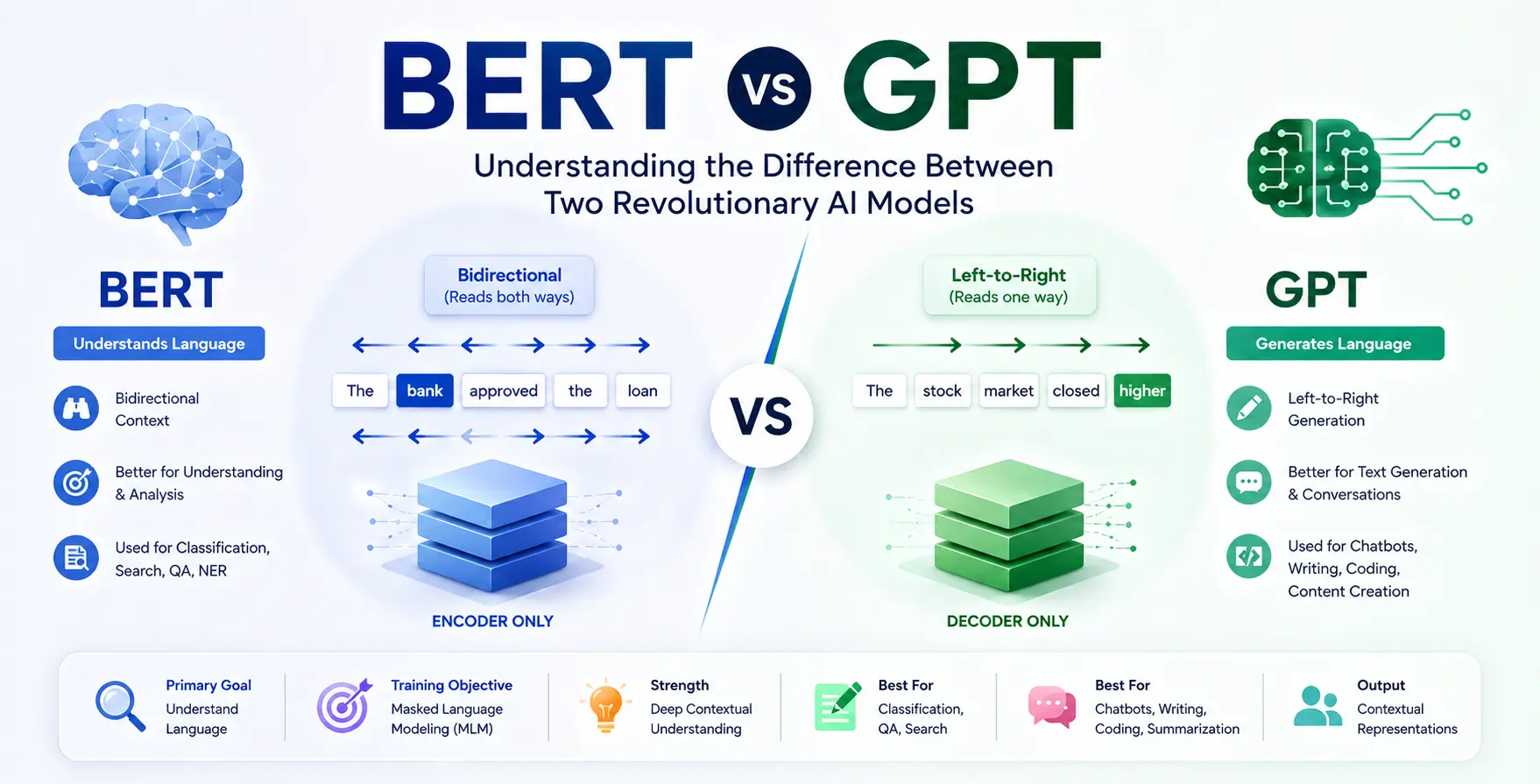
BERT uses only the Encoder stack, while GPT uses only the Decoder stack.
What is BERT?
BERT stands for Bidirectional Encoder Representations from Transformers. Introduced by Google in 2018, it revolutionized NLP by enabling machines to understand context from both directions simultaneously.
For example, BERT understands the difference between:
- "The bank approved the loan."
- "The fisherman sat by the bank."
Because it analyzes words before and after the target word, it can determine the correct meaning based on context.
How BERT Works
BERT uses the Transformer Encoder and processes text bidirectionally. Unlike traditional models that read left-to-right, BERT simultaneously considers words before and after a token.
- Uses Transformer Encoder.
- Reads context in both directions.
- Provides deep contextual understanding.
BERT Training Objectives
1. Masked Language Modeling (MLM)
During training, some words are hidden from the model.
The cat [MASK] on the mat.
The model predicts the missing word, forcing it to understand surrounding context.
2. Next Sentence Prediction (NSP)
BERT learns whether one sentence logically follows another. This helps improve sentence-level understanding tasks.
Strengths of BERT
- Excellent language understanding.
- Strong contextual comprehension.
- Superior classification performance.
- Effective question answering.
- Named entity recognition capabilities.
Limitations of BERT
- Not designed for long-form text generation.
- Computationally expensive.
- Limited conversational abilities.
What is GPT?
GPT stands for Generative Pre-trained Transformer. Developed by OpenAI, GPT specializes in generating human-like text.
Rather than understanding context bidirectionally, GPT predicts the next word in a sequence and generates text one token at a time.
How GPT Works
GPT uses only the Transformer Decoder. It processes text from left to right and continuously predicts the next token.
- Uses Transformer Decoder.
- Generates text sequentially.
- Optimized for language generation.
GPT Training Objective
GPT uses Autoregressive Language Modeling. It learns by predicting the next token repeatedly across billions of examples.
- Learns grammar.
- Learns facts and patterns.
- Learns writing styles.
- Learns programming languages.
Strengths of GPT
- Natural text generation.
- Strong conversational AI capabilities.
- Content creation.
- Code generation.
- Few-shot learning.
Limitations of GPT
- May hallucinate facts.
- Requires significant computing resources.
- Knowledge depends on training data.
- Can generate biased outputs.
BERT vs GPT: Architecture Comparison
| Feature |
BERT |
GPT |
| Architecture |
Encoder Only |
Decoder Only |
| Processing Direction |
Bidirectional |
Left-to-Right |
| Primary Goal |
Language Understanding |
Language Generation |
| Training Objective |
Masked Word Prediction |
Next Word Prediction |
| Best For |
Classification, Search, QA |
Chatbots, Writing, Coding |
Example: BERT vs GPT
Consider the sentence:
The movie was surprisingly good.
BERT determines sentiment and classifies it as positive. GPT can generate a complete movie review based on the prompt.
Real-World Applications of BERT
- Search engines.
- Financial sentiment analysis.
- Customer support ticket classification.
- Intent detection.
- Question answering systems.
Real-World Applications of GPT
- AI chatbots.
- Content generation.
- Software development assistance.
- Education and tutoring.
- Summarization.
The Evolution of GPT
- GPT-1 (2018) – 117 Million Parameters
- GPT-2 (2019) – 1.5 Billion Parameters
- GPT-3 (2020) – 175 Billion Parameters
- GPT-4 and Beyond – Improved reasoning and multimodal capabilities
The Evolution of BERT
- RoBERTa
- ALBERT
- DistilBERT
- FinBERT
- BioBERT
Which Model Should You Choose?
Choose BERT if your goal is:
- Sentiment analysis
- Classification
- Entity recognition
- Search optimization
- Question answering
Choose GPT if your goal is:
- Chatbots
- Content creation
- Coding assistants
- Text generation
- Conversational AI
Future of Language Models
The distinction between understanding and generation is becoming increasingly blurred. Modern AI systems combine retrieval, reasoning, multimodal capabilities, tool usage, and agentic workflows.
Future AI models are expected to merge the strengths of both BERT and GPT, creating systems capable of understanding, reasoning, and generating content with unprecedented effectiveness.
Conclusion
BERT and GPT are two landmark innovations in Natural Language Processing. Although both are built on Transformer architecture, they were designed for different objectives.
BERT excels at understanding language through bidirectional context, making it ideal for classification, sentiment analysis, and information extraction. GPT specializes in generating coherent and human-like text, powering modern chatbots, content creation tools, and coding assistants.
Understanding their differences helps organizations and developers select the right model for their specific requirements.


 In collaboration with