Table of Contents
- Introduction
- Understanding Heroku Postgres Advanced
- Core Features of Advanced Tiers
- The Role of Heroku Postgres Follower Pools
- Implementing Heroku Postgres Logical Replication
- Scaling Strategies for Database Performance
- When to Upgrade Your Database Plan
- Managing Connection Constraints
- Database Maintenance and Performance
- Optimizing for High Traffic
- Handling Data Growth
- Deployment Considerations
- Final Thoughts
Introduction
Choosing the right database infrastructure is a foundational decision for any high-growth application. Developers often start with entry-level plans, but as traffic increases, these configurations eventually hit their limits.
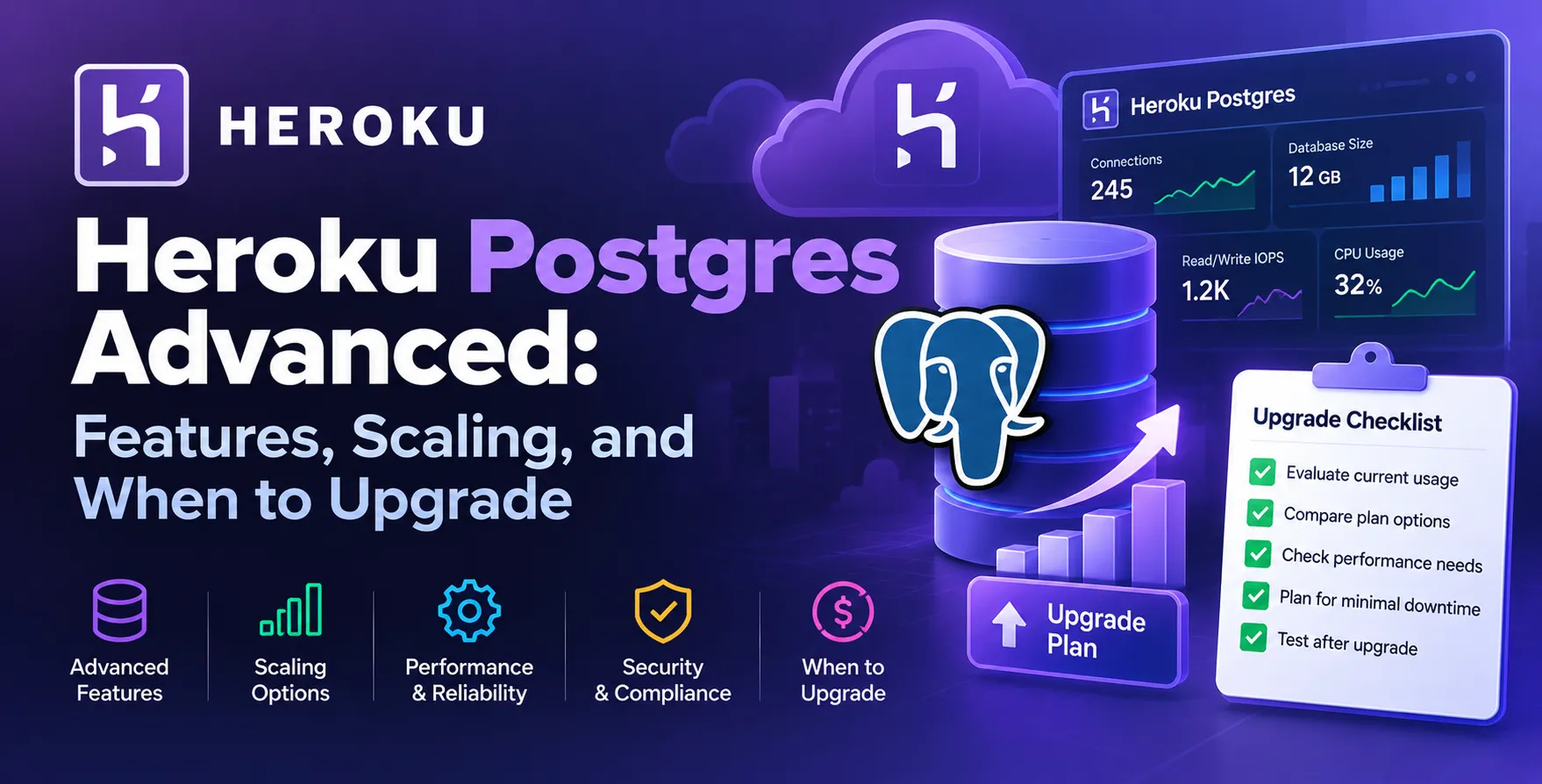
Heroku Postgres Advanced offers a suite of tools designed to handle enterprise-grade workloads. Understanding these capabilities is essential for maintaining a stable and performant backend.
Understanding Heroku Postgres Advanced
The transition toward more robust database tiers is rarely just about raw memory or storage capacity. It is about accessing architectural features that enable high availability and operational flexibility.
When your application demands lower latency and better fault tolerance, moving beyond basic plans becomes a necessity. These tiers introduce advanced capabilities that allow teams to manage data at scale without sacrificing reliability.
- Increased memory limits for query caching
- Enhanced storage performance for write-heavy apps
- Priority support for critical production issues
- Advanced monitoring and diagnostic tools
Core Features of Advanced Tiers
Upgrading your database tier unlocks functionalities that go far beyond simple capacity increases. These features are built to address the complexities of modern cloud-native environments.
They provide the foundation for building resilient systems that can survive hardware failures. This reliability is built into the platform architecture.
- Automated backups with point-in-time recovery
- Enhanced security features like disk encryption
- Support for specialized extensions
- High availability through automated failover
The Role of Heroku Postgres Follower Pools
For applications experiencing heavy read traffic, managing database load is a constant challenge. Heroku Postgres follower pools provide a scalable solution by offloading read operations to secondary instances.
This architecture allows your primary instance to focus entirely on write operations. By separating read and write traffic, you effectively double or triple your throughput capabilities.
- Distributing read queries across multiple nodes
- Reducing latency for global user bases
- Improving primary database stability
- Simplifying horizontal read scaling
Implementing Heroku Postgres Logical Replication
Modern data pipelines often require moving data between different systems for analytics or integration purposes. Heroku Postgres logical replication provides a flexible way to stream database changes in real time.
This functionality is crucial when you need to sync data between different regions or cloud providers. It serves as the backbone for complex, distributed data architectures.
- Real-time data synchronization across databases
- Building reliable event-driven pipelines
- Enabling zero-downtime database migrations
- Supporting cross-version data upgrades
Scaling Strategies for Database Performance
Scaling your infrastructure requires a proactive approach rather than a reactive one. You must identify performance bottlenecks before they impact your users.
Applying proper PostgreSQL partitioning for large tables can drastically improve query efficiency. Similarly, focusing on PostgreSQL indexing best practices for web applications ensures that your most frequent queries remain lightning fast.
| Scaling Method |
Primary Benefit |
Complexity Level |
| Vertical Scaling |
Increased CPU/Memory |
Low |
| Horizontal Read Scaling |
Throughput for Reads |
Medium |
| Database Partitioning |
Large Table Management |
High |
| Logical Replication |
Data Sync/Migration |
High |
When to Upgrade Your Database Plan
Knowing when to upgrade is often more art than science. You should monitor your database metrics closely to identify trends that indicate an impending capacity wall.
High CPU utilization and frequent memory swapping are clear signals that your current tier is insufficient. If you are constantly hitting connection limits, an upgrade is likely necessary to maintain service levels.
- Consistent high CPU usage
- Frequent disk I/O bottlenecks
- Reaching connection count limits
- Need for stricter compliance requirements
Managing Connection Constraints
Database connections are a finite resource that can quickly become a bottleneck. High concurrency environments often overwhelm the standard limits of entry-level plans.
Learning how to configure PostgreSQL connection pooling with PgBouncer effectively manages these requests. This setup prevents your database from crashing under a sudden spike in concurrent user activity.
- Reducing overhead of new connections
- Improving memory usage efficiency
- Preventing connection exhaustion errors
- Optimizing resource utilization
Database Maintenance and Performance
Even the most powerful database hardware will degrade if maintenance is neglected. Routine tasks are the only way to ensure long-term stability.
Prioritizing PostgreSQL VACUUM best practices to keep databases fast is essential for cleaning up dead tuples. Without regular maintenance, bloated tables will eventually slow down even the most optimized queries.
- Automated cleanup of dead records
- Regular statistics updates for query planner
- Monitoring for table bloat issues
- Managing index fragmentation
Optimizing for High Traffic
High-traffic applications require a multifaceted approach to performance. You cannot rely on a single optimization technique to solve every problem.
Developers must combine efficient schema design with smart query strategies. This ensures that your database remains responsive regardless of the load.
- Implementing efficient caching strategies
- Optimizing complex join operations
- Monitoring query execution plans
- Reducing unnecessary data fetching
Handling Data Growth
As your application matures, your data footprint will naturally increase. You need a strategy to manage this growth without incurring exorbitant costs.
Archiving older data or using specialized storage tiers can help keep your primary database lean. A clean database is always faster than a cluttered one.
- Archiving historical data sets
- Using appropriate data types
- Regularly auditing unused indexes
- Monitoring storage trends
Deployment Considerations
Smooth updates require careful planning and testing. You should never perform major changes in production without a clear rollback strategy.
Standardizing your deployment services ensures that database schema migrations are handled safely. Leveraging containerization and automated pipelines makes these complex operations predictable and repeatable.
- Testing migrations in staging environments
- Automating schema migration scripts
- Ensuring zero-downtime deployments
- Maintaining detailed environment logs
Final Thoughts
Heroku Postgres Advanced offers the power and flexibility needed to scale modern applications. From utilizing follower pools to managing logical replication, these features provide the tools to handle enterprise-scale workloads.
Always monitor your performance metrics and perform routine maintenance to keep your database healthy. When the time comes to upgrade, do so proactively to ensure your application remains fast and reliable for your users.


 In collaboration with