Table of Contents
- Introduction to Claude Fable 5.1
- Understanding Claude API Pricing Models
- Breaking Down Claude Fable 5.1 Cost
- Input vs Output Token Economics
- Rate Limits and API Quotas
- Managing Anthropic API Costs Effectively
- Comparing Claude Fable 5.1 to Other Models
- Integration Best Practices for Cost Efficiency
- Monitoring Your API Consumption
- Common Pitfalls in API Cost Management
- Scaling Your AI Infrastructure
- Security Considerations for API Usage
- Future Proofing Your AI Architecture
- Conclusion
Introduction to Claude Fable 5.1
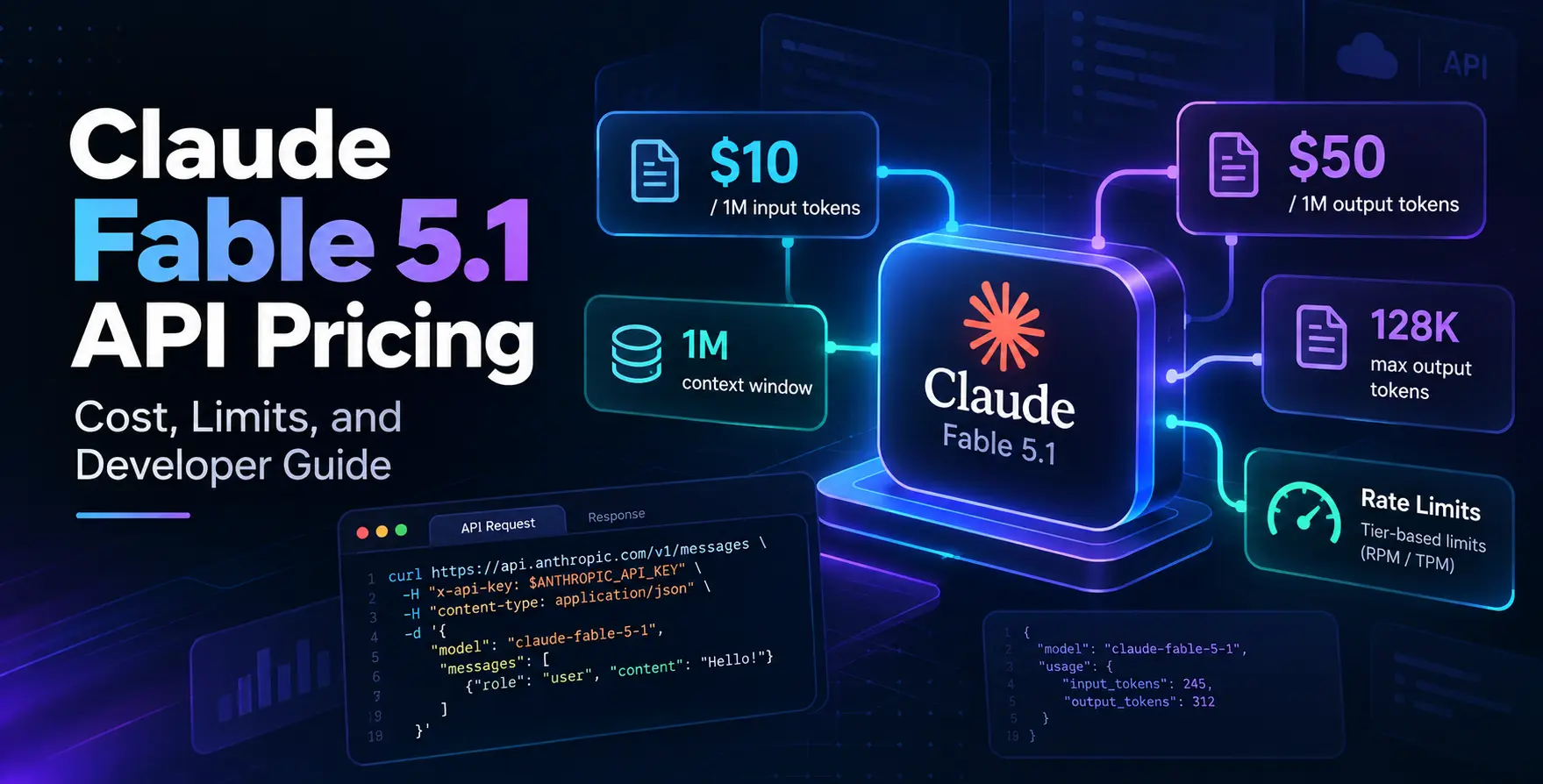
Choosing the right model for your application involves balancing performance with budget. Claude Fable 5.1 represents a significant milestone in generative AI, offering high reasoning capabilities for complex developer tasks.
Understanding the underlying financial structure is critical for any team building production-grade software. This guide breaks down the essential components of managing your AI infrastructure expenses.
Understanding Claude API Pricing Models
The Claude API pricing structure follows a standard consumption-based model common in modern AI development. You pay for what you use, calculated by the number of tokens processed during each request.
This approach allows startups and enterprises to scale their usage incrementally. By aligning expenses with actual consumption, teams can avoid the overhead of fixed monthly licensing fees.
- Predictable billing based on tokens
- Granular control over request volume
- Tiered access for high-volume users
- Transparent per-million-token metrics
Breaking Down Claude Fable 5.1 Cost
The total Claude Fable 5.1 cost depends on the complexity of your prompts and the length of the generated responses. Because this model is optimized for high-reasoning tasks, the cost per token is tiered to reflect its computational intensity.
Developers should account for both input and output costs during the design phase. Calculating the expected cost per request early on prevents unexpected budget overruns during scaling.
You must also factor in the context window size when estimating costs. Large context windows allow for rich, state-aware interactions but increase the token count for every turn in a conversation.
- Input tokens for context processing
- Output tokens for model generation
- Variable pricing for long-context requests
- Volume discounts for enterprise clients
Input vs Output Token Economics
Input Token Dynamics
Input tokens represent the data you send to the model. This includes system prompts, documents, codebases, or conversation history provided to the AI.
- System instructions
- Attached documentation
- User conversation history
- Raw code files
Optimizing these inputs is a primary method for controlling Anthropic API costs. Trimming unnecessary context or using efficient prompt engineering can significantly lower your bill.
Output Token Dynamics
Output tokens represent the data generated by the model. These often carry a higher cost per token because generating new information is computationally more expensive than processing existing input.
- Generated creative text
- Code generation tasks
- Summarization outputs
- Complex reasoning steps
Keeping outputs concise is an effective way to maintain a sustainable usage-based pricing model for SaaS. Use precise instructions to limit verbose or redundant model responses.
Rate Limits and API Quotas
Rate limits are essential for maintaining platform stability and fair access for all users. These limits define how many requests or tokens you can process per minute or per day.
Exceeding these limits triggers throttling, which can disrupt your application functionality. Understanding your specific tier's limits is essential for architecting reliable integrations.
- Requests per minute
- Tokens per minute
- Concurrent request limits
- Daily usage quotas
Managing Anthropic API Costs Effectively
Effective Cloud Cost Management involves more than just monitoring; it requires active optimization. Engineering teams must implement strategies to track and control spending across different environments.
Using monitoring tools helps identify inefficient API calls or rogue scripts. Proactive alerts can notify your team before a budget limit is crossed, allowing for immediate corrective action.
| Strategy |
Focus Area |
Expected Impact |
| Prompt Engineering |
Input Efficiency |
High |
| Caching Responses |
Redundant Calls |
Medium |
| Batch Processing |
Latency/Throughput |
Medium |
| Monitoring/Alerting |
Budget Control |
High |
Comparing Claude Fable 5.1 to Other Models
When selecting an AI model, price is just one factor. You must weigh the cost against performance metrics like reasoning accuracy, latency, and context window capacity.
While some lighter models offer lower costs, they may lack the depth required for sophisticated applications. Claude Fable 5.1 sits at the higher end of the performance spectrum, justifying its cost through superior results.
Integration Best Practices for Cost Efficiency
Designing your architecture with cost in mind from day one is a hallmark of senior engineering. Implementing caching layers for common queries can eliminate redundant requests to the model.
Using API development services or internal middleware to manage traffic allows you to enforce strict usage quotas. This ensures that individual services do not inadvertently consume your entire monthly budget.
- Implement caching for static responses
- Use middleware for request limiting
- Design for asynchronous processing
- Validate inputs before sending requests
Monitoring Your API Consumption
Visibility is the foundation of any Engineering Cloud Cost Optimization strategy. You cannot optimize what you do not measure, so establishing clear dashboards is mandatory.
Tracking your token usage by project or service allows you to correlate costs with business value. This granular view helps stakeholders understand the financial impact of specific product features.
Common Pitfalls in API Cost Management
Many teams fail to account for the hidden costs of long-running conversations. As context length grows, every subsequent API call becomes progressively more expensive due to the cumulative nature of token processing.
Ignoring error handling can also lead to wasted tokens. If your application automatically retries failed requests without backoff logic, you may be paying for unnecessary failed attempts during outages.
- Uncontrolled context growth
- Aggressive retry mechanisms
- Lack of budget alerts
- Over-prompting the model
Scaling Your AI Infrastructure
Scaling requires a robust approach to API management. As your user base grows, you may need to transition from a simple request-response cycle to more complex architectures.
Consider utilizing asynchronous job queues to manage high-volume tasks. This decouples the user experience from the API processing time and allows for smoother request throttling.
Security Considerations for API Usage
Security and cost are linked through access control. Ensuring that only authorized services can access your API keys prevents unauthorized usage and unexpected billing spikes.
Follow API security best practices by rotating keys regularly and using environment-specific credentials. Never hardcode keys in your source code, as this is a major vulnerability that often leads to leaked credentials.
- Use environment variables
- Rotate API keys regularly
- Implement least-privilege access
- Monitor usage logs for anomalies
Future Proofing Your AI Architecture
AI technology moves fast, and today's optimal model might be replaced by a more efficient alternative tomorrow. Building a modular architecture allows you to swap models without rewriting your entire codebase.
By abstracting your LLM interactions behind a internal service layer, you maintain flexibility. This ensures your system stays performant and cost-effective as new models are released.
Conclusion
Mastering Claude Fable 5.1 API pricing is a critical skill for modern software developers. By balancing high-performance capabilities with diligent cost monitoring, you can build scalable and sustainable AI applications.
Focus on efficient prompt engineering, proper monitoring, and robust architectural design to maximize the value of your infrastructure. With these practices in place, you are well-positioned to leverage the full power of advanced AI while maintaining strict control over your budget.


 In collaboration with