Table of Contents
- Introduction to Database Scaling
- Understanding Read-Heavy Workloads
- How PostgreSQL Read Replicas Work
- The Role of Streaming Replication
- Benefits of Horizontal Read Scaling
- Managing PostgreSQL Replication Lag
- When to Use Read Replicas
- Architecting for Read-Write Splitting
- Connection Pooling Considerations
- Monitoring Your Replication Health
- Common Pitfalls in Scaling
- Comparing Replicas vs Caching
- Final Thoughts
Introduction to Database Scaling
Modern web applications often start with a single primary database. As traffic grows, this primary node inevitably becomes a bottleneck for performance and availability.
Scaling your infrastructure requires a strategic approach to handling data access. Implementing PostgreSQL read replicas for scaling read-heavy applications is a proven pattern for engineering teams needing higher throughput.
This architectural shift allows your system to handle thousands of concurrent queries without overloading the primary database. By offloading read operations, you keep the main node dedicated to writes and critical transactions.
- Increases read capacity
- Reduces primary database stress
- Improves overall application availability
- Supports high concurrency demands
Understanding Read-Heavy Workloads
Not all applications have the same database profile. Many platforms perform far more reads than writes, such as social feeds, product catalogs, or reporting dashboards.
A single primary node will eventually struggle under these conditions. If your CPU usage spikes during peak traffic, it is likely time to consider Postgres read scaling strategies.
Identifying these patterns early helps in designing a more resilient architecture. You should analyze your query logs to distinguish between heavy write transactions and frequent, repetitive reads.
- User dashboards and profiles
- Product listing pages
- Reporting and analytics queries
- Global content delivery systems
- Search result generation
How PostgreSQL Read Replicas Work
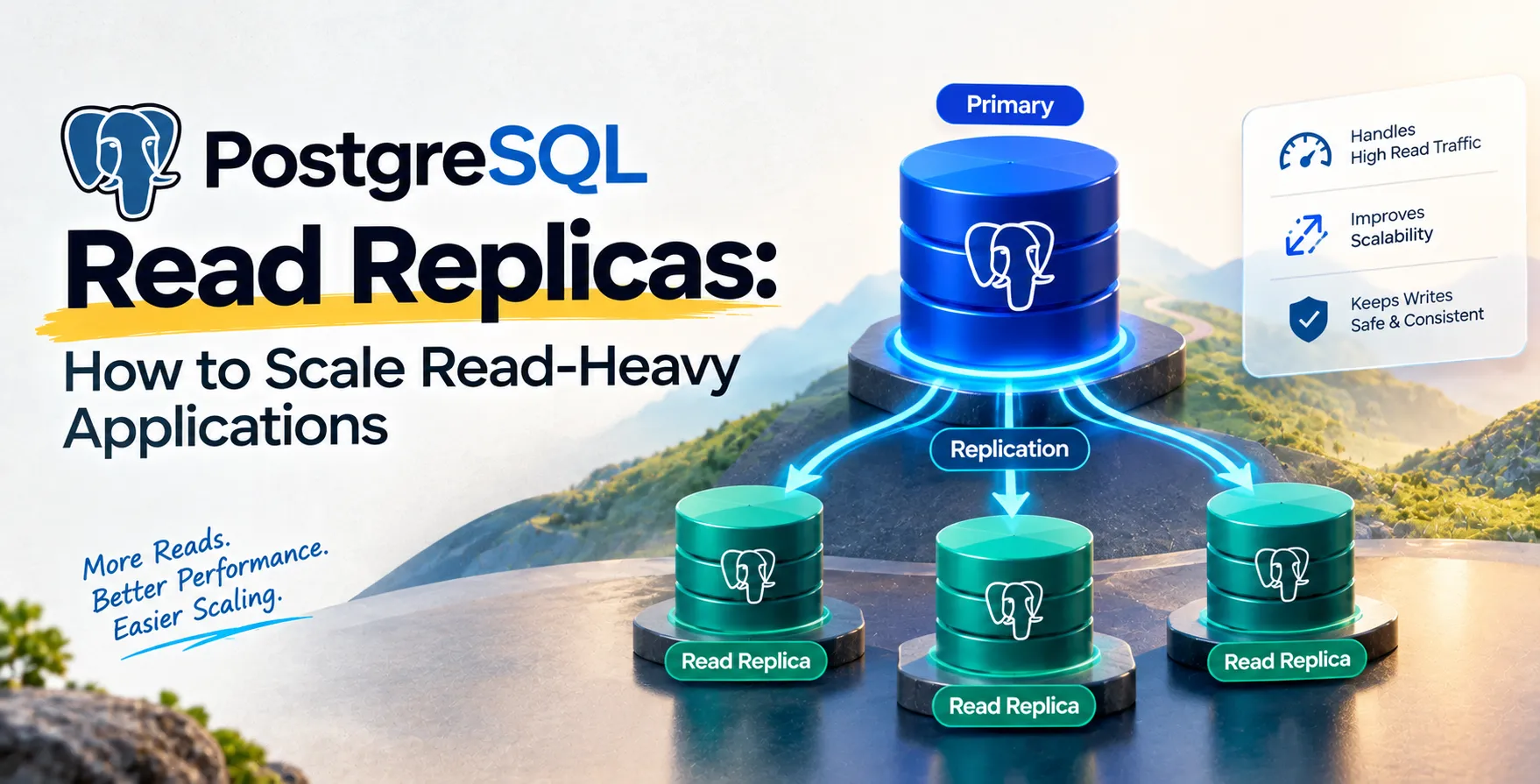
Read replicas are essentially secondary instances that maintain a copy of the primary database. They accept incoming connections but remain in a read-only state for standard application traffic.
When data is written to the primary, it is streamed to these replicas in near real-time. This ensures that the secondary nodes stay updated with the latest information.
Clients can then route their read-only queries to these replicas, effectively splitting the traffic. The primary database remains lean and focused on transactional integrity.
- Asynchronous data updates
- Transparent read-only operations
- Independent query processing
- Scalable capacity additions
The Role of Streaming Replication
At the core of this architecture is the streaming replication protocol. It sends the write-ahead log (WAL) data from the primary to the standby servers continuously.
This process is highly efficient and reliable for most production environments. It minimizes the time delay between the primary node and the replica nodes.
Developers should understand how this configuration affects their system design. Reliable replication is the backbone of any distributed database strategy.
- Continuous WAL streaming
- Low overhead on primary
- Automatic standby recovery
- Synchronous or asynchronous modes
Benefits of Horizontal Read Scaling
Scaling horizontally means adding more nodes rather than upgrading a single massive server. This approach provides flexibility and avoids the hard limits of hardware vertical scaling.
You can dynamically add read replicas during peak shopping seasons or marketing events. Once the traffic subsides, you can decommission them to save costs.
This modularity is essential for custom software development projects that anticipate rapid user growth. It creates a robust foundation for scaling your infrastructure efficiently.
| Scaling Factor |
Primary-Only |
Read Replicas |
| Read Throughput |
Limited by CPU |
Highly Scalable |
| Write Throughput |
High |
Maintained |
| Cost Efficiency |
Lower initially |
Better at high scale |
| Setup Complexity |
Simple |
Requires configuration |
| Data Consistency |
Strong |
Eventual |
Managing PostgreSQL Replication Lag
One of the most important metrics to watch is PostgreSQL replication lag. This refers to the time difference between a write occurring on the primary and becoming visible on the replica.
Network congestion or heavy write volumes can cause this gap to grow. If your application requires absolute consistency, you must account for this potential delay in your code.
Most read-heavy applications can tolerate slight delays. However, you should monitor this metric closely to ensure your system remains within acceptable bounds.
- Monitor network bandwidth
- Optimize write transactions
- Use synchronous replication sparingly
- Review hardware performance
When to Use Read Replicas
Read replicas are not the solution for every performance problem. If your queries are slow due to poor indexing, adding replicas will not fix the underlying issue.
First, ensure you are following standard PostgreSQL indexing best practices for web applications. Only after optimizing your queries and indexes should you look toward replica scaling.
If you have already tuned your database and still hit resource limits, that is the right time for replicas. They are best suited for CPU-bound or connection-limited scenarios.
- High concurrent read traffic
- Heavy reporting workloads
- Geographically distributed users
- Need for high availability
- Offloading complex analytics
Architecting for Read-Write Splitting
Implementing read-write splitting requires your application code or connection layer to be aware of the database topology. You must explicitly send writes to the primary and reads to the replicas.
Many modern frameworks and ORMs support this out of the box with minimal configuration. Alternatively, you can use middleware to handle the routing logic automatically.
This keeps your application logic clean and separated from infrastructure concerns. It allows developers to focus on features rather than managing database connections.
- Application-level routing
- Middleware-based splitting
- Load balancer configuration
- Database-aware client drivers
Connection Pooling Considerations
Scaling your read operations also increases the number of connections your database must manage. Using a tool like PgBouncer is critical for managing these connections effectively.
Properly configuring PostgreSQL connection pooling ensures that your application doesn't exhaust the database's connection limits. It is a vital step for maintaining performance under high traffic.
When using replicas, you should have separate connection pools for the primary and the standby nodes. This prevents a surge in read traffic from affecting your write-heavy transaction pool.
- Reduces connection overhead
- Improves resource utilization
- Prevents process exhaustion
- Supports high concurrency
Monitoring Your Replication Health
Effective monitoring is the key to a stable database cluster. You need to keep track of CPU usage, memory, disk I/O, and the status of your replication stream.
Alerting tools can notify your team if a replica falls too far behind or becomes unavailable. Proactive monitoring helps you address issues before they impact your end users.
Maintain dashboards that visualize the traffic distribution across your primary and replica nodes. This visibility helps in making informed decisions about future infrastructure needs.
- Track WAL receive status
- Monitor replication lag
- Observe connection counts
- Check node availability
Common Pitfalls in Scaling
Scaling databases is a complex task that can lead to unexpected issues if done incorrectly. Avoid the temptation to over-engineer your initial setup before it is necessary.
Another common mistake is neglecting security when setting up replication. Ensure that communication between your primary and standby nodes is encrypted and restricted to authorized traffic.
Finally, always test your failover procedures. If your primary node goes down, you must be prepared to promote a replica to become the new master immediately.
- Ignoring slow queries
- Incomplete failover planning
- Underestimating network latency
- Poor security configurations
Comparing Replicas vs Caching
While replicas scale your database, caching can often provide even greater performance gains. Redis caching strategies to speed up web applications are frequently used alongside database replicas.
Replicas provide a way to serve data directly from the disk-backed database store. Caching provides a way to serve frequently accessed data from memory for near-instant responses.
Using both techniques allows you to build a multi-layered storage strategy. This combination is common in high-scale enterprise environments.
- Database replicas for complex queries
- Memory cache for static data
- Reduced load on replicas
- Improved user experience
Final Thoughts
Scaling a database requires a balance between technical implementation and business needs. PostgreSQL read replicas are a powerful tool, but they should be used as part of a broader strategy.
Start by optimizing your queries and implementing caching. When those steps are no longer sufficient, introduce replicas to distribute the load and ensure your application can handle growth.
With the right monitoring and configuration, your database will be ready for any amount of traffic your application encounters. Focus on building a resilient and scalable system from the ground up.


 In collaboration with