Table of Contents
- Introduction to JSONB in Postgres
- Understanding the JSONB Data Type
- Why Standard Indexes Fail for JSON
- GIN Indexes Explained
- Optimizing with GIN Indexes
- Using B-tree Indexes for Specific Keys
- Advanced JSONB Indexing Techniques
- Comparing Indexing Strategies
- Common Pitfalls to Avoid
- Impact on Write Performance
- Leveraging Partial Indexes
- Maintaining Index Health
- Final Thoughts
Introduction to JSONB in Postgres
Modern applications frequently handle semi-structured data. PostgreSQL offers a robust way to manage this data through the JSONB data type.
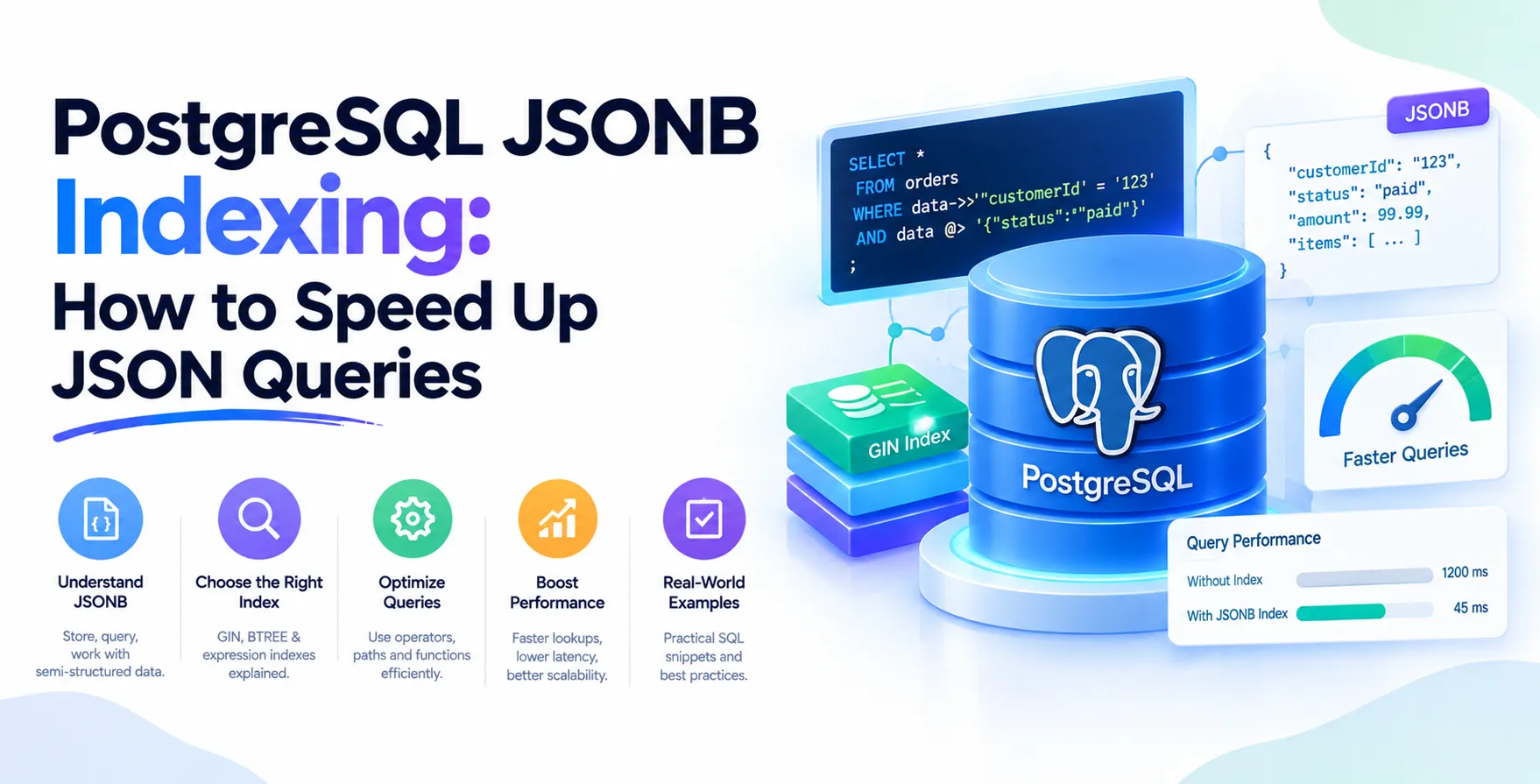
However, as your dataset grows, simple queries can become slow without proper tuning. Learning how to implement PostgreSQL JSONB indexing to speed up JSON queries is vital for any developer working with document-oriented data structures.
Understanding the JSONB Data Type
The JSONB type stores data in a decomposed binary format. This format is slightly slower to insert than plain text JSON but significantly faster to process.
Because it is binary, Postgres can perform complex searches without needing to re-parse the data every time. This efficiency is why developers often choose it for flexible schema requirements.
- Supports indexing for fast lookups
- Allows complex queries on nested data
- Maintains schema flexibility
- Reduces parsing overhead
Why Standard Indexes Fail for JSON
Traditional B-tree indexes work perfectly for scalar values like integers or strings. They map a single value to a physical disk location.
JSON objects, however, contain multiple keys and values. A standard B-tree index cannot effectively index the entire internal structure of a JSON document.
Trying to force a standard index on a raw JSONB column usually results in a full table scan. This leads to the classic performance bottleneck many teams face when scaling their backend services.
GIN Indexes Explained
The Generalized Inverted Index (GIN) is the industry standard for JSONB indexing. It works by creating an index entry for every key and value pair within the JSON document.
When you perform a query, the database searches the GIN index to find the specific documents containing your criteria. This approach transforms slow scans into lightning-fast lookups.
Benefits of GIN Indexes
GIN indexes allow for powerful containment queries using the @> operator. This is the most efficient way to filter your data.
- Enables fast containment operators
- Supports complex nested searches
- Handles large and dynamic schemas
- Greatly improves Postgres JSON query performance
Implementation Steps
Applying a GIN index is straightforward. You simply define the index on your JSONB column to start seeing immediate gains.
- Identify the frequently queried column
- Run the CREATE INDEX command
- Use the USING GIN clause
- Verify with EXPLAIN ANALYZE
Optimizing with GIN Indexes
While GIN is powerful, it can get large. You must ensure your JSONB index optimization strategy focuses on the specific paths or keys you actually query.
Using the default GIN operator class indexes every key and value. This is flexible but consumes significant disk space and memory.
For high-traffic systems, consider defining the index more narrowly. This keeps the index small and performant without sacrificing search capabilities.
Using B-tree Indexes for Specific Keys
Sometimes, you only need to query a single field within a large JSON document. In these cases, a GIN index might be overkill.
You can create a B-tree index on a specific expression extracted from the JSONB data. This is a highly efficient way to handle specific lookup patterns.
By targeting a specific field, you minimize index size and maximize speed. This technique is often used when implementing specific features in a multi-tenant SaaS architecture database design.
- Targets specific JSON fields
- Smaller footprint than GIN
- Fast equality lookups
- Lower maintenance overhead
Advanced JSONB Indexing Techniques
Advanced developers often use expression indexes to improve performance for computed JSON values. If your queries frequently use functions like jsonb_extract_path_text, you can index that function result directly.
This allows the query planner to bypass the function execution during the search. It effectively caches the result of the path extraction in the index.
This approach is particularly useful for complex data analytics where you need to filter by calculated metrics stored within a JSON field. It provides a massive boost when dealing with heavy enterprise software development requirements.
Comparing Indexing Strategies
| Strategy |
Best For |
Complexity |
| GIN (Default) |
General search |
Low |
| GIN (Path) |
Large datasets |
Medium |
| B-tree (Field) |
Specific key lookups |
Low |
| Expression |
Computed values |
High |
Common Pitfalls to Avoid
One common mistake is indexing every single column as a JSONB field. This bloat slows down insert and update operations significantly.
Another issue is forgetting to reindex after large data migrations. Your index needs to stay in sync with your data distribution to remain efficient.
- Over-indexing columns
- Ignoring index maintenance
- Using wrong operator classes
- Failing to test with real data
Impact on Write Performance
Every index you add to a table introduces overhead during write operations. Postgres must update the index structure whenever a row is changed.
GIN indexes are especially heavy on writes. If your application is write-heavy, you need to balance index quantity against query performance.
Always benchmark your specific workload. What works for a reporting dashboard might be too slow for a high-frequency transactional system.
Leveraging Partial Indexes
Partial indexes are a hidden gem for JSONB performance. You can create an index that only covers a subset of your data.
For example, you could index only the active records in a table. This reduces the size of the index and speeds up queries on that subset.
It is a highly effective way to keep your database lean. This is common when managing data across different regions in a custom software development project.
Maintaining Index Health
Indexes require periodic maintenance to remain fast. Bloat can accumulate over time, especially with frequent updates to JSON documents.
Regularly run vacuuming processes to clean up dead tuples. If performance degrades, consider rebuilding your indexes during off-peak hours.
Monitoring your index hit ratio is the best way to determine if your current strategies are working. Use database observability tools to stay ahead of these issues.
Final Thoughts
Mastering JSONB indexing is essential for modern PostgreSQL development. It allows you to leverage the flexibility of JSON while maintaining the speed of a relational database.
Start by identifying your most expensive queries. Apply GIN or B-tree indexes strategically based on your specific access patterns.
With careful planning and testing, you can achieve excellent performance even with complex JSON documents. Keep your indexes lean, monitor their health, and you will ensure your application scales effectively.


 In collaboration with