Table of Contents
- Introduction to Table Partitioning
- Why Use Partitioning for Scaling
- Understanding Declarative Partitioning
- Types of Partitioning Strategies
- Implementing Range Partitioning
- Working with List Partitioning
- The Power of Hash Partitioning
- How Partition Pruning Improves Speed
- Maintenance and Administrative Tasks
- Handling Indexes on Partitioned Tables
- Comparison of Partitioning Methods
- Common Pitfalls to Avoid
- Best Practices for Large Databases
- Conclusion
Introduction to Table Partitioning
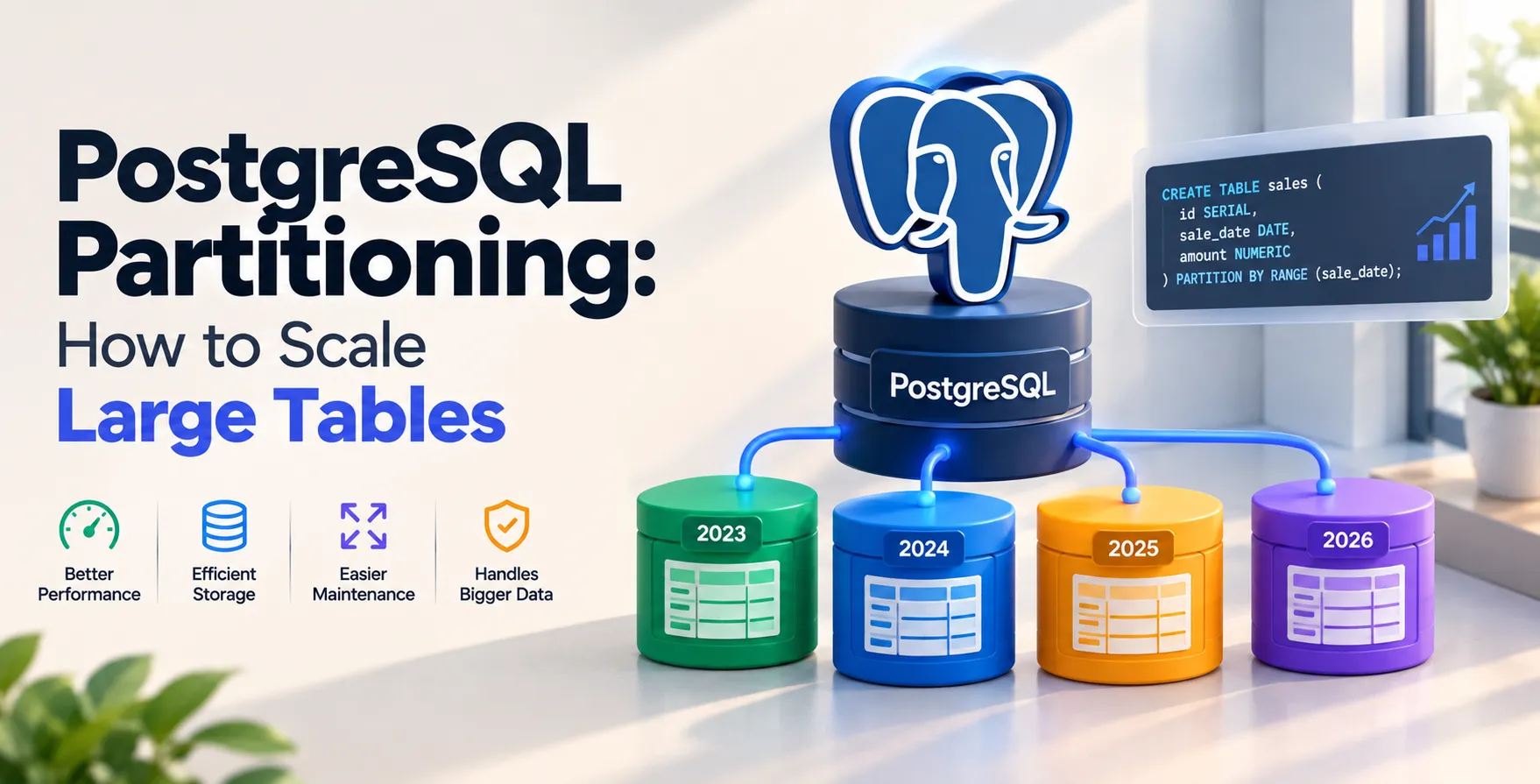
When your database grows into the millions or billions of rows, standard table structures often buckle under the pressure. PostgreSQL partitioning for large tables provides a way to break these massive entities into smaller, more manageable pieces.
This architectural shift allows the database engine to treat a single logical table as a set of physical chunks. By doing so, you maintain a consistent API for your application while drastically improving internal data management.
Why Use Partitioning for Scaling
The primary driver for implementing partitioning is the need to sustain performance as data volume explodes. Without it, index bloat and long scan times become inevitable bottlenecks for your application.
Using a well-structured partitioning strategy helps keep indexes small enough to fit comfortably in memory. This effectively boosts Postgres large table performance by reducing disk I/O requirements for common queries.
- Faster data archival and deletion
- Improved index maintenance operations
- Better utilization of buffer cache
- Enhanced query throughput for analytical workloads
Understanding Declarative Partitioning
PostgreSQL introduced declarative partitioning to simplify the setup and management of partitioned tables. This approach uses built-in syntax to define how data is distributed across sub-tables, often called partitions.
The system automatically manages the routing of inserts and updates to the correct partition based on your defined rules. This eliminates the need for complex trigger-based solutions that were common in older versions of the database.
Types of Partitioning Strategies
Choosing the right strategy depends entirely on the nature of your data and your typical query patterns. Each method serves a specific use case, and picking the wrong one can lead to performance degradation rather than improvement.
Range Partitioning
This is the most common method for time-series data or sequentially increasing values. You define partitions based on contiguous ranges, such as monthly or yearly segments.
- Ideal for time-stamped data
- Efficient for chronological data archival
- Simplifies drop operations for old data
List Partitioning
You assign rows to partitions based on a set of discrete, non-overlapping values. This works exceptionally well for multi-tenant SaaS architecture database design, where data is logically separated by organization IDs or regions.
- Perfect for categorized or regional data
- Direct mapping to specific business units
- Simplifies data isolation requirements
Hash Partitioning
This method distributes data evenly across partitions by applying a hash function to a specific key. It is the best choice when you need to prevent hotspots and ensure uniform data distribution.
- Distributes data evenly regardless of key
- Minimizes contention on specific partitions
- Useful for high-concurrency write workloads
Implementing Range Partitioning
To implement range partitioning, you define a parent table that acts as the interface for your application queries. You then create child tables that inherit the schema but hold specific subsets of the data.
The parent table does not store data itself but rather acts as a router. When you perform an insert, the database engine inspects the values and directs them to the appropriate child partition based on the range.
Working with List Partitioning
List partitioning allows for highly granular control over where individual records reside. It is particularly effective when you have a defined set of categories that rarely change over time.
For instance, if your system serves different geographic markets, you can map each country code to its own partition. This allows for localized maintenance tasks that do not impact the global user base.
The Power of Hash Partitioning
Hash partitioning is a robust solution for balancing load across your storage subsystem. By hashing a primary key or a frequently queried ID, you ensure that no single partition grows disproportionately larger than others.
This balancing act is crucial for systems that handle massive, uniform data streams. It prevents the "overflow" problem where one partition becomes too large, reintroducing the very performance issues you intended to solve.
How Partition Pruning Improves Speed
One of the most significant benefits of this architectural choice is PostgreSQL partition pruning. The query planner analyzes your WHERE clauses to determine which partitions it can safely ignore.
If a query only requests data from a specific date range, the engine will only scan the partitions containing that range. This drastically reduces the amount of data processed, leading to near-instant results even in massive tables.
| Feature |
Non-Partitioned Table |
Partitioned Table |
| Index Size |
Very Large |
Small per partition |
| Scan Time |
Linear growth |
Constant per partition |
| Maintenance |
Locked Table |
Individual partition operations |
| Data Deletion |
Expensive Delete |
Cheap Drop Table |
Maintenance and Administrative Tasks
Managing a partitioned system requires a shift in how you think about maintenance. Routine tasks like vacuuming and reindexing become significantly more efficient when performed at the partition level.
You can run intensive maintenance operations on individual partitions during off-peak hours. This approach helps maintain high availability for your production applications, ensuring that the entire system never needs a global lock.
Handling Indexes on Partitioned Tables
When you create an index on a parent table, PostgreSQL automatically creates a corresponding index on all child partitions. This ensures that every sub-table remains performant and ready for incoming queries.
However, you can also create unique indexes on individual partitions if necessary for specific local constraints. This flexibility allows you to optimize for both global query patterns and local storage constraints effectively.
Common Pitfalls to Avoid
It is easy to misconfigure partitioning if you do not account for your specific application workload. Over-partitioning is a common error where you create too many small partitions, which creates overhead for the query planner.
- Creating too many partitions
- Choosing high-cardinality keys for ranges
- Neglecting default partition definitions
- Ignoring partition-specific statistics
- Failing to monitor growth trends
Best Practices for Large Databases
Start by identifying your most frequently queried data and partitioning based on those access patterns. If your users mostly search by date, range partitioning is your best starting point for success.
Always maintain proper statistics on each partition to assist the query planner. Regular monitoring of your database growth will help you decide when to rotate old partitions or create new ones, keeping your system lean and fast.
Conclusion
PostgreSQL partitioning is a powerful tool for scaling your database infrastructure effectively. By breaking down large tables, you unlock significantly better performance and simplify long-term maintenance tasks.
Whether you choose range, list, or hash methods, the key is to align your strategy with your actual query patterns. When implemented correctly, partitioning ensures your database can grow alongside your business without sacrificing responsiveness.


 In collaboration with