Table of Contents
- Introduction
- What is On-Device AI?
- The Shift from Cloud to Edge Computing
- Key Drivers of On-Device AI in 2026
- Privacy and Data Security Advantages
- Eliminating Latency for Real-Time Execution
- Offline Capabilities and Reliability
- Cost Efficiency for Enterprises and Developers
- On-Device AI vs Cloud AI Comparison
- Hardware Breakthroughs Enabling Edge Intelligence
- Implementing On-Device AI in Modern Apps
- Potential Challenges and Technical Trade-offs
- Final Thoughts
Mobile applications are undergoing a massive architectural shift in 2026. For years, software engineers relied almost exclusively on central cloud servers to run machine learning algorithms.
That dependency is rapidly dissolving as smart mobile hardware becomes exceptionally powerful. Today, user expectations for real-time performance and absolute privacy demand intelligent execution directly on consumer hardware.
What is On-Device AI?
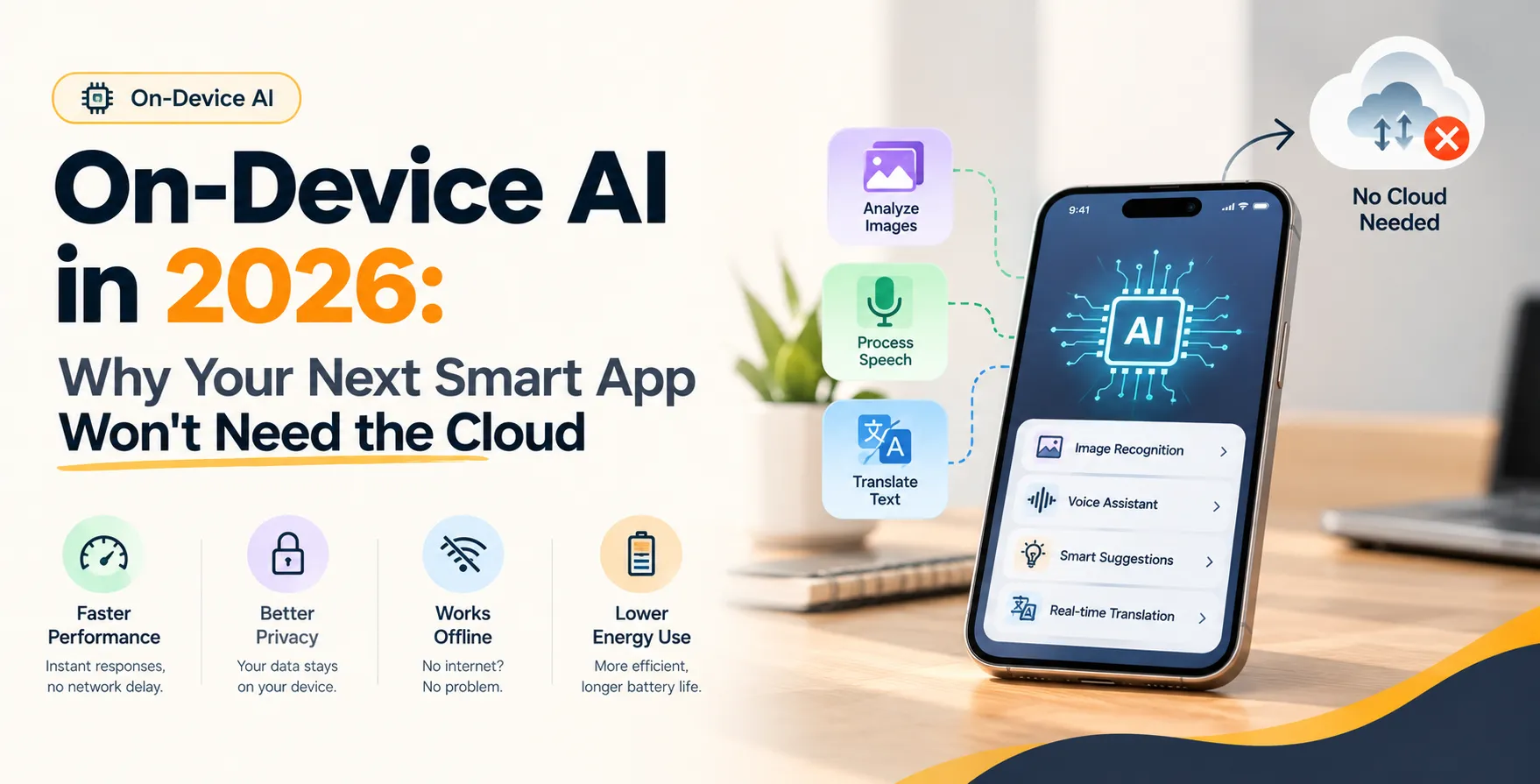
On-device AI refers to executing machine learning models directly on local hardware like smartphones, tablets, and edge devices. Instead of streaming raw user inputs to distant data centers, processing occurs locally inside dedicated hardware components.
This localized execution model fundamentally transforms how intelligent software operates on modern end-user hardware. It enables instant inferences without requiring constant cellular network transfers or cloud backend compute resources.
By shifting computational workloads closer to the point of data generation, developers build highly responsive user experiences. This architectural evolution minimizes remote server dependency while providing users complete control over their sensitive data.
The Shift from Cloud to Edge Computing
Cloud infrastructure transformed early software scaling, but centralized server processing introduced clear physical limitations. High network latency and intermittent connection dropped calls regularly degrade user experiences in cloud-dependent applications.
As a result, modern software engineering teams are embracing Edge AI architectures to decentralize application intelligence. Shifting workloads directly to user hardware creates significant performance gains for mobile app platforms.
Several major factors accelerate this migration across the enterprise app software ecosystem.
- Substantial decrease in cloud hosting expenses
- Complete independence from network availability
- Strict adherence to global data privacy laws
- Immediate execution speeds for interactive components
Moving inference tasks to local processors guarantees that critical app functions remain functional regardless of remote infrastructure health.
Key Drivers of On-Device AI in 2026
The rapid adoption of specialized neural hardware across consumer silicon chips has redefined client-side software capabilities. Semiconductor manufacturers now equip standard mobile devices with powerful hardware accelerators optimized specifically for matrix math.
Simultaneously, model compression methodologies have advanced significantly over recent years. Quantization and pruning allow software teams to shrink large architectures into highly efficient small language models without sacrificing practical output quality.
This convergence of efficient silicon and optimized architectures makes edge execution practical for everyday applications. Mobile platforms now run complex contextual reasoning tasks locally without draining battery reserves.
Privacy and Data Security Advantages
Data privacy regulations have tightened globally, requiring enterprise applications to limit unnecessary server telemetry. When biometric data, private voice recordings, and text inputs never leave the physical device, compliance burdens vanish naturally.
Analyzing the primary On-device AI benefits reveals immediate operational security improvements for mobile application owners.
- Personal user data remains on client hardware
- Zero risk of remote data transit interception
Software architectures that prioritize localized compute gain immediate trust from security-conscious users and global enterprise clients.
Eliminating Latency for Real-Time Execution
Network round trips to distant cloud data centers introduce unavoidable delays into digital interaction loops. For applications requiring continuous visual or audio feedback, even minimal latency ruins user engagement.
Implementing targeted AI model latency optimization strategies ensures modern mobile applications react instantly to user actions. Local model execution removes network transmission delays entirely from the runtime path.
- Instant live speech transcription output
- Real-time augmented reality spatial tracking
- Immediate camera scene segmentation adjustments
- Fluid conversational assistant responses
- Low-latency touch gesture interaction handling
Offline Capabilities and Reliability
Cloud-bound software features fail completely when users enter underground transit, isolated areas, or congested physical venues. Localized processing guarantees that core intelligent application capabilities stay available anywhere.
High availability is mandatory for mission-critical software in healthcare, field operations, and industrial logistics. Applications using localized neural runtimes function seamlessly through airplane mode and sudden cellular drops.
Users expect modern digital tools to function reliably without displaying endless network retry dialogs. Client-side execution fulfills this expectation by decoupling feature functionality from remote server uptime.
Cost Efficiency for Enterprises and Developers
Cloud GPU inference fees scale directly with active app usage, making popular AI features incredibly expensive to sustain. Serving millions of daily user prompts through cloud backend clusters creates escalating financial challenges for growing companies.
Offloading computational inference onto client hardware dramatically alters application operational economics.
- Zero recurring per-query cloud API fees
- Predictable cloud infrastructure budget forecasts
- Reduced operational network bandwidth usage
- Highly scalable application user onboarding
- Lower cloud storage database requirements
- Simplified backend microservice architecture design
On-Device AI vs Cloud AI Comparison
Evaluating client-side processing against centralized cloud servers illustrates clear functional trade-offs across key operational criteria.
| Evaluation Dimension |
Cloud AI Architecture |
On-Device AI Architecture |
| Inference Latency |
Network variable (100ms - 2000ms) |
Deterministic and ultra-low (<15ms) |
| Offline Support |
Requires active network connection |
Operates completely offline |
| Data Privacy |
Data transmitted to third-party servers |
Data stays stored on local hardware |
| Operational Cost |
Scales linearly with total usage |
Fixed software engineering costs |
| Model Scale |
Multi-billion parameter capabilities |
Optimized compact parameters |
| Hardware Dependency |
Standard web access needed |
Requires modern NPU silicon support |
Hardware Breakthroughs Enabling Edge Intelligence
Silicon architecture innovations have made edge processing practical across lightweight consumer devices.
Neural Processing Units
Dedicated Neural Processing Units execute matrix multiplication tasks with minimal electrical current draw.
- Accelerated parallel tensor operation execution
- Minimal power drain on device batteries
- Specialized silicon for deep learning tasks
Integrated NPUs execute billions of operations per second without overheating lightweight mobile phone enclosures.
Unified Memory Architectures
Shared hardware memory pools allow processor cores to access model parameter matrices without slow bus transfers.
- Zero-copy memory access between engines
- Faster model loading into active memory
- Higher data bandwidth during active inference
Eliminating memory copy overhead allows mobile applications to run neural calculations smoothly alongside standard app features.
Implementing On-Device AI in Modern Apps
Building reliable edge software requires intentional engineering choices throughout the system design lifecycle. Modern AI mobile app development methodologies prioritize compact model binaries, specialized runtime engines, and hardware acceleration drivers.
For document-heavy mobile workflows, utilizing local AI document parsing enables client applications to extract structured data locally without external processing APIs.
Engineers follow systematic procedures to deploy optimized machine learning models into client application packages.
- Selecting lightweight foundation model architectures
- Quantizing floating-point weights to 4-bit integers
- Embedding lightweight runtime libraries into builds
- Profiling execution across target hardware profiles
Packaging optimized models directly inside app binaries guarantees fast runtime execution while keeping app store installation sizes manageable.
Potential Challenges and Technical Trade-offs
While local execution offers transformational benefits, mobile development teams must navigate clear physical hardware boundaries.
Model Scale Constraints
Consumer mobile devices possess strict memory allocations compared to high-end cloud server clusters.
- Restricted device system RAM availability
- Strict app store bundle download limits
- Reduced context memory allocation windows
Engineering teams must carefully pare down non-essential parameter parameters to fit client memory boundaries.
Thermal Management and Battery Longevity
Unoptimized execution loops can quickly draw excessive power and trigger system thermal throttling.
- Increased battery power drain during long tasks
- Hardware clock throttling under high thermal load
- Strict operating system background execution limits
Intelligent software must balance local inference duration with aggressive power throttling strategies to protect device longevity.
Final Thoughts
The era of relying exclusively on remote cloud infrastructure for intelligent software functionality is officially concluding. Utilizing Edge AI for real-time analytics enables application developers to build lightning-fast, secure, and highly resilient digital experiences directly on consumer hardware.
By pairing efficient specialized models with modern mobile silicon, modern software operates flawlessly regardless of internet connectivity. Adopting local execution gives engineering teams the tools to protect consumer privacy, eliminate server costs, and deliver immediate response times in 2026.


 In collaboration with