Introduction
Enterprises today are rapidly adopting AI document processing tools to automate workflows involving invoices, contracts, compliance records, and customer onboarding. However, one key decision continues to shape long-term outcomes:
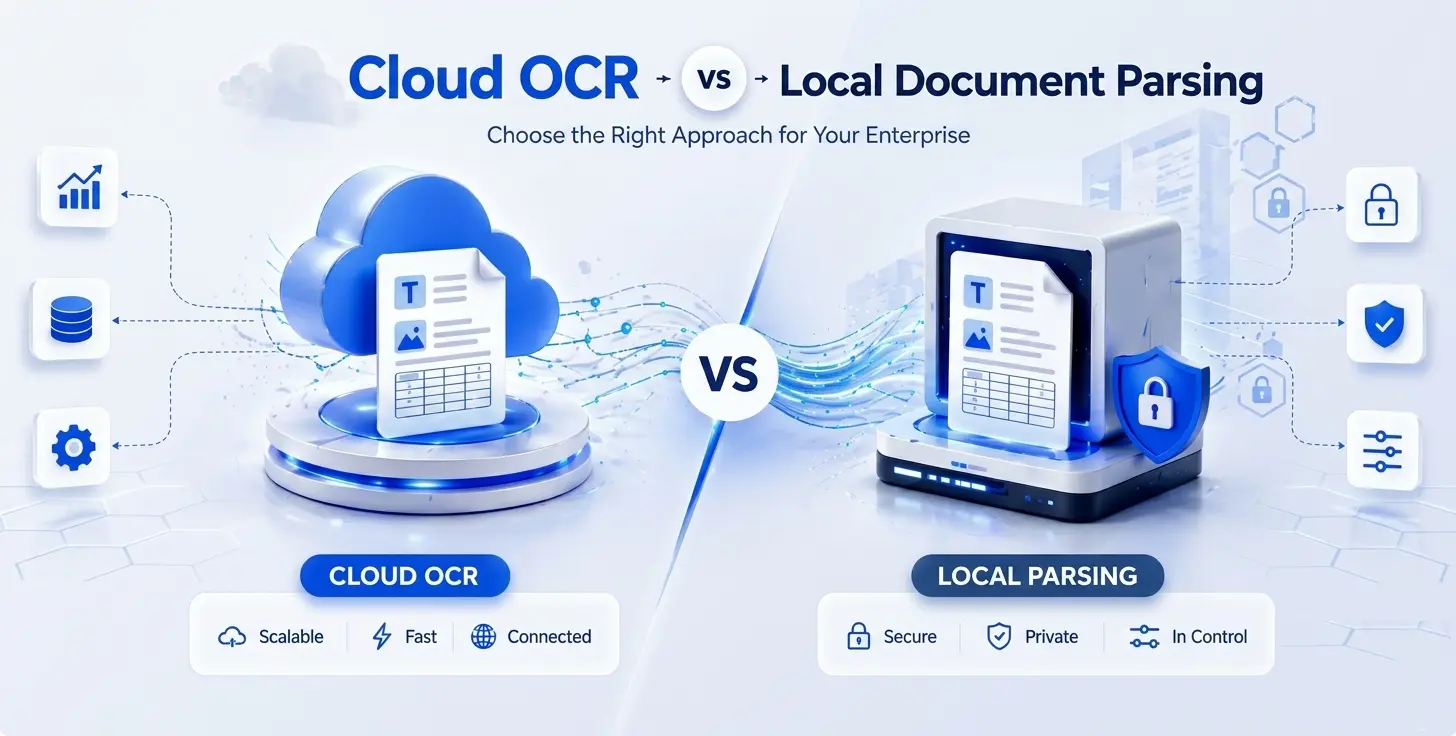
Should you use Cloud OCR or Local AI Document Parsing?
This choice directly impacts cost, scalability, data privacy, and operational control. While cloud-based solutions such as Amazon Textract have become a standard for scalable document processing, emerging local frameworks such as LiteParse are redefining how enterprises approach secure and intelligent document automation.
This guide provides a strategic comparison to help organizations evaluate the right approach for enterprise document processing in 2026 and beyond.
What is Cloud OCR in Document Processing?
Cloud OCR (Optical Character Recognition) refers to extracting text and structured data from documents using cloud-hosted services.
Solutions like Amazon Textract enable organizations to:
- Extract printed and handwritten text
- Identify key-value pairs in forms
- Detect tables and structured layouts
- Integrate with cloud-native workflows
Advantages of Cloud OCR
- Rapid deployment with minimal infrastructure
- High accuracy with continuously trained models
- Elastic scalability for large document volumes
- Seamless integration with cloud ecosystems
Limitations of Cloud OCR
- Usage-based pricing (can scale significantly with volume)
- Data processed on external servers
- Dependency on internet connectivity
- Limited customization for domain-specific parsing
What is Local AI Document Parsing?
Local AI document parsing is an advanced approach that combines OCR with AI-driven structure extraction, running entirely within private or on-premise environments.
Frameworks such as LiteParse provide:
- Built-in OCR capabilities
- Structured data extraction (JSON outputs)
- Layout-aware parsing with bounding box metadata
- Full local or private deployment
Advantages of Local AI Parsing
- Enhanced data privacy and regulatory compliance
- Lower long-term costs for high-volume processing
- Greater flexibility and customization
- Full control over document pipelines
Limitations of Local AI Parsing
- Initial setup and infrastructure requirements
- OCR accuracy may require tuning
- Requires technical expertise for optimization
- Still evolving compared to mature cloud solutions
Cloud OCR vs Local AI Document Parsing: Key Differences
| Dimension |
Cloud OCR (e.g., Textract) |
Local AI Parsing (e.g., LiteParse) |
| Deployment Model |
Cloud-based |
On-premise / private |
| Cost Structure |
Pay-per-use |
Infrastructure-based |
| Data Privacy |
External processing |
Full internal control |
| Scalability |
High (elastic) |
Depends on setup |
| Customization |
Limited |
High |
| Setup Complexity |
Low |
Moderate |
| Layout Intelligence |
Supported |
Advanced with developer control |
Why Enterprises Are Exploring AWS Textract Alternatives
Organizations evaluating AWS Textract alternatives are increasingly considering local AI-based solutions due to:
- Rising document processing costs at scale
- Increasing data privacy regulations (GDPR, compliance needs)
- Demand for custom document automation workflows
- Need for secure document processing without cloud dependency
Cost and Scalability Considerations
Cloud OCR Cost Model:
Cloud solutions like Amazon Textract operate on a pay-per-document or per-page basis.
- Suitable for low to medium workloads
- Suitable for rapid deployment scenarios
- Challenge: costs increase significantly with large-scale processing
Local AI Cost Model:
- Requires initial infrastructure investment
- Offers lower marginal cost per document at scale
- Suitable for high-volume document processing
- Suitable for long-term cost optimization strategies
Use Case-Based Recommendation
Choose Cloud OCR if you need:
- Fast implementation
- Minimal infrastructure setup
- Standardized document processing
- Cloud-first architecture
Choose Local AI Document Parsing if you need:
- Secure document processing without cloud
- High-volume invoice or document automation
- Custom workflows (KYC, legal, healthcare)
- Greater control over data and processing
The Rise of Intelligent Document Processing (IDP)
Modern enterprises are moving toward Intelligent Document Processing (IDP), a combination of:
- OCR
- AI/ML models
- Layout-aware parsing
- Workflow automation
Future Outlook: Cloud vs Local AI is Not Binary
The decision between cloud OCR vs local AI document parsing is no longer binary.
- Combining both approaches
- Optimizing for cost, compliance, and performance
- Building AI-first document automation pipelines
Frequently Asked Questions
What is the difference between cloud OCR and local AI document parsing?
Cloud OCR processes documents on external servers, while local AI parsing runs within internal infrastructure.
Is AWS Textract a good solution for document automation?
Amazon Textract is highly scalable and accurate, making it suitable for many enterprise use cases.
What are the best AWS Textract alternatives?
Solutions like LiteParse are emerging as strong alternatives.
Which is better for sensitive data processing?
Local AI document parsing is generally preferred for strict data privacy requirements.
Conclusion
As enterprises scale their document automation solutions, the choice between cloud OCR and local AI document parsing becomes a strategic decision.
While cloud platforms like Amazon Textract offer scalability and ease of use, local frameworks like LiteParse provide better control and privacy.
About Us
At Zillion Infotech, we help enterprises implement AI-based document processing and automation solutions to deliver secure and scalable outcomes.


 In collaboration with