Table of Contents
- Introduction
- What are AI Regulations?
- Why AI Regulation is Important
- Global Overview of AI Regulations
- AI Regulations by Country
- Key Challenges in AI Regulation
- Impact on Developers and Businesses
- Future of AI Governance
- Conclusion
Introduction
Artificial Intelligence is growing rapidly and becoming a core part of industries like healthcare, finance, recruitment, and automation. However, with great power comes responsibility.
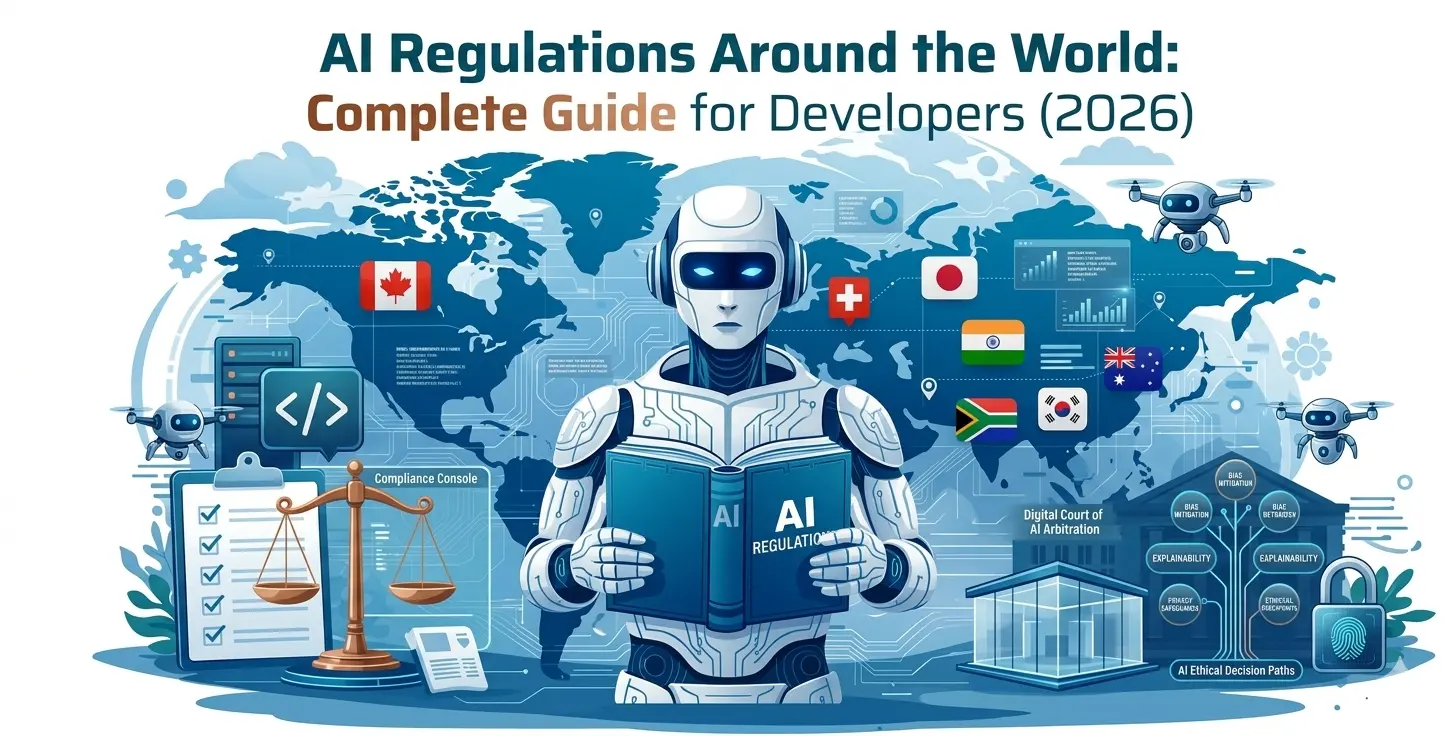
Governments across the world are introducing AI regulations to ensure ethical usage, data privacy, and accountability. For developers and organizations, understanding AI regulations around the world is becoming essential.
AI regulation is not just about restrictions—it’s about building trustworthy and safe systems.
- Ensures ethical AI development
- Protects user data and privacy
- Builds trust in AI systems
What are AI Regulations?
AI regulations are laws, policies, and guidelines created by governments to control how artificial intelligence systems are developed and used.
These global AI laws focus on areas such as data protection, bias and fairness, transparency, and accountability.
They aim to ensure that AI systems do not harm individuals or society.
Why AI Regulation is Important
Without proper regulation, AI systems can lead to serious risks like biased decisions, privacy violations, and lack of accountability.
AI regulations and AI compliance help:
- Prevent misuse of AI technologies
- Ensure fairness and non-discrimination
- Protect sensitive user data
- Promote responsible innovation
In simple terms, regulations make AI safer and more reliable.
Global Overview of AI Regulations
Different countries are approaching AI regulation in different ways. Some focus on strict laws, while others provide guidelines and frameworks.
There are three main approaches globally:
- Strict Regulation (EU style) – Strong laws and compliance requirements
- Balanced Approach (US style) – Innovation with some regulation
- Controlled Governance (China style) – Government-controlled AI systems
Each approach reflects the country’s priorities and political structure under global AI laws.
AI Regulations by Country
European Union (EU)
The EU has one of the most advanced AI regulatory frameworks.
- AI Act (risk-based classification)
- Strict rules for high-risk AI systems
- Strong focus on privacy and ethics
This is considered the global benchmark for AI regulation.
United States
The US follows a more flexible approach.
- AI Bill of Rights (guidelines, not strict laws)
- Focus on innovation and industry growth
- Regulations vary by sector
The US prioritizes innovation with responsibility and AI compliance.
China
China has a centralized and strict approach.
- Regulations on generative AI
- Strong government control over AI systems
- Focus on national security and content control
AI development is closely monitored by the state.
India
India is still evolving its AI regulatory framework.
- Focus on responsible AI
- Digital Personal Data Protection Act
- Encouragement for AI innovation
India aims to balance growth, governance, and AI compliance.
Other Countries
UK: Pro-innovation regulatory strategy
Canada: AI and Data Act (AIDA)
Australia: Ethical AI guidelines
Key Challenges in AI Regulation
Regulating AI is complex because technology evolves faster than laws.
Major challenges include:
- Rapid advancement of AI models
- Lack of global standardization
- Difficulty in defining “high-risk AI”
- Balancing innovation and control
Governments are still adapting to these challenges.
Impact on Developers and Businesses
AI regulations directly affect how developers build and deploy systems.
Following AI compliance is essential.
- Need for model transparency
- Documentation and audit requirements
- Bias testing and fairness checks
- Data privacy compliance
For businesses, non-compliance can lead to legal risks and penalties.
Future of AI Governance
AI regulation will continue to evolve as technology advances.
Future trends include:
- Global AI regulatory standards
- Stronger enforcement of laws
- Increased focus on explainable AI
- Regulation of generative AI (like LLMs)
The goal is to create a safe and sustainable AI ecosystem under global AI laws.
Conclusion
AI regulations are becoming a critical part of modern technology development. Understanding AI regulations around the world and global AI laws helps developers and organizations build compliant systems.
Instead of seeing regulations as a limitation, they should be viewed as a foundation for responsible innovation.
AI compliance will be essential for long-term success.


 In collaboration with