Table of Contents
- Introduction
- What Is AI User Experience (AI UX)?
- Why UX Matters in AI App Development
- Understanding User Expectations in AI Applications
- Building Trust Through Transparency
- UX Design Best Practices for AI-Powered Applications
- Designing Explainable AI Interfaces
- Creating Human-Centered AI Experiences
- Common UX Challenges in Artificial Intelligence App Development
- Measuring AI UX Success
- Future Trends in AI User Experience
- Conclusion
Introduction
Artificial intelligence is transforming the way people interact with digital products. From personalized recommendations and intelligent chatbots to predictive analytics and automation, AI is becoming a core part of modern software experiences.
However, successful AI-powered products require more than advanced algorithms. The true value of artificial intelligence depends on how users experience and interact with it. This is where AI User Experience (AI UX) becomes critical.
Organizations investing in AI App Development must ensure that AI features are understandable, trustworthy, and easy to use. Without a strong user experience strategy, even the most advanced AI solutions can fail to gain adoption.
This guide explores the most important UX Design Best Practices for designing AI-powered applications and explains how businesses can create successful Artificial Intelligence App Development projects that users love.
- Improve user trust in AI systems
- Create intuitive AI interactions
- Increase user engagement
- Reduce user confusion
- Deliver better business outcomes
What Is AI User Experience (AI UX)?
AI User Experience (AI UX) refers to the design of interactions between users and artificial intelligence systems. It focuses on ensuring that AI-powered features are understandable, useful, transparent, and aligned with user expectations.
Unlike traditional applications that follow predictable rules, AI systems often generate recommendations, predictions, and automated decisions. Because these outcomes can vary based on data and context, users need clear guidance and explanations.
Strong AI User Experience (AI UX) helps bridge the gap between complex technology and everyday users by making artificial intelligence feel approachable and trustworthy.
| Traditional UX |
AI UX |
| Predictable outputs |
Dynamic AI-driven outputs |
| Rule-based interactions |
Data-driven interactions |
| Fixed workflows |
Adaptive experiences |
| Limited personalization |
Highly personalized experiences |
Why UX Matters in AI App Development
Many organizations focus heavily on model performance during AI App Development but overlook the user experience. While technical accuracy is important, users ultimately judge a product based on how easy and valuable it is to use.
A well-designed AI experience can increase adoption, build trust, and improve customer satisfaction. On the other hand, poor UX can make even powerful AI features feel confusing or unreliable.
Successful AI App Development combines strong technical foundations with user-centered design principles to ensure that AI solutions solve real problems effectively.
- Improves user confidence
- Increases feature adoption
- Reduces support requests
- Builds long-term trust
- Creates better user experiences
Understanding User Expectations in AI Applications
Users often have high expectations when interacting with AI-powered applications. Many assume that artificial intelligence will always provide accurate answers, make perfect recommendations, and understand every request.
In reality, AI systems can make mistakes, misinterpret data, and produce unexpected outcomes. Managing user expectations is therefore an essential part of AI User Experience (AI UX).
Research, usability testing, and continuous feedback collection help teams understand user needs and improve AI-powered experiences.
- Understand user goals
- Identify user concerns
- Analyze user behavior
- Test assumptions regularly
- Gather continuous feedback
Building Trust Through Transparency
Trust is one of the most important factors in Artificial Intelligence App Development. Users are more likely to rely on AI systems when they understand how decisions and recommendations are generated.
Transparency reduces uncertainty and helps users feel more comfortable interacting with AI-powered features.
Applications should clearly communicate when AI is being used and provide meaningful explanations whenever possible.
| Transparency Practice |
User Benefit |
| Explain recommendations |
Builds trust |
| Show confidence levels |
Improves understanding |
| Allow feedback |
Enhances engagement |
| Disclose AI usage |
Increases transparency |
UX Design Best Practices for AI-Powered Applications
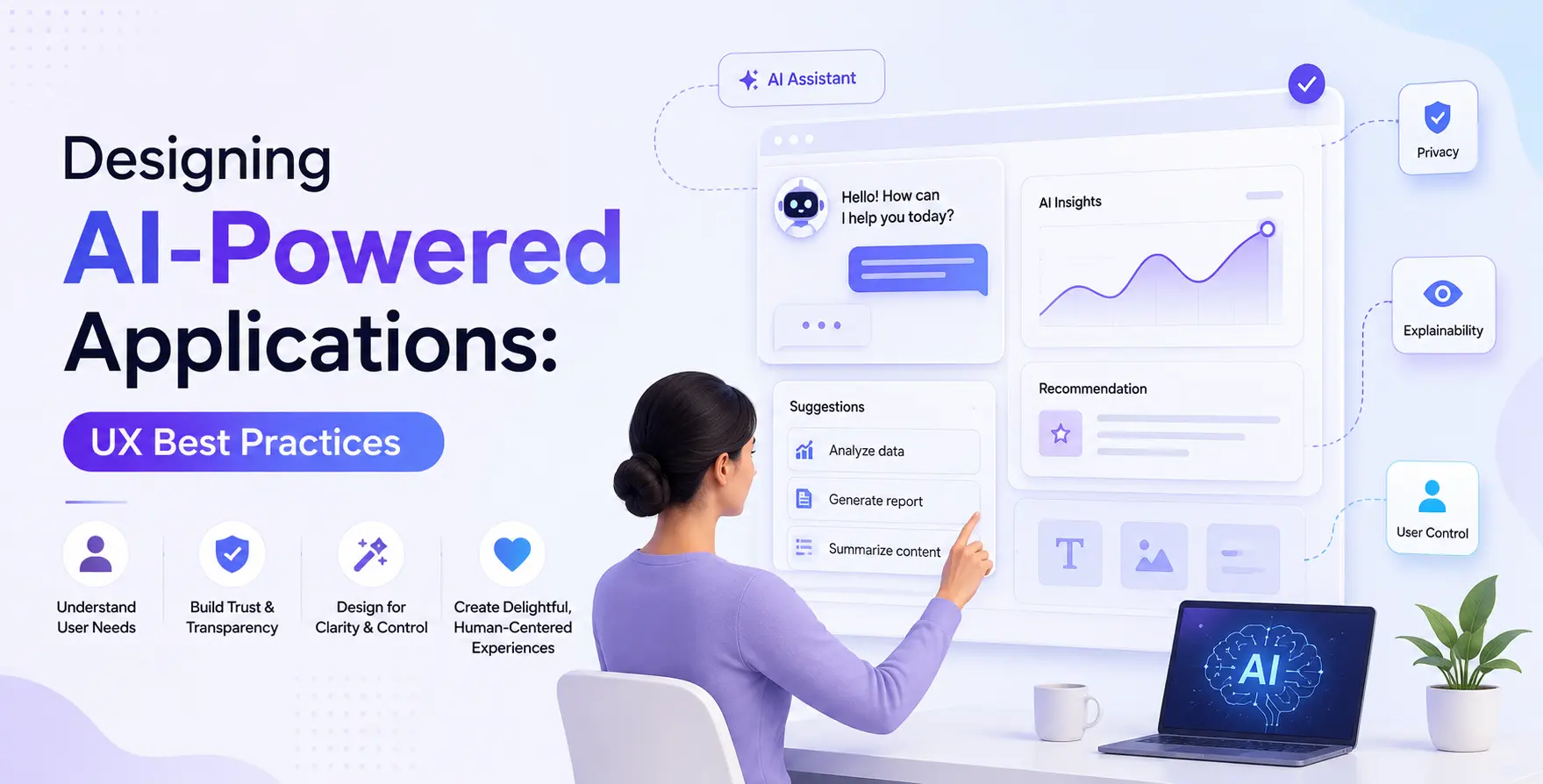
Successful AI-powered products are built around user needs rather than technology alone. Following proven UX Design Best Practices helps ensure that AI features provide real value while remaining intuitive and easy to use.
Designers and developers should focus on creating experiences that feel natural, trustworthy, and supportive throughout the user journey.
- Keep interfaces simple and intuitive
- Clearly communicate AI capabilities
- Provide user control whenever possible
- Design for accessibility and inclusivity
- Use consistent interaction patterns
- Continuously test with real users
- Provide meaningful feedback
- Focus on solving user problems
By implementing these UX Design Best Practices, organizations can improve user satisfaction and maximize the impact of AI-powered features.
Designing Explainable AI Interfaces
Explainability is a critical aspect of AI User Experience (AI UX). Users should understand why an AI system generated a recommendation, prediction, or decision.
When users can understand AI outputs, they are more likely to trust and engage with the application. Explainability also helps users identify errors and make informed decisions.
| Explainability Feature |
User Benefit |
| Recommendation explanations |
Improves trust |
| Confidence indicators |
Supports decision-making |
| Feedback options |
Encourages engagement |
| Decision summaries |
Enhances understanding |
Effective explainability helps users feel more comfortable interacting with AI-powered applications and improves overall user satisfaction.
Creating Human-Centered AI Experiences
Human-centered design places users at the center of every product decision. During Artificial Intelligence App Development, teams should focus on understanding user goals, behaviors, and challenges before implementing AI features.
The most successful AI-powered applications do not force users to adapt to technology. Instead, they adapt technology to meet user needs.
- Prioritize user goals
- Reduce cognitive load
- Design for clarity
- Support user confidence
- Create seamless workflows
Organizations that embrace human-centered design often achieve higher adoption rates and stronger user engagement.
Common UX Challenges in Artificial Intelligence App Development
Despite rapid advances in AI technology, many organizations face challenges when designing effective user experiences.
Understanding these challenges can help teams avoid common mistakes and create better products.
| Challenge |
Impact |
| Lack of transparency |
Reduces trust |
| Overcomplicated interfaces |
Creates confusion |
| Unclear AI capabilities |
Raises unrealistic expectations |
| Limited user control |
Decreases satisfaction |
| Poor feedback systems |
Restricts improvement opportunities |
Addressing these challenges early in Artificial Intelligence App Development can significantly improve the overall user experience.
Measuring AI UX Success
To improve AI User Experience (AI UX), teams must track performance and understand how users interact with AI-powered features.
Measuring success helps organizations identify opportunities for improvement and validate design decisions.
- User satisfaction scores
- Feature adoption rates
- User retention metrics
- Task completion rates
- Feedback quality and volume
- Customer support requests
Regular monitoring enables teams to refine experiences and deliver greater value over time.
Future Trends in AI User Experience
The future of AI App Development will be shaped by increasingly personalized, intelligent, and context-aware experiences. As AI technology evolves, user expectations will continue to rise.
Organizations that prioritize AI User Experience (AI UX) today will be better prepared to meet future demands and create competitive advantages.
- Advanced personalization
- More conversational interfaces
- Context-aware interactions
- Greater transparency tools
- Enhanced accessibility features
- Improved explainable AI systems
These trends will influence both AI App Development strategies and future UX Design Best Practices.
Conclusion
Creating successful AI-powered applications requires more than advanced technology. A strong focus on AI User Experience (AI UX) ensures that users can understand, trust, and benefit from artificial intelligence features.
Organizations investing in AI App Development should incorporate UX Design Best Practices throughout the entire product lifecycle. By prioritizing transparency, explainability, accessibility, and user-centered design, teams can create better experiences and achieve stronger business outcomes.
As Artificial Intelligence App Development continues to evolve, businesses that focus on exceptional user experiences will be best positioned for long-term success.


 In collaboration with