Table of Contents
- Introduction
- The Evolution of Modern React Frameworks
- Understanding Next.js 15 Architecture
- Understanding Remix and React Router Integration
- Server Components vs Progressive Enhancement
- Performance and Speed Comparison
- Routing and Navigation Models
- Data Loading and State Management
- Developer Experience and Tooling
- Next.js vs Remix for SaaS Applications
- Side-by-Side Feature Matrix
- Making the Right Framework Decision
- Conclusion
Introduction
Choosing the right frontend framework shapes your entire engineering velocity for years. In 2026, the battle between React ecosystems has reached a mature stage.
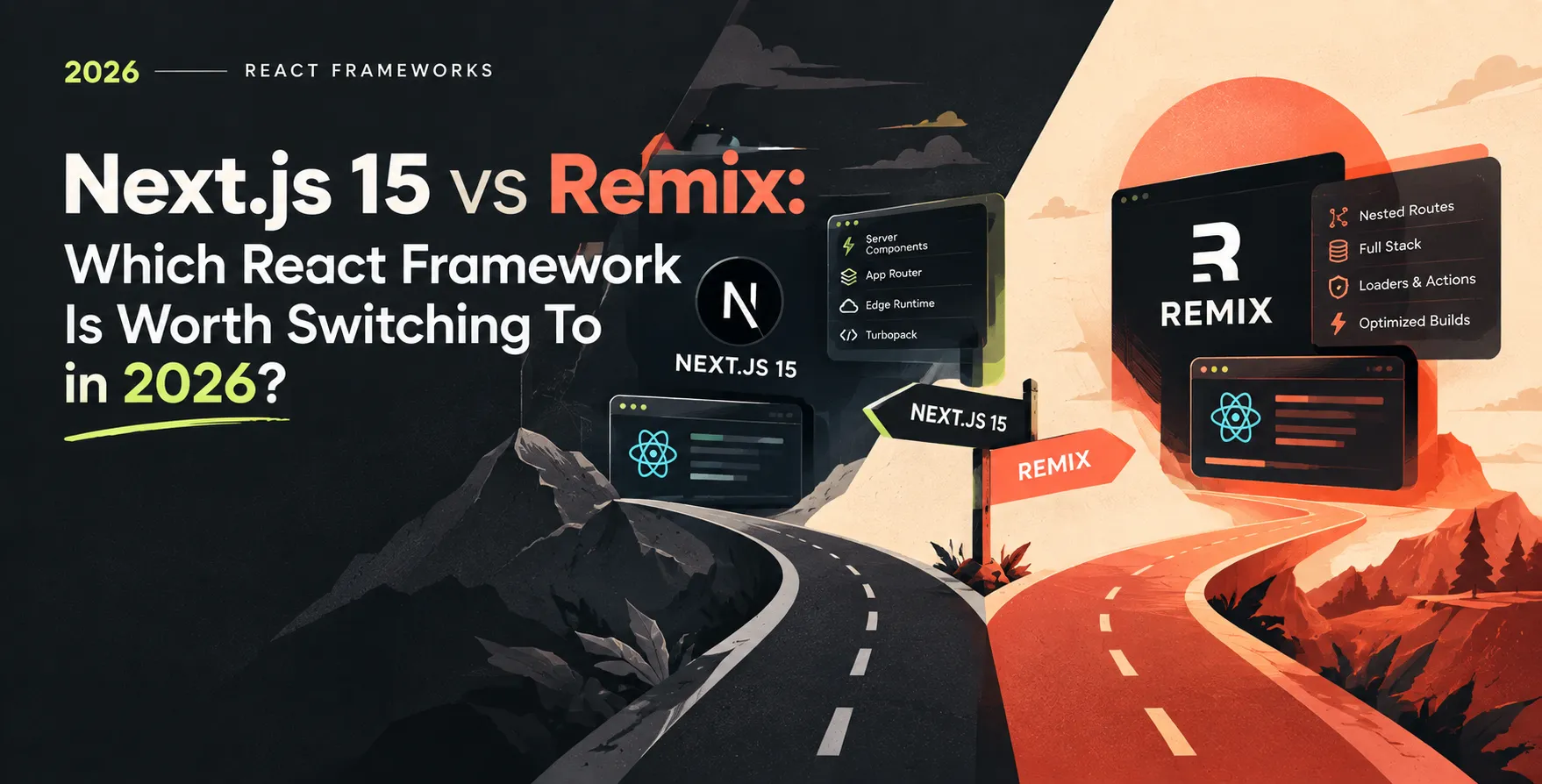
This detailed comparison explores Next.js vs Remix to help technical leaders pick the ideal platform. We evaluate rendering models, developer experience, and long-term maintainability.
React remains the foundation for modern web applications. However, plain client-side rendering is rarely enough for scale.
Evaluating Next.js vs Remix 2026 requires understanding how both projects evolved recently.
- Simplifies server-side rendering architecture
- Improves initial page loads
The Evolution of Modern React Frameworks
Frontend architecture shifted dramatically over the last few years. Key frontend development trends 2026 focus on reducing client JavaScript bundles.
Next.js pioneered server-driven React architectures with its App Router model. It pushed server rendering into the mainstream industry standard.
Remix took a different path by leveraging standard Web Fetch APIs. Its merger with React Router created a unified ecosystem for full-stack apps.
Both platforms now offer exceptional performance out of the box.
Understanding Next.js 15 Architecture
Next.js 15 introduces key refinements to server component execution and caching strategies. The framework defaults to un-cached request handling for maximum runtime flexibility.
Caching is no longer aggressive by default. Developers explicitly choose when to cache responses across edge nodes.
- Default un-cached fetch behavior for dynamic data
- Enhanced React 19 compiler integration
- Optimized partial pre-rendering capabilities
- Streamlined server action error boundaries
- Improved hydration speed on complex pages
Understanding Remix and React Router Integration
Remix aligned its core APIs directly with React Router v7. This unified approach eliminates artificial boundaries between client-side routing and server framework logic.
Developers build web applications using Web Standard APIs like Request and Response objects. This guarantees high portability across serverless, edge, and Docker environments.
By relying heavily on browser fundamentals, Remix minimizes framework-specific abstractions. You learn standard web platform standards rather than proprietary framework tricks.
Server Components vs Progressive Enhancement
Architectural philosophy is the biggest differentiator when deciding between Next.js or Remix. Each project solves data rendering challenges differently.
Next.js Server Component Philosophy
Next.js leans heavily into React Server Components for granular render control.
- Zero client bundle overhead for server components
- Direct database connectivity inside UI code
- Seamless streaming with React Suspense
- Automated component-level code splitting
This model allows seamless mixing of static and dynamic server UI.
Remix Progressive Enhancement Philosophy
Remix focuses on browser native behaviors and HTML form submissions.
- Works reliably before client JavaScript hydrates
- Built on standard HTML form navigation mechanics
- Simplified mutation handling via action functions
- Automatic revalidation after server data changes
Your application remains fully functional even on slow network connections.
Performance and Speed Comparison
Modern web apps require aggressive website performance optimization to meet user expectations. Speed directly impacts conversion rates and search engine rankings.
Next.js 15 achieves low initial latency through static generation and server components. Server components stream HTML fragments directly to the browser during dynamic page loads.
Remix excels in client navigation and interactive state transitions. Its parallel data loading prevents request waterfalls during nested route updates.
Routing and Navigation Models
Routing structures directly affect project organization and developer velocity over time. The best frontend framework 2026 should provide clear, intuitive routing paradigms.
Next.js uses a directory-based App Router structure with specialized file conventions.
- Directory hierarchy dictates route URL paths
- Special files like page, layout, and loading handle states
- Parallel routes enable concurrent layout rendering
- Intercepting routes allow contextual modal overlays
- Nested layouts preserve state across route updates
- Server actions manage backend data mutations directly
Data Loading and State Management
Data fetch patterns determine how cleanly your application manages complex dynamic states.
Remix uses explicit route loaders and actions to handle backend interactions.
- Loader functions isolate data retrieval at route boundaries
- Action functions encapsulate mutation logic safely
- Optimistic UI updates run smoothly out of the box
- No global state library required for UI sync
Remix keeps state management simple by using the URL and server as ultimate sources of truth.
Developer Experience and Tooling
Developer velocity depends heavily on build systems, error messages, and debugging capabilities.
Next.js features Turbopack for lightning-fast hot module replacement during local development.
- Instant local server startup times
- Comprehensive TypeScript error integration
- Robust debugging tools inside browser devtools
- Vercel ecosystem deployment automation
- Extensive third-party plugin ecosystem support
Next.js vs Remix for SaaS Applications
Evaluating Next.js vs Remix for SaaS projects involves evaluating dashboard complexity, dynamic forms, and SEO requirements.
SaaS applications need fast authenticated dashboards and high-converting marketing landing pages.
- Next.js provides superior static marketing page optimization
- Remix handles complex multi-step forms without state bugs
- Next.js offers deep server side rendering capabilities out of the box
- Remix simplifies granular data mutations in heavy admin dashboards
Both frameworks comfortably handle production SaaS workloads at enterprise scale.
Side-by-Side Feature Matrix
Here is how the two frameworks compare across core technical dimensions:
| Feature Category |
Next.js 15 |
Remix / React Router |
| Core Render Model |
React Server Components |
Standard SSR & SSR Streaming |
| Routing Convention |
File-system App Router |
Config/File-system Hybrid |
| Data Loading |
Async Server Components & Fetch |
Route Loaders & Web Fetch API |
| Data Mutation |
Server Actions |
Form Actions & Action Functions |
| Form Handling |
Client State or Server Actions |
Native Progressive Enhancement |
| Deployment Target |
Vercel Optimized / Node / Docker |
Any Edge / Node Runtime Host |
Making the Right Framework Decision
Choosing between frameworks should be based on team expertise and specific product requirements.
Avoid migrating existing working systems without a clear technical rationale.
- Pick Next.js for rich content and hybrid static sites
- Pick Remix for dynamic form-heavy web apps
- Pick Next.js for deep Vercel ecosystem integration
- Pick Remix for strict adherence to web standards
Conclusion
Both Next.js 15 and Remix represent the absolute cutting edge of modern React web development. Neither framework is universally better; each excels in specific architectural contexts.
If you need flexible hybrid rendering, rich server components, and rapid landing page generation, Next.js 15 remains an incredible choice. If you prioritize standard web primitives, resilient form handling, and clean nested data loading, Remix is worth switching to in 2026.
Evaluate your team's workflow and application needs carefully before committing to your next web build.


 In collaboration with