Table of Contents
- Introduction
- Overview of React in 2026
- Overview of Vue.js in 2026
- Performance and Speed Comparison
- Learning Curve and Developer Experience
- Ecosystem and Community Support
- State Management Solutions
- Server-Side Rendering and Frameworks
- Vue.js vs React for Beginners
- React vs Vue 2026 Feature Comparison
- Key Factors When Choosing React or Vue for Web Development
- How to Pick the Best Frontend Framework 2026
- Final Thoughts
Choosing the right user interface tool remains a crucial business decision for modern digital products.
Both library ecosystems have matured significantly while introducing groundbreaking capabilities for modern web engines.
Introduction
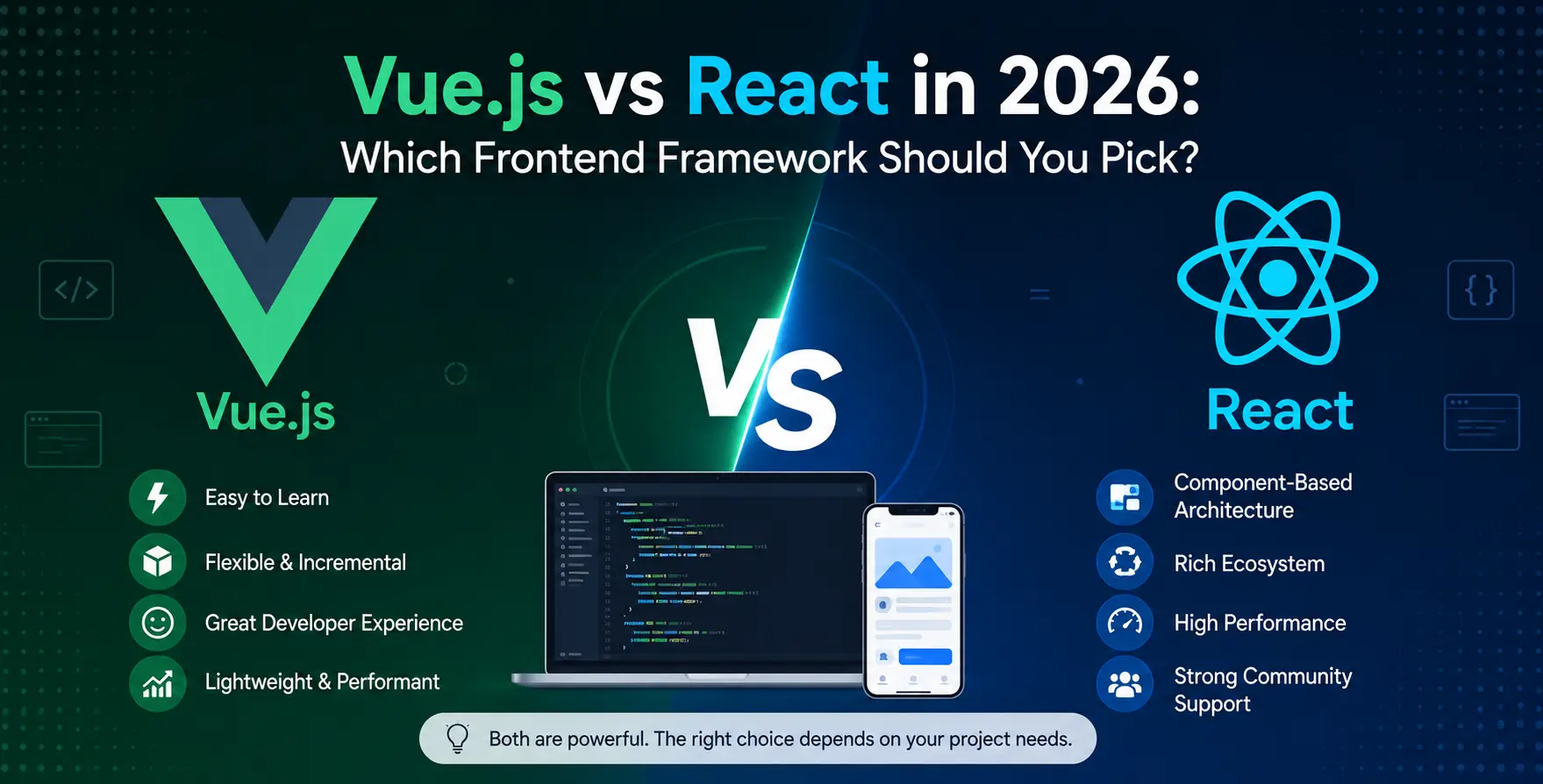
Selecting a UI architecture shapes your engineering culture and product trajectory. In the context of React vs Vue 2026, both technologies continue to dominate modern web development.
React maintains its massive market footprint backed by Meta and an expansive third-party package ecosystem.
Vue.js delivers exceptional developer satisfaction through a flexible core and intuitive reactivity model.
- Drives frontend architectural choices
- Impacts recruitment and long-term hiring
Overview of React in 2026
React remains a premier JavaScript library focused primarily on building user interface components. Its component-driven architecture relies heavily on immutable state management and JSX syntax extensions.
Automatic batching and concurrent rendering features streamline complex application updates. Meta and open-source contributors actively refine the compiler engine for zero-runtime overhead.
Engineers favor React when building massive distributed systems that require battle-tested platform stability.
Overview of Vue.js in 2026
Vue.js provides a progressive web framework designed for incremental adoption across projects. The framework pairs declarative templates with precise fine-grained reactive primitives.
Core Principles
Vue prioritizes developer ergonomics with clean single-file components containing HTML, CSS, and script blocks.
- Single file component architecture
- Fine grained automatic dependency tracking
- Official router and store integration
- Flexible progressive adoption path
Modern Features
Composition API patterns enable efficient code reuse across large enterprise software solutions.
- Built in script setup syntax
- Native TypeScript type inference engines
- Optimized virtual DOM patch flags
- Zero configuration build tooling setup
Performance and Speed Comparison
Performance benchmark numbers between both UI solutions remain remarkably close for standard application scenarios. Virtual DOM optimization engines in both libraries reduce unnecessary browser redraw cycles efficiently.
React leverages automated compiler transformations to skip unnecessary re-rendering during dynamic view state changes.
Vue utilizes dynamic block trees to isolate static markup from changing dynamic expressions during render passes.
Learning Curve and Developer Experience
Developer productivity depends heavily on framework ergonomics and conceptual complexity. Evaluating the best frontend framework 2026 requires analyzing team onboarding speed and code maintainability.
- Vue offers faster initial developer onboarding
- React demands solid JavaScript functional fundamentals
- Vue templates separate concerns cleanly by default
- JSX provides full programmatic flexibility within JavaScript
- Both frameworks offer excellent TypeScript tooling support
Engineering teams often transition to Vue faster due to familiar HTML template structure and clear convention boundaries.
Ecosystem and Community Support
The broader package ecosystem often dictates long-term maintenance overhead for software enterprise applications. Meta's backing provides React with unprecedented corporate support and enterprise stability assurance.
Vue maintains an independent community-driven funding model supported by dedicated open-source sponsorships.
React offers vastly more third-party UI component libraries and enterprise integration plugins today.
State Management Solutions
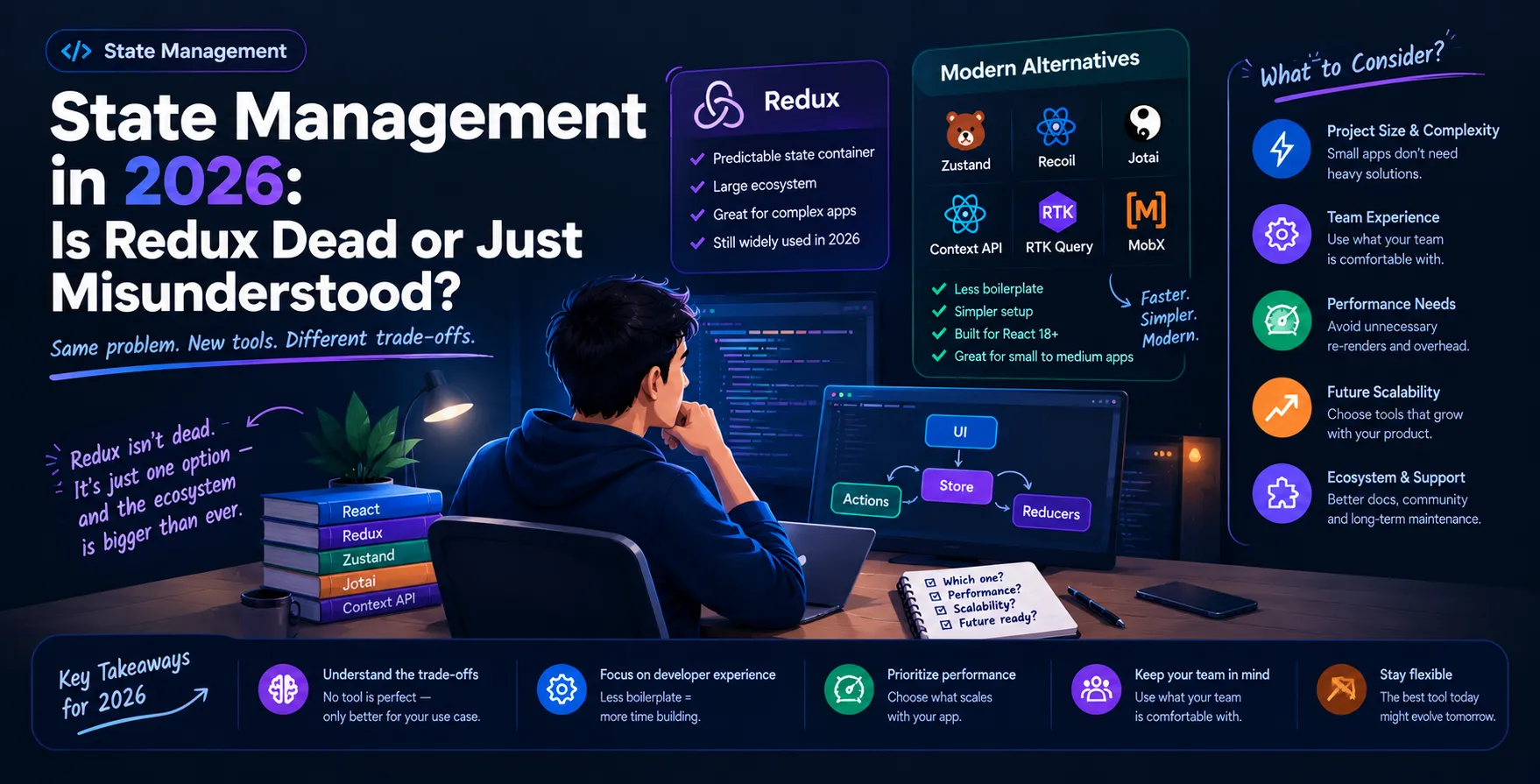
State propagation mechanics differ fundamentally between reactive signals and explicit immutable state dispatchers. Global state control ensures application data flows predictably across deeply nested UI component trees.
React relies on external libraries like Zustand, Redux Toolkit, or Jotai for complex application state management.
Vue provides Pinia as an officially supported lightweight state management engine with modular store definitions.
- Pinia provides seamless automatic devtools integration
- Zustand simplifies React state without boilerplate code
- Vue reactivity tracks dynamic property access automatically
- React hooks enforce explicit variable dependency arrays
- Both solutions support atomic global state models
- Modular stores simplify code splitting and lazy loading
Official framework tooling in Vue creates a cohesive development workflow out of the box.
Server-Side Rendering and Frameworks
Modern web development emphasizes server render strategies for fast initial page load metrics and search indexing.
React SSR Ecosystem
Next.js serves as the dominant meta-framework powering server rendered React production platforms today.
- Server components execute purely on backend infrastructure
- Built in route handling and asset optimization
- Nested layout routing systems simplify page architecture
Vue SSR Ecosystem
Nuxt provides a full-featured meta-framework environment tailored specifically for Vue web application architectures.
- Automated route generation based on directory structures
- Universal data fetching hooks streamline server requests
- Powerful module ecosystem extends backend functionality easily
Vue.js vs React for Beginners
New software engineers frequently evaluate Vue.js vs React for beginners when starting web development careers. Learning fundamental web development concepts becomes easier when syntax overhead remains manageable.
- Vue features gentler learning curve for new developers
- React teaches deep JavaScript patterns and functional paradigms
- Vue documentation provides clear official step by step guides
- React requires understanding custom hooks and render cycles
Beginners often grasp Vue faster, while React opens more total immediate software developer job openings worldwide.
React vs Vue 2026 Feature Comparison
Comparing core specifications side by side clarifies architectural differences between these front-end technologies.
| Feature |
React |
Vue.js |
| Core Model |
Library |
Progressive Framework |
| Syntax |
JSX |
HTML Templates or JSX |
| Reactivity |
Explicit setState and hooks |
Fine-grained reactive signals |
| First-party Tools |
Minimal core focus |
Router and Pinia maintained |
| Backing |
Meta and Community |
Community and Sponsors |
| Meta-Framework |
Next.js |
Nuxt |
Key Factors When Choosing React or Vue for Web Development
Selecting React or Vue for web development requires auditing your engineering team's existing skill sets. Application scale, delivery timelines, and long-term maintenance plans heavily inform your tech stack decision.
React excels when building large cross-platform software systems with shared mobile React Native codebases.
Vue shines when rapid feature delivery and clean maintainable code structures are top business priorities.
How to Pick the Best Frontend Framework 2026
Follow a structured evaluation process to determine which platform aligns best with product goals.
- Build a small prototype application in both technologies
- Evaluate developer ergonomics and team feedback during testing
- Analyze component library compatibility for your domain needs
- Finalize decision based on long term maintenance costs
A hands-on proof of concept reveals real-world development friction faster than theoretical comparisons.
Final Thoughts
Both technologies represent world-class solutions for crafting modern web application interfaces in 2026. React excels in massive enterprise environments with huge hiring requirements and broad library choices.
Vue offers an extraordinarily cohesive developer experience with fast onboarding and streamlined framework conventions.
Evaluate your team's specific workflow demands and project goals to select the optimal frontend foundation.


 In collaboration with