Table of Contents
- The State of Frontend Architecture
- Understanding the Redux Legacy
- The Rise of Atomic State Management
- React State Management 2026 Landscape
- Redux Toolkit vs Zustand Performance
- When to Use Context API
- Managing Global vs Local State
- Developer Experience in 2026
- The Impact of Server Components
- Scalability and Long-term Maintenance
- Redux vs Zustand Comparison
- Is Redux Truly Necessary Anymore?
- Final Thoughts
The State of Frontend Architecture
The way we handle data in the browser has shifted dramatically over the last few years. As we look at React state management 2026, the focus has moved away from monolithic global stores toward highly modular, local-first approaches.
Modern web development emphasizes performance and reducing the bundle size sent to the client. This architectural shift forces developers to reconsider how they manage application data across complex component trees.
Understanding the Redux Legacy
Redux arrived as a solution to the chaotic nature of prop drilling in early React applications. It provided a predictable, unidirectional data flow that became the industry standard for large-scale enterprise software.
Many developers today view it as overly verbose or complex for smaller projects. However, its core principles of immutability and centralized state remain foundational to how we think about data.
- Predictable state transitions
- Robust debugging tools
- Middleware ecosystem
- Strict data architecture
The Rise of Atomic State Management
Atomic patterns have gained significant traction by allowing developers to define state in small, independent units. This approach minimizes re-renders by ensuring components only subscribe to the specific data they need.
By treating state as a collection of atoms rather than one giant object, we can optimize rendering cycles much more effectively. This pattern is particularly useful in complex dashboards where dozens of inputs interact simultaneously.
- Granular component updates
- Simplified data flow
- Reduced boilerplate code
- Better performance scaling
React State Management 2026 Landscape
Today, the ecosystem is fragmented but mature. We have moved past the era where every app required a heavy global store, and we now favor tools that fit the specific scale of the project.
Developers are prioritizing libraries that offer minimal API surfaces and zero-config setups. The goal is to spend less time configuring store providers and more time building user-facing features.
- Server-side synchronization
- Client-side caching
- Optimistic UI updates
- Framework-agnostic state
Redux Toolkit vs Zustand
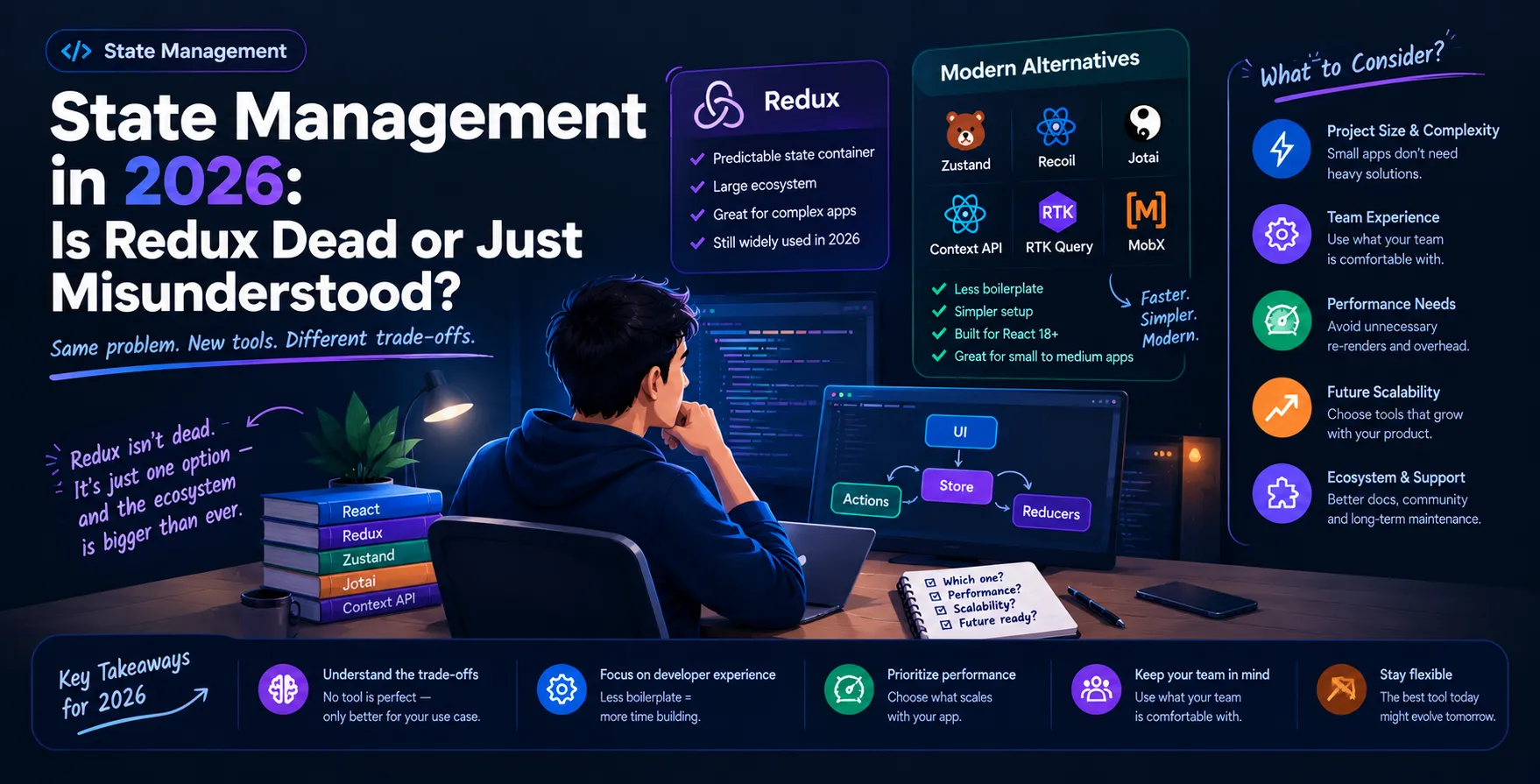
When comparing Redux Toolkit vs Zustand, the choice often comes down to the scale and complexity of the team. Redux Toolkit provides a highly structured environment that enforces patterns, while Zustand offers a lightweight, flexible alternative.
Many teams are migrating to Zustand for its simplicity and ease of use in smaller applications. However, Redux Toolkit remains a powerhouse for large-scale systems where consistency across teams is a business requirement.
- Reduced boilerplate requirements
- Easier learning curves
- Efficient memory usage
- Stronger type safety
When to Use Context API
The Redux vs Context API debate is a classic in the React community. Context is excellent for low-frequency updates like themes, user authentication status, or language settings.
It is not, however, a complete replacement for high-frequency state updates. When used for large, frequently changing datasets, it can trigger performance bottlenecks that are difficult to debug.
- Ideal for static data
- Built into core React
- Simple to implement
- Avoids external dependencies
Managing Global vs Local State
Distinguishing between global and local state is a critical skill for any senior developer. Not every piece of data needs to live in a global store accessible by every component.
Keeping state as close to the relevant components as possible is the best way to maintain a clean codebase. Global state should be reserved for data that truly needs to be shared across disparate parts of the UI.
Developer Experience in 2026
The developer experience has improved significantly with modern tooling. Debugging tools now provide a clear visual representation of state changes, making it easier to track down bugs in complex systems.
We are seeing a trend where state management libraries integrate directly with browser devtools. This allows us to inspect, modify, and replay state transitions in real time.
- Real-time state monitoring
- Improved hot-reloading support
- Better TypeScript integration
- Visual event timelines
The Impact of Server Components
Server components have changed the game by shifting data fetching to the server level. This reduces the amount of state we need to manage on the client side, effectively offloading the burden of initial data hydration.
Because server components don't require client-side state hooks, they naturally encourage a flatter component hierarchy. This shift makes it easier to keep the remaining client-side state thin and manageable.
Scalability and Long-term Maintenance
Choosing a state management strategy is about balancing immediate speed with long-term maintenance costs. A solution that is easy to write today might become a technical debt burden in two years.
Senior engineers prioritize maintainable patterns over the latest trends. They know that a well-architected Redux store can outlive a dozen micro-libraries if implemented with clear structure and documentation.
Redux vs Zustand Comparison
| Feature |
Redux Toolkit |
Zustand |
| Setup Time |
Moderate |
Fast |
| Boilerplate |
High |
Very Low |
| Learning Curve |
Steep |
Minimal |
| Middleware |
Extensive |
Limited |
| Ideal Use Case |
Large Scale |
Small/Medium |
Is Redux Truly Necessary Anymore?
The answer is nuanced. Redux is not dead, but it has certainly evolved from the default choice to a specialized tool for complex enterprise requirements.
If your application requires strict data consistency and a massive team of developers, the structure provided by Redux is still hard to beat. For everything else, simpler alternatives like Zustand or native hooks often suffice.
Final Thoughts
The landscape of state management in 2026 is defined by diversity and practicality. We are no longer bound to a single "correct" way of handling application data.
Whether you choose the structured approach of Redux or the lightweight flexibility of newer tools, the key is understanding your project's specific needs. Build for the scale you have, but keep your architecture flexible enough to grow as your application evolves over time.


 In collaboration with