Table of Contents
- Introduction to Server Components
- Defining the Architecture
- The Core Concept Explained
- Why Performance Matters
- Client Components vs Server Components
- When to Use Server Components
- When to Stick with Client Components
- Impact on Bundle Sizes
- Data Fetching Advantages
- Direct Backend Access
- Modern Framework Integration
- Future of Frontend Development
- Best Practices for Implementation
- Conclusion
Introduction to Server Components
Modern frontend development is shifting away from heavy client-side processing. React Server Components represent a fundamental change in how we structure our applications.
Instead of shipping every line of code to the browser, this approach allows developers to execute logic directly on the server. This shift is crucial for improving user experience, especially on slower mobile devices.
Defining the Architecture
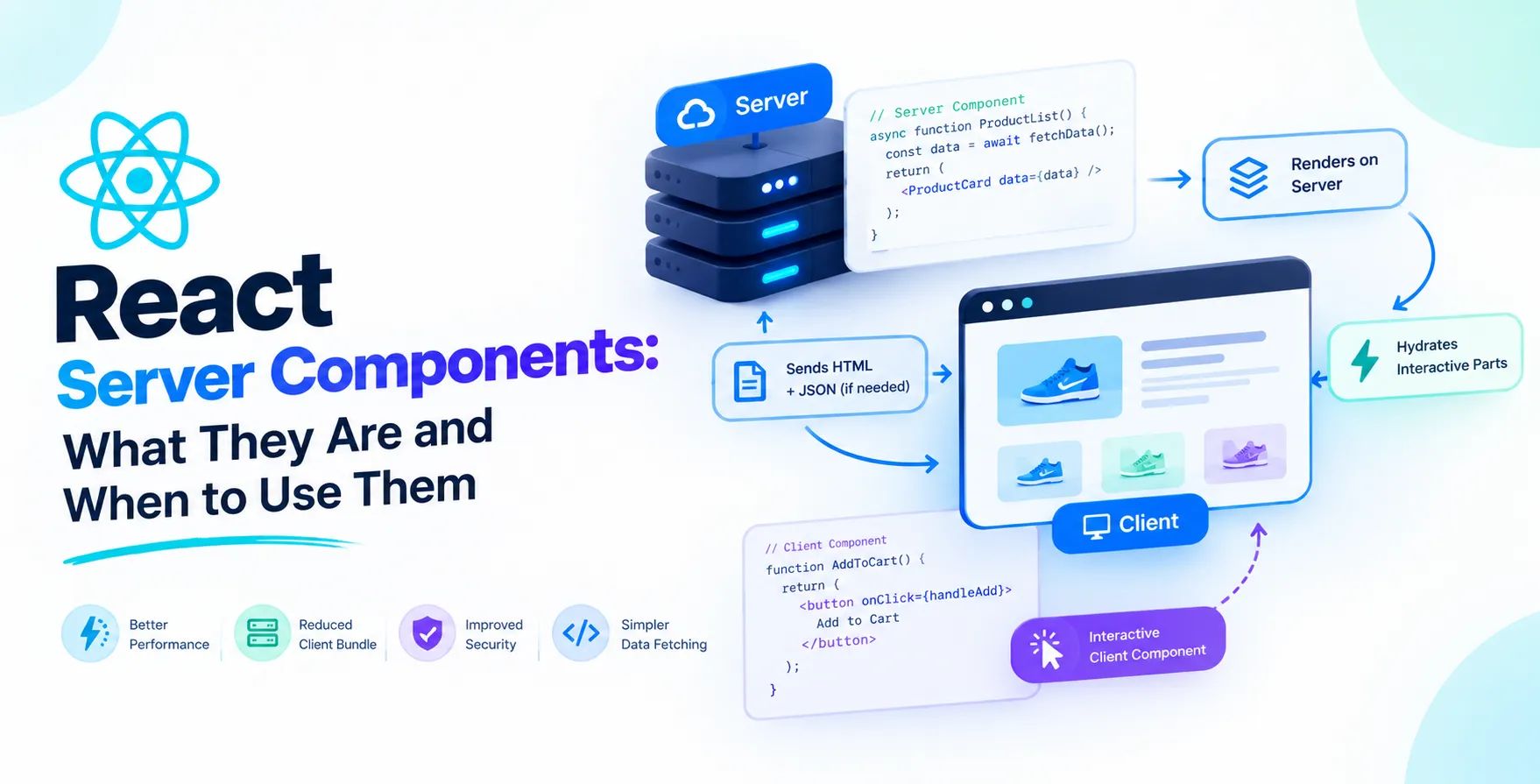
The React server component architecture fundamentally separates UI logic into distinct execution environments. By running code on the server, we reduce the amount of JavaScript sent to the client.
This means your application starts faster because the browser has less code to parse and execute. It effectively bridges the gap between traditional server-side rendering and interactive client-side interfaces.
- Separates server and client logic
- Reduces JavaScript bundle size
- Enhances initial page load performance
- Simplifies complex data fetching pipelines
The Core Concept Explained
At its heart, understanding React Server Components involves recognizing that not every UI piece needs interactivity. Many parts of a webpage, like static text or blog posts, are purely presentational.
By default, components in these frameworks can now be treated as server-side entities. They run once on the server, generate the necessary HTML, and only send the final output to the user.
This eliminates the need for shipping large component libraries to the client for simple tasks. You save bandwidth and CPU cycles, which directly translates to a more responsive web development experience.
Why Performance Matters
Speed is a critical factor for any web application. Users abandon sites that take too long to become interactive or display content.
RSC in React optimizes this by offloading heavy computational tasks. Your server handles the heavy lifting, and the browser handles the final display.
- Faster Time to Interactive
- Lower memory usage on devices
- Reduced network payload size
- Improved SEO friendly web development
Client Components vs Server Components
Distinguishing between these two is vital for architecture design. Server components are best for static data, while client components handle user interactions.
| Feature |
Server Components |
Client Components |
| Execution |
Server-side only |
Client-side and Server |
| Interactivity |
No hooks like useState |
Full support for hooks |
| Data Fetching |
Direct database access |
Requires API endpoints |
| Bundle Size |
Zero impact |
Increases with complexity |
| Browser API |
Not accessible |
Fully accessible |
When to Use Server Components
You should prioritize server components for any part of your UI that does not require immediate user feedback. This includes rendering markdown, displaying static product descriptions, or fetching data from a CMS.
Using them in these scenarios keeps your main bundle lean. It also allows you to query your database or internal APIs directly without exposing sensitive logic to the client.
- Fetching data from databases
- Accessing back-end services directly
- Rendering static page layouts
- Processing markdown or text content
- Reducing total bundle size
When to Stick with Client Components
Client components remain necessary for any part of your UI that requires state changes or browser APIs. If a component needs to handle clicks, form inputs, or window events, it must be a client component.
Attempting to force these into a server-side context will result in runtime errors. Always keep interactivity as the primary indicator for choosing between the two.
- Components using useEffect
- Forms requiring immediate validation
- Buttons handling click events
- Dynamic animations and transitions
Impact on Bundle Sizes
One of the biggest wins with this architecture is the drastic reduction in total JavaScript shipped to the browser. Before this, every dependency used in a component was included in the bundle.
Now, if a large library is only needed on the server to process data, it never touches the user's browser. This keeps the initial load lightweight and performant.
This is a major leap forward compared to traditional patterns where all code was bundled together. Developers can now use powerful server-side tools without worrying about the performance cost on the client side.
Data Fetching Advantages
Data fetching becomes significantly cleaner with this new model. You no longer need to build complex API endpoints just to serve data to your own frontend components.
Instead, you can fetch data directly within the component itself. This reduces the boilerplate code usually required for managing request states and loading indicators.
- Direct database queries
- Reduced API route maintenance
- Cleaner component hierarchy
- Synchronous data flow patterns
Direct Backend Access
Security is improved by keeping sensitive logic off the client. You can safely perform authentication checks or database operations inside your components without exposing secrets.
The server environment is a trusted zone. This allows for more secure implementations of complex business rules that might otherwise be leaked in client-side code.
Modern Framework Integration
Most modern frameworks have fully embraced this paradigm. Using these features often requires a meta-framework that handles the routing and data layer orchestration.
This makes the transition much smoother for teams already using professional tools. It aligns perfectly with the future of frontend development by standardizing how we handle server-client communication.
Best Practices for Implementation
Start by converting your most static pages first to see the performance gains. Do not attempt to refactor your entire codebase at once, as it requires a mindset shift.
Always keep your server components lean and focused on data preparation. Reserve client components for the interactive "islands" that truly need them.
- Start with static landing pages
- Keep component logic separated
- Use specialized frameworks
- Monitor bundle sizes regularly
- Maintain clear component boundaries
Conclusion
Mastering React Server Components is essential for any developer looking to stay relevant. They offer a powerful way to balance performance with interactivity in modern web apps.
By understanding what they are and when to use them, you can build faster, more secure, and more efficient applications. Start experimenting with these patterns today to see the difference in your own projects.


 In collaboration with