Table of Contents
- Introduction to ISO 20022
- The Role of Payment APIs
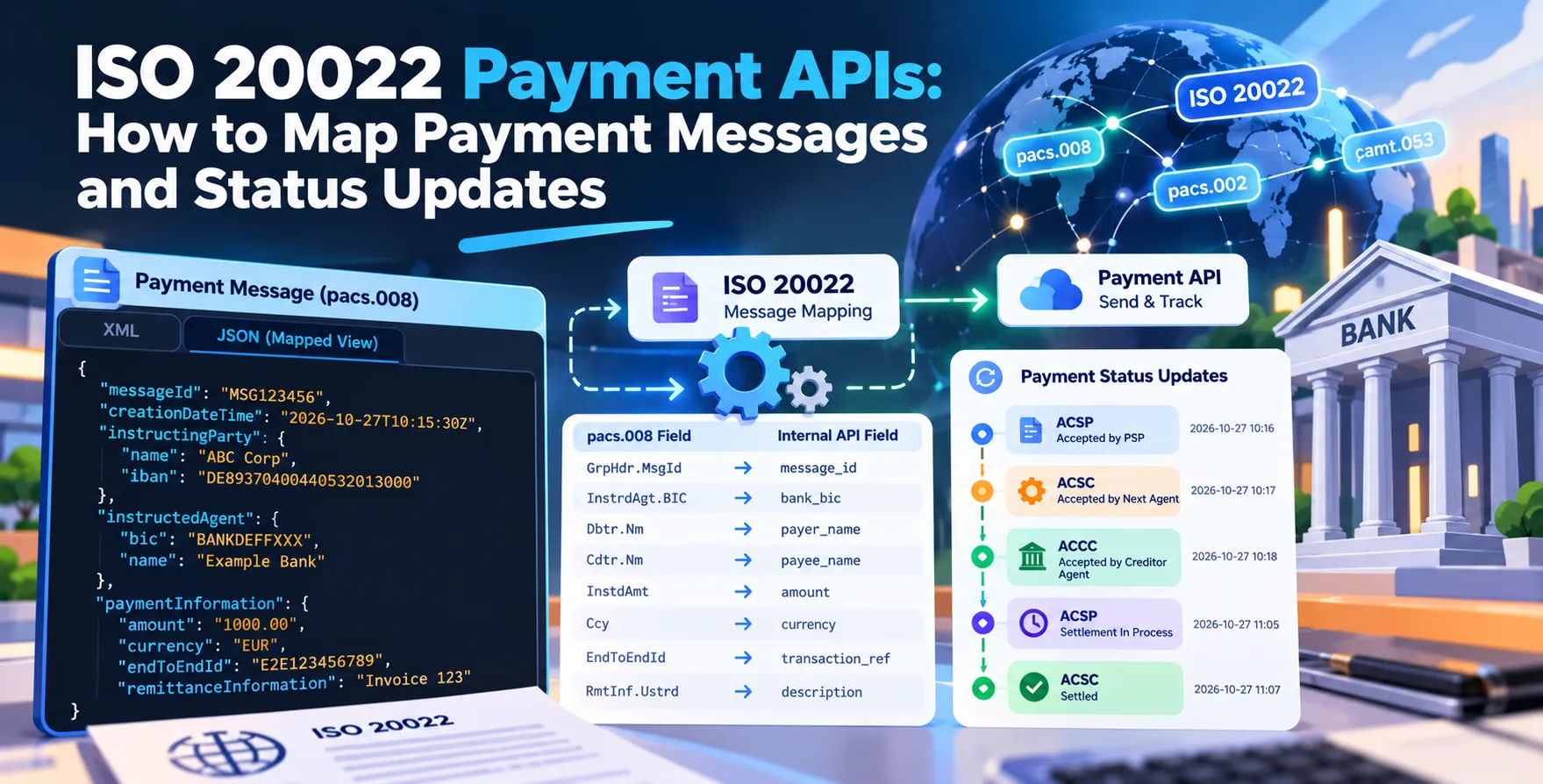
- Understanding pacs.008 Payment Messages
- Mapping Financial Data Fields
- Handling pacs.002 Payment Status Messages
- Challenges in API Integration
- Best Practices for Data Mapping
- Ensuring Message Integrity
- Security Considerations
- Testing Your ISO Integration
- The Shift Toward Real-Time Payments
- Scaling Financial Infrastructure
- Final Thoughts
Introduction to ISO 20022
The financial services industry is undergoing a massive transformation toward standardized data exchange. At the heart of this shift is ISO 20022, a global messaging standard that provides rich, structured data for financial transactions.
As developers building modern fintech platforms, understanding ISO 20022 payment APIs how to map payment messages and status updates is no longer optional. It is a fundamental requirement for building interoperable global payment systems.
By using this standard, institutions move away from legacy, fragmented formats toward a single, unified language for payments. This leads to better compliance, fewer errors, and faster clearing times.
The Role of Payment APIs
Modern payment infrastructure relies heavily on RESTful architectures to expose banking capabilities. When integrating these services, developers must bridge the gap between internal data models and the rigid requirements of ISO XML schemas.
Effective ISO 20022 API integration requires more than just passing JSON objects back and forth. You must ensure that the semantic meaning of each data field is preserved across the entire lifecycle of a transaction.
APIs serve as the translation layer that makes these complex financial standards accessible to modern applications. Without well-designed API contracts, the richness of ISO data is often lost during the transformation process.
- Facilitates seamless inter-bank communication
- Provides granular transaction tracking
- Enables real-time data visibility
- Reduces manual intervention for reconciliation
Understanding pacs.008 Payment Messages
The pacs.008 payment message is the industry standard for customer credit transfers. It carries the primary instruction for moving funds from a debtor to a creditor.
Unlike older formats, this message type contains extensive information about the parties involved and the remittance details. Mapping this accurately is the most critical step in your payment pipeline.
Developers must ensure that their API request body maps correctly to the required XML tags. A single missing field can result in a rejected transaction by the clearing system.
- Debtor and creditor identification
- Structured remittance information
- Currency and amount details
- Intermediate agent information
Mapping Financial Data Fields
Mapping internal application data to ISO formats is a complex task that requires attention to detail. You are essentially converting your internal representation into a strictly typed, schema-validated XML document.
Start by identifying the mandatory fields for the transaction type. Use a mapping table to document how your internal database columns align with the specific ISO elements.
Automated validation tools can help you catch schema violations before the message is sent to the network. Always validate against the specific version of the ISO 20022 standard required by your banking partner.
| ISO Field |
Internal Data Point |
Validation Rule |
| InstdAmt |
TransactionAmount |
Decimal, 2 places |
| DbtrAcct |
SenderAccountID |
IBAN format required |
| CdtrAcct |
RecipientAccountID |
IBAN format required |
| Purp |
PaymentReasonCode |
ISO 20022 code list |
| RmtInf |
InvoiceReference |
Alphanumeric string |
Handling pacs.002 Payment Status Messages
A payment lifecycle is never complete without feedback. The pacs.002 payment status message provides the necessary updates on the outcome of a transaction, whether it is settled, rejected, or pending.
Your API must be equipped to handle these asynchronous notifications gracefully. This is where robust webhook implementations become essential for notifying your internal systems of state changes.
Always verify the transaction reference in the status update to ensure you are updating the correct record in your database. Failure to handle these messages can lead to inconsistent state across your platform.
- Confirming successful transaction settlement
- Identifying reasons for rejection
- Managing pending or queued states
- Triggering downstream business logic
Challenges in API Integration
Integrating with global banking systems presents unique obstacles. The primary challenge is the sheer complexity of the ISO 20022 specification, which is extensive and frequently updated.
Developers often struggle with the verbosity of XML-based messages compared to lighter JSON formats. This disparity necessitates robust serialization and deserialization layers within your codebase.
Additionally, handling multi-currency and cross-border regulatory requirements adds layers of logic that must be managed carefully. You must account for regional variations in how the standard is implemented by different central banks.
Best Practices for Data Mapping
Consistency is key when working with financial data. Establish a clear schema mapping strategy from the beginning and document it thoroughly for your engineering team.
Avoid hardcoding values wherever possible. Use configuration files or lookup tables to manage mapping logic, which allows for easier updates as banking requirements evolve.
Regularly audit your mapping logic against production data. Identifying discrepancies early prevents costly reconciliation issues later in the payment cycle.
- Use centralized mapping dictionaries
- Implement automated schema validation
- Maintain version control for mappings
- Document all edge-case scenarios
Ensuring Message Integrity
Data integrity is non-negotiable in financial services. Every message must be validated to ensure it has not been tampered with or corrupted during transmission.
Use digital signatures to verify the authenticity of incoming and outgoing payloads. This provides non-repudiation, ensuring that both parties can prove the transaction occurred.
Implement strict logging for every stage of the message lifecycle. This allows you to reconstruct the history of a payment if a dispute or audit occurs later.
Security Considerations
Protecting financial data requires a defense-in-depth approach. Ensure that your API communication is encrypted using modern TLS standards and that you are using secure authentication methods like OAuth 2.1.
Implement strict access controls to ensure only authorized services can trigger payment operations. Periodically rotate API keys and monitor for any suspicious activity.
For sensitive operations, consider using hardware security modules to manage cryptographic keys. This provides an extra layer of protection for the most critical components of your infrastructure.
Testing Your ISO Integration
Comprehensive testing is the only way to ensure your implementation is production-ready. You should simulate various scenarios, including successful payments, rejected messages, and network timeouts.
Use mock servers to emulate the behavior of banking clearing houses. This allows you to test your handling of pacs.002 payment status message updates without executing real financial transactions.
Integrate your tests into your CI/CD pipeline to ensure that new code changes do not break existing mapping logic. Consistent testing is the foundation of a reliable payment platform.
- Unit testing for mapping functions
- Integration testing with banking mocks
- End-to-end testing of transaction flows
- Load testing for high-volume scenarios
The Shift Toward Real-Time Payments
The industry is moving toward instant payment settlement. This creates a need for APIs that can process messages with near-zero latency, requiring highly optimized serialization routines.
Real-time systems do not allow for human-in-the-loop intervention. Your API must be capable of autonomous decision-making based on the status codes returned by the clearing network.
Embracing this speed requires a modern architecture that can handle spikes in traffic without compromising data integrity. Performance monitoring becomes a critical component of your operations.
Scaling Financial Infrastructure
As your transaction volume grows, your API architecture must scale accordingly. Distributed systems often introduce challenges in maintaining message order and state consistency.
Utilize robust queuing systems to manage message ingestion and processing. This ensures that you can handle bursts of traffic without overwhelming your core banking interfaces.
Monitor your system health using observability tools to identify bottlenecks in your message processing pipeline. Proactive scaling based on real-time data ensures your platform stays performant under load.
Final Thoughts
Implementing ISO 20022 is a major undertaking that requires deep technical knowledge and careful planning. By focusing on accurate data mapping and robust handling of status updates, you can build a resilient payment system.
Take the time to design your API contracts with longevity in mind. As the global financial landscape continues to evolve, a flexible and well-structured implementation will serve your business well.
Stay committed to security and rigorous testing. These practices form the bedrock of trust in any financial application.
- Focus on semantic data mapping
- Prioritize robust error handling
- Invest in comprehensive automated testing
- Maintain strict security standards


 In collaboration with