Table of Contents
- Introduction to PCI DSS 4.0.1
- Why Compliance Matters for SaaS
- Scope of Your Payment Environment
- Data Encryption Requirements
- Strong Authentication Protocols
- Secure API Communication Standards
- Logging and Monitoring Infrastructure
- Managing Third-Party Service Providers
- Configuration and Patch Management
- Testing and Vulnerability Assessment
- The Role of Secure Development
- Maintaining Continuous Compliance
- Conclusion
Introduction to PCI DSS 4.0.1
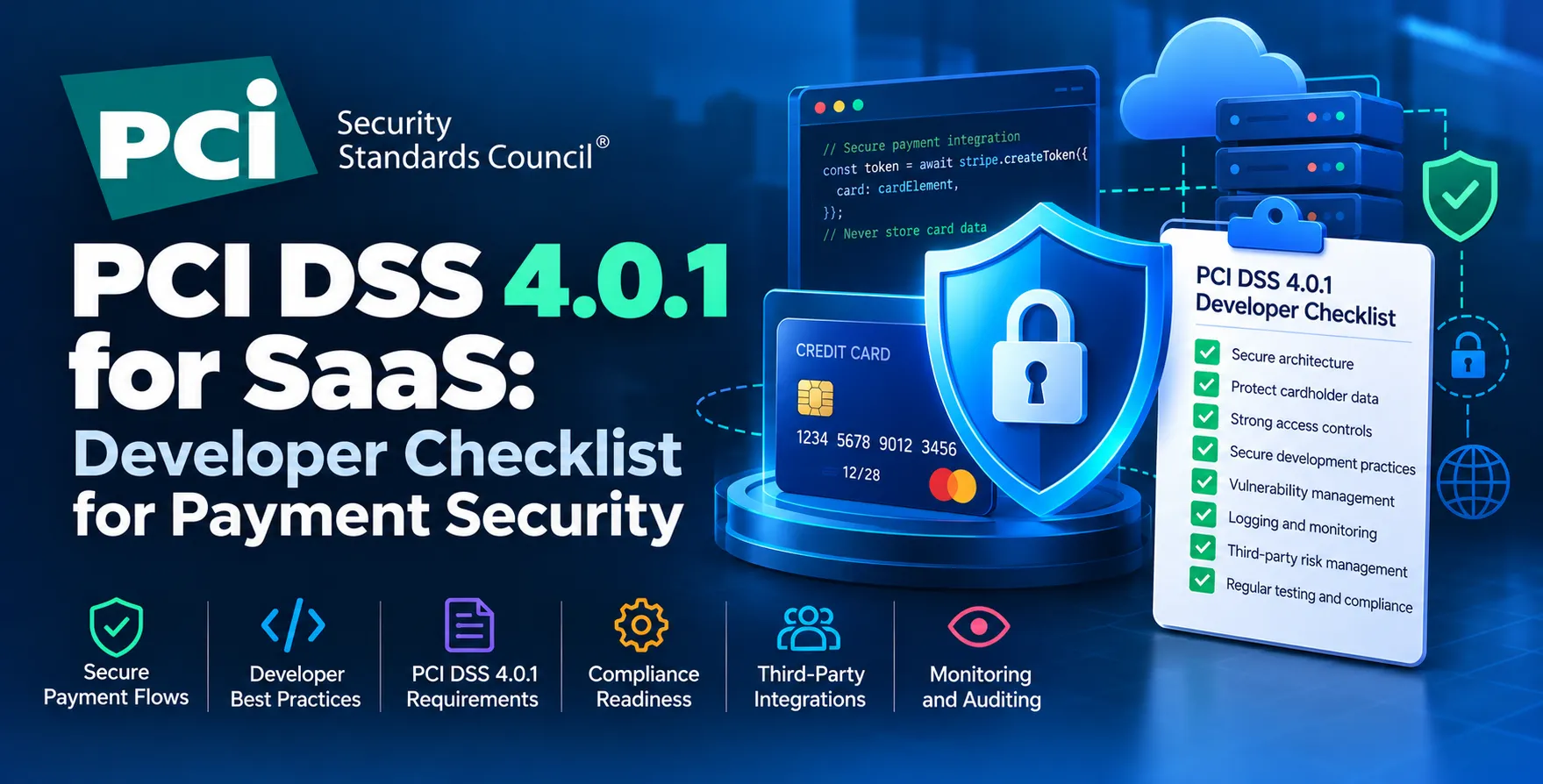
The landscape of payment security is constantly shifting, and PCI DSS 4.0.1 represents the latest standard for protecting cardholder data. For teams involved in SaaS development, this updated framework introduces more rigorous requirements than its predecessors.
Understanding these changes is critical for any engineering team building modern financial platforms. You must move beyond simple checkbox compliance to a mindset of robust, continuous security.
Why Compliance Matters for SaaS
PCI compliance for SaaS is not just about avoiding fines or legal repercussions. It is fundamentally about protecting your customers and building trust in your platform.
A breach in a multi-tenant environment can have catastrophic consequences for your brand and operations. Ensuring your architecture meets these standards is a baseline expectation for any professional payment processing service.
- Prevents costly data breaches
- Establishes enterprise-grade trust
- Required for payment gateway partnerships
- Streamlines audit preparation processes
Scope of Your Payment Environment
Defining the scope is the most critical step in your security journey. If you do not know where cardholder data lives, you cannot secure it properly.
You must map every system, service, and database that touches sensitive payment information. Limiting this scope is a highly effective strategy to reduce your compliance burden.
- Isolate cardholder data environments
- Document all data flows
- Minimize systems in scope
Data Encryption Requirements
Encryption at rest and in transit is a non-negotiable pillar of PCI DSS 4.0.1. You must ensure that cryptographic keys are managed with strict access controls and rotated regularly.
Simply using standard TLS is no longer sufficient for all internal data movement. Your implementation should leverage modern, strong ciphers that align with current industry standards.
Encryption Best Practices
Developers should focus on hardware security modules or cloud-native key management services. These tools provide the necessary audit trails and security guarantees required by the latest standard.
- Use industry-standard encryption algorithms
- Implement strict key management policies
- Rotate cryptographic keys frequently
- Secure data at rest storage
- Utilize hardware security modules
Always avoid storing sensitive authentication data post-authorization. Any data kept must be necessary for business operations and clearly defined in your retention policy.
Strong Authentication Protocols
Multi-factor authentication is mandatory for all access to the cardholder data environment. This applies to both your administrative staff and your automated systems that manage keys or databases.
Implementing robust identity management prevents unauthorized access to your core infrastructure. Relying on single-factor passwords in a modern cloud environment is a significant security risk.
- Enforce multi-factor authentication everywhere
- Implement least privilege access models
- Disable default vendor passwords
- Log all authentication attempts
Secure API Communication Standards
When building a financial SaaS platform, your interfaces are the most exposed part of your architecture. Implementing secure API best practices is vital to prevent injection attacks and unauthorized data exfiltration.
You should treat every incoming request as potentially malicious. Ensuring that your platform follows secure REST API patterns and validates all inputs is essential for preventing common vulnerabilities.
- Validate all API inputs strictly
- Use strong API authentication methods
- Implement rate limiting and throttling
- Encrypt all API traffic endpoints
- Maintain detailed API access logs
Developers should also consider the security of webhooks and other asynchronous communication channels. Using signature verification ensures that your endpoints only process legitimate, untampered events from your payment partners.
Logging and Monitoring Infrastructure
You must have a centralized logging system that captures all relevant security events. PCI DSS 4.0.1 places a heavy emphasis on the ability to detect and respond to suspicious activity in real-time.
Automated alerts are necessary to catch anomalies that manual reviews would miss. Your logs should be protected from tampering and stored in a secure, immutable format.
- Centralize all security logs
- Retain logs for at least one year
- Implement automated real-time alerting
- Protect logs from unauthorized modification
Managing Third-Party Service Providers
Your security is only as strong as the vendors you integrate with. You must verify that your payment orchestrators and cloud providers also maintain their own compliance certifications.
Maintaining an updated list of these service providers is part of your ongoing obligation. You need to know exactly which parts of your security stack are handled by external entities.
- Perform regular vendor security audits
- Document all shared responsibilities
- Review third-party compliance reports
Configuration and Patch Management
Default configurations are a frequent target for attackers. You must harden all servers, databases, and containers before they are deployed to production environments.
A rigorous patch management process ensures that known vulnerabilities are addressed before they can be exploited. Delaying security updates is one of the most common reasons for successful attacks on SaaS platforms.
| Task |
Frequency |
Importance |
| Hardening Servers |
At deployment |
Critical |
| Patching OS |
Monthly |
Critical |
| Reviewing Rulesets |
Quarterly |
High |
| Scanning Ports |
Weekly |
Medium |
| Auditing Access |
Monthly |
High |
Testing and Vulnerability Assessment
Regular penetration testing and internal vulnerability scanning are core parts of the payment security checklist. These exercises identify weaknesses in your defenses before bad actors can find them.
Automated tools should be integrated into your development lifecycle to catch issues early. Do not wait for an annual audit to discover that your systems are vulnerable.
- Conduct regular penetration testing
- Automate vulnerability scans
- Fix critical findings promptly
- Document remediation efforts
The Role of Secure Development
Security must be integrated into your development culture from the start. Training your engineering team on secure coding practices prevents vulnerabilities from even entering your codebase.
Code reviews should include a security-focused perspective rather than just functional logic. Catching a security flaw during the pull request phase is significantly cheaper than fixing it in production.
- Perform security-focused code reviews
- Train developers on OWASP standards
- Use static analysis security testing
- Implement secure build pipelines
Maintaining Continuous Compliance
Compliance is a constant state, not a one-time event. You should design your architecture to make continuous monitoring and reporting as automated as possible.
Treat your security controls as code. Versioning your policies and configurations allows you to track changes and roll back if necessary, providing an audit trail for future reviews.
Conclusion
Achieving compliance with PCI DSS 4.0.1 for SaaS requires dedication and a proactive approach to security. By following this payment security checklist, you build a foundation that protects sensitive cardholder data while fostering customer trust.
Focus on isolation, encryption, and rigorous monitoring to stay ahead of evolving threats. Remember that security is a journey, and your systems must adapt as the standard continues to mature.


 In collaboration with