Table of Contents
- Introduction to German E-Invoicing
- The Shift Toward Mandatory E-Invoicing
- Understanding the Core Standards
- Why Developers Must Act Now
- Technical Architecture for Compliance
- Key API Integration Components
- Handling Data Validation Rules
- Security Considerations for Financial Data
- Testing Strategies for E-Invoices
- Managing Invoice Lifecycle States
- Common Implementation Challenges
- Scaling Your E-Invoicing Infrastructure
- Future-Proofing Your SaaS Platform
- Conclusion
Introduction to German E-Invoicing
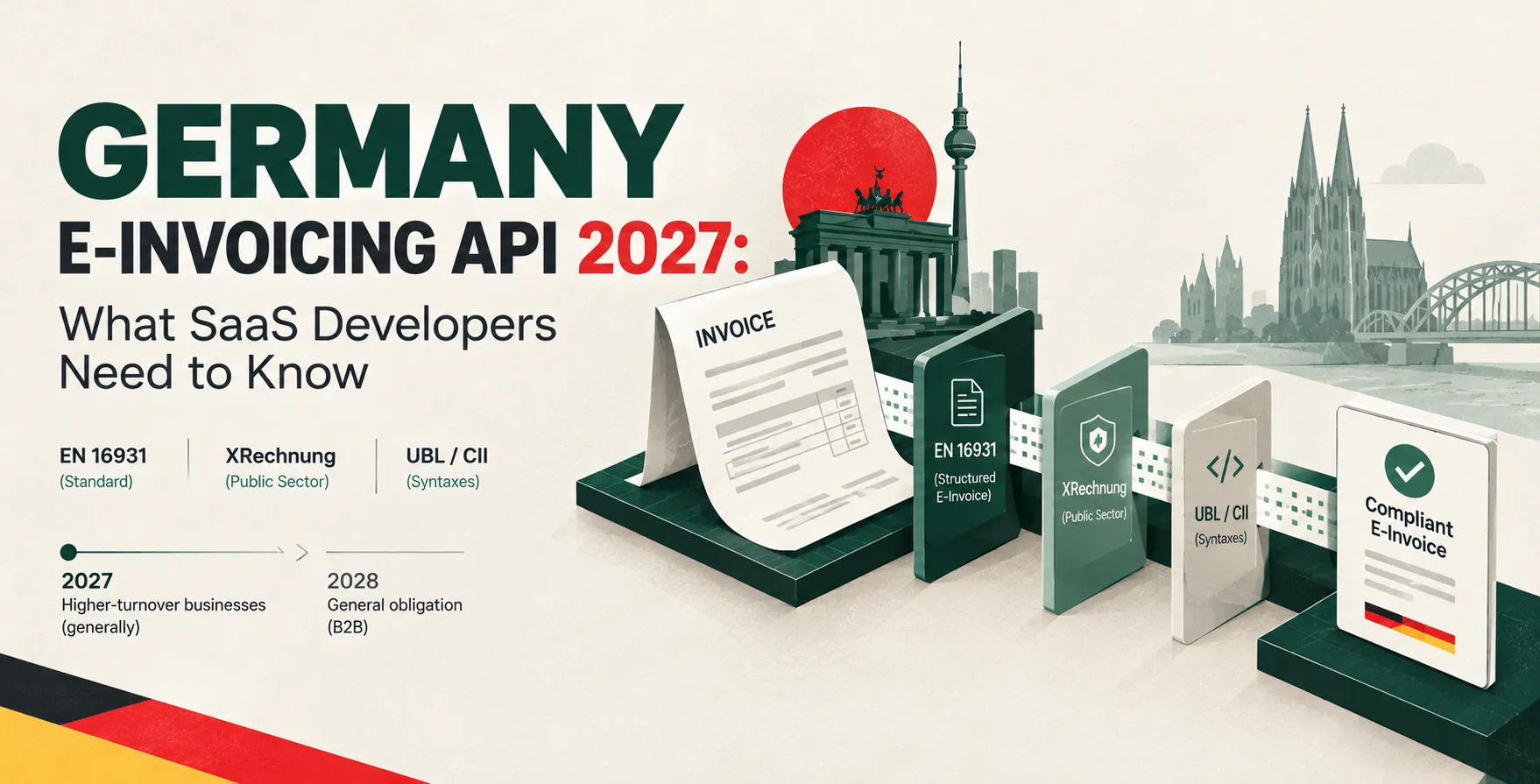
The landscape of B2B commerce in Germany is undergoing a significant transformation. By 2027, businesses will face strict mandates regarding how they exchange electronic invoices.
For SaaS platforms, this means integrating robust solutions to support these new standards. Ignoring these changes is not an option for any provider operating in the German market.
The Shift Toward Mandatory E-Invoicing
German authorities are moving toward a mandatory e-invoicing model to reduce tax fraud and modernize administrative processes. This transition represents a fundamental shift in how financial documents are processed.
Companies must move away from traditional PDFs and legacy formats toward structured, machine-readable data. This change directly impacts how software platforms handle invoice generation and delivery.
- Increased focus on structured data
- Mandatory adoption for B2B transactions
- Enhanced tax compliance visibility
- Reduced manual data entry errors
- Standardized data transmission protocols
Understanding the Core Standards
Successful implementation requires deep familiarity with the technical formats mandated by the German government. The primary standards revolve around structured XML files that allow for automated processing.
These formats ensure that tax authorities can easily ingest and verify transaction data. Your platform must be capable of generating and validating files that conform strictly to these government-defined schemas.
- XRechnung as the primary format
- ZUGFeRD for hybrid document support
- Peppol network connectivity requirements
- Semantic compliance with EU standards
- Validation against official XSD schemas
Why Developers Must Act Now
Waiting until 2027 to start your development cycle is a major risk for any product team. The complexity of building a reliable **German e-invoicing API** requires months of planning and rigorous testing.
Early adoption allows you to fine-tune your integration, identify edge cases, and establish trust with your enterprise clients. Companies already looking for finance software are prioritizing vendors who can demonstrate clear readiness for these regulatory updates.
Technical Architecture for Compliance
Your technical architecture needs to be modular and highly resilient to handle the demands of automated tax reporting. A monolithic approach will likely struggle under the weight of frequent schema updates and high transaction volumes.
Think of your integration as a dedicated service within your existing ecosystem. This separation ensures that regulatory changes don't disrupt your core business logic or user experience.
Modular Service Design
Isolate your invoice generation logic from your main application core to maintain system stability. This allows you to update your XML generation engine without deploying your entire platform.
- Decoupled microservices architecture
- Dedicated invoice processing queues
- Separation of generation and transmission
- Independent logging for audit trails
- Caching layer for recurring tax data
Scalability Patterns
Ensure your system can handle spikes in invoice generation at the end of the month or quarter. Without proper scaling, your API could become a bottleneck for your users.
- Asynchronous processing for invoice transmission
- Horizontal scaling of worker nodes
- Load balancing for API traffic
- Database indexing for rapid lookup
- Monitoring for performance bottlenecks
Key API Integration Components
A well-designed integration relies on several moving parts working in harmony. You need a reliable way to map internal invoice data to the required XML fields without losing fidelity.
Using a standardized approach to **XRechnung API integration** helps prevent common mapping errors. You must ensure that your transformation engine can handle complex tax calculations and business rules required by German tax law.
| Component |
Purpose |
Criticality |
| Data Mapper |
Maps internal fields to XML |
High |
| XML Generator |
Creates compliant documents |
High |
| Signature Service |
Ensures document integrity |
Medium |
| Transmission Layer |
Handles network communication |
High |
| Logging Module |
Tracks audit history |
High |
Handling Data Validation Rules
Validation is perhaps the most critical step in the entire pipeline. If your output fails government validation, the entire invoice transmission process is effectively broken.
Implement a two-stage validation process. First, validate against your own internal business rules, then perform a secondary check against official government XSD schemas.
- Pre-submission schema validation
- Mandatory field presence checks
- Tax rate consistency verification
- Currency and rounding precision tests
- Error reporting for end users
Security Considerations for Financial Data
Handling financial documents requires strict adherence to data protection standards. Your integration must prioritize security at every layer of the communication process.
You should implement robust encryption for data in transit and at rest. Furthermore, ensure that only authorized services within your infrastructure can initiate invoice transmission or access sensitive tax data.
- End-to-end encryption for transmission
- Strict API authentication methods
- Regular security audits of pipelines
- Access control for invoice data
- Immutable logging for compliance
Testing Strategies for E-Invoices
Robust testing is the difference between a successful rollout and a catastrophic system failure. You cannot rely on manual testing when dealing with hundreds of potential edge cases in invoice structures.
Automated testing frameworks are essential for verifying that your XML outputs remain valid even after minor code changes. Treat these tests as a core part of your development lifecycle rather than an afterthought.
- Unit tests for data mapping
- Integration tests for XML generation
- End-to-end testing with sandbox environments
- Negative testing for invalid inputs
- Performance testing under high loads
Managing Invoice Lifecycle States
An invoice does not simply disappear once sent. You must track its lifecycle from creation to receipt confirmation by the buyer and final tax authority acknowledgment.
This requires a state machine approach to manage transitions. Ensure your API provides clear status codes so that your front-end and your users always know the current standing of their invoices.
- Draft status for pending records
- Validated status after schema check
- Submitted status during transmission
- Accepted status upon receipt
- Rejected status with error details
Common Implementation Challenges
The path to full compliance is rarely straightforward. Many developers underestimate the difficulty of handling legacy data formats or unexpected changes in government documentation.
You will face challenges regarding data normalization and the sheer variety of business cases across different industries. Plan for constant iteration as the regulatory environment in Germany continues to clarify its specific requirements.
- Mapping legacy data to modern XML
- Handling complex multi-tax scenarios
- Version mismatches in schema definitions
- Network timeouts during transmission
- User interface design for error handling
Scaling Your E-Invoicing Infrastructure
As your user base grows, the volume of invoices will increase linearly. You must design your infrastructure to support this growth without requiring constant manual intervention.
Consider utilizing cloud-native services to handle the heavy lifting of document generation and storage. This offloads the burden from your primary servers and improves overall system reliability.
- Cloud-managed storage for documents
- Auto-scaling worker clusters
- Global content delivery networks
- Managed database services for audit logs
- Automated disaster recovery planning
Future-Proofing Your SaaS Platform
Technology and regulations move fast. Building a system that is flexible enough to adapt to future mandates is vital for long-term success in the fintech space.
Avoid hard-coding specific validation rules deep within your logic. Use configuration-driven approaches to ensure you can update your engine quickly when requirements change again in the future.
Conclusion
Preparing for the **Germany e-invoicing** mandate is a significant undertaking that requires careful planning. By focusing on modular architecture, robust validation, and automated testing, you can build a system that meets the 2027 standards reliably.
Start your planning phase now to avoid the inevitable rush as the deadline approaches. Your dedication to technical excellence today will pay off in user trust and platform stability tomorrow.
- Prioritize early integration development
- Focus on modular, scalable architecture
- Implement strict automated testing
- Monitor official regulatory updates
- Maintain clear documentation for users


 In collaboration with