Table of Contents
- Introduction
- What is Open Banking?
- What is Open Finance?
- Key Differences Between Open Banking and Open Finance
- The Regulatory Shift in 2026
- How Financial APIs Are Evolving
- Impact on Corporate Banking and Operations
- Unlocking Customer Insights with Expanded Data
- Security and Compliance Challenges
- Implementation Strategies for Tech Leaders
- Monetization Models for Enterprise Fintech
- Practical Use Cases Across Industries
- Final Thoughts
Financial technology is undergoing a massive transformation as global regulatory frameworks mature. Businesses are moving beyond simple account aggregation into total financial interoperability.
Understanding the shift from basic transactional sharing to full ecosystem connectivity is essential for modern enterprise planning. This transition opens up unprecedented operational efficiency and product innovation.
Introduction
The global financial ecosystem is moving toward complete technical interoperability at an unprecedented pace. What began as a simple way to view bank account balances has evolved into a comprehensive strategy for institutional financial management.
Businesses entering 2026 face major opportunities as data sharing mandates expand across entire corporate balance sheets. Software engineering teams must understand how these changing frameworks alter system architectures and user experiences.
Adapting early allows organizations to optimize capital flows, reduce operational overhead, and launch high-margin financial products directly within native software environments.
What is Open Banking?
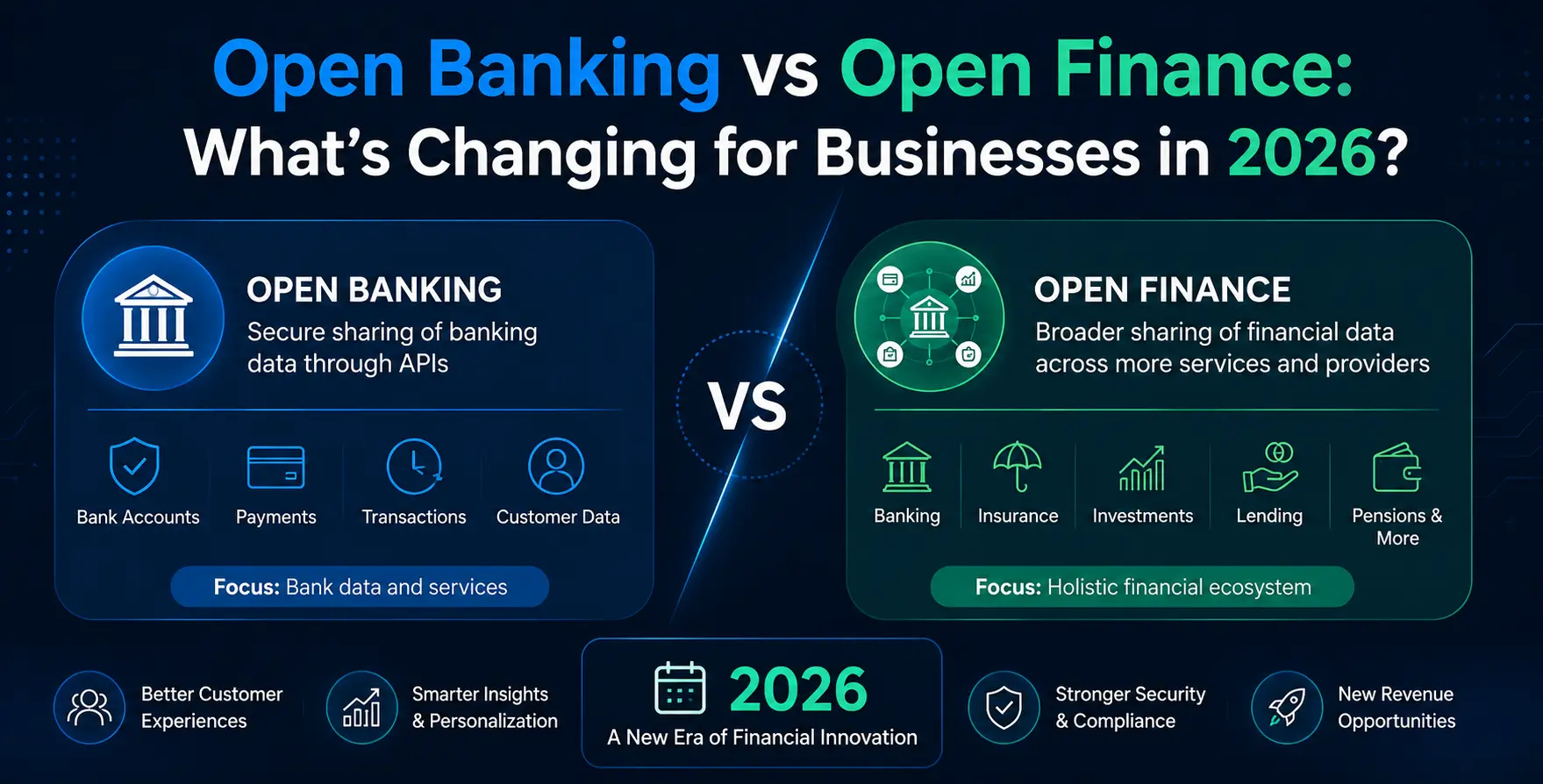
Open Banking refers to the secure sharing of traditional deposit account data through standardized application programming interfaces. It allows authorized third-party applications to inspect payment history and initiate direct transfers with consumer consent.
This foundational architecture established the initial standard for banking software integrations. It transformed payment processing across consumer and business applications alike.
The primary capabilities established under this framework include:
- Payment initiation services
- Checking account information aggregation
- Standardized developer access portals
- Granular user consent controls
These core capabilities created the baseline infrastructure for automated web checkouts and digital bookkeeping tools.
What is Open Finance?
Open Finance expands data sharing mechanisms beyond standard payment accounts to include an enterprise's entire monetary footprint. It encompasses corporate credit products, commercial real estate loans, investments, insurance policies, and tax records.
By connecting these diverse asset classes into unified software pipelines, companies gain complete visibility over enterprise liquidity and risk exposure.
The broader ecosystem incorporates several specialized financial categories:
- Commercial mortgages and term loans
- Corporate investment and treasury portfolios
- Enterprise insurance policies and claims
- Payroll and employee pension records
- Corporate tax filings and ledger history
- Trade credit and supplier financing
Accessing these diverse endpoints allows software to automate complex financial decision-making that previously required manual auditing.
Key Differences Between Open Banking and Open Finance
While both frameworks leverage modern software design to exchange data, their scope and commercial potential differ substantially. Engineering teams must evaluate these structural distinctions when architecting internal data pipelines.
| Dimension |
Open Banking |
Open Finance |
| Data Scope |
Deposit and checking accounts |
All corporate assets and liabilities |
| Primary Functionality |
Payment initiation and balance checks |
Holistic corporate asset management |
| Target Assets |
Current accounts and credit cards |
Investments, loans, and insurance policies |
| Regulatory Basis |
PSD2 and open banking mandates |
FIDA and expanded data frameworks |
| Data Complexity |
Standardized transactional payloads |
Multi-schema institutional asset models |
| Commercial Impact |
Faster payment processing speed |
Automated underwriting and dynamic risk scoring |
Understanding these differences helps enterprise leaders invest in backend integrations that deliver long-term commercial leverage.
The Regulatory Shift in 2026
Regulators across major economic jurisdictions are enacting stricter standards in 2026. Government authorities are expanding legacy consumer protection rules into broad mandates governing corporate asset connectivity.
These updated rules force legacy financial institutions to expose structured developer endpoints for non-deposit accounts. The shift removes long-standing data monopolies previously held by traditional banking conglomerates.
As a result, tech companies can build direct software connections without relying on fragile data scraping tools. This regulatory backing ensures higher API uptime and consistent payload structures.
How Financial APIs Are Evolving
Integrating an Open Banking API has transitioned from basic request-response calls into sophisticated real-time event streaming architectures. Modern infrastructure platforms now offer robust webhooks, automated token refresh cycles, and granular error handling primitives.
Developers can now construct reactive applications that respond instantly to changing financial conditions across connected accounts.
Modern developer interfaces deliver two foundational upgrades:
- Bi-directional real-time transaction sync
- Granular event-driven webhook notifications
These advancements significantly reduce integration maintenance costs while improving platform responsiveness.
Impact on Corporate Banking and Operations
Enterprise treasury divisions are seeing massive gains in operational efficiency. Real-time visibility into multi-bank accounts eliminates hours of manual spreadsheet reconciliation every single week.
Automated cash sweep triggers allow enterprise software to reallocate idle working capital dynamically into interest-bearing vehicles. Seamless data flows enable financial controllers to manage foreign exchange exposure in real time.
This structural transformation converts corporate financial management into an active competitive advantage.
Unlocking Customer Insights with Expanded Data
Broader operational visibility allows software vendors to construct sophisticated risk and behavior models. Analyzing complete balance sheets yields significantly more accurate credit scoring than examining isolated transaction histories.
Platforms can now deliver tailored recommendations based on an enterprise's total net worth and debt service capabilities.
Access to expansive data payloads yields concrete functional advantages:
- Automated continuous risk assessment
- Hyper-personalized commercial lending offers
- Predictive cash flow and runway forecasting
- Dynamic fraud prevention algorithms
- Streamlined corporate merchant onboarding
These analytical tools help software vendors lower customer acquisition costs while maximizing lifetime platform value.
Security and Compliance Challenges
Expanding data sharing perimeters introduces unique security responsibilities for software engineering teams. Protecting sensitive commercial records requires strict adherence to global cybersecurity standards.
Data Authorization Standards
Managing dynamic client consent requires robust authorization servers capable of processing fine-grained permission scopes continuously.
- OAuth 2.0 PKCE access delegation
- Financial-grade API security profiles
Implementing modern security protocols safeguards endpoints against token injection attacks.
Regulatory Audit Trails
Enterprise platforms must maintain immutable event logs for every data request executed across connected financial providers.
- Cryptographic request signing and verification
- Real-time consent revocation synchronization
Robust audit logging guarantees full compliance during regulatory reviews and security assessments.
Implementation Strategies for Tech Leaders
Software architects must design flexible data ingestion layers to manage diverse payload formats from external financial institutions. Direct point-to-point integrations create technical debt that slows product iteration over time.
Establishing an abstraction layer isolates core domain logic from backend vendor schema variations.
Key structural principles for scalable integration include:
- Decouple interface adapters from domain models
- Implement resilient dead-letter message queues
- Normalize heterogeneous vendor data payloads
- Enforce strict outbound rate limiting controls
A resilient backend structure minimizes system downtime during third-party service degradation.
Monetization Models for Enterprise Fintech
Broad data availability allows B2B software vendors to unlock direct monetization channels. Incorporating financial functionality into standard business tools increases software stickiness and opens new revenue streams.
Selecting the correct commercial structure depends on overall software positioning and target customer profile.
Leading financial software monetization models include:
- Usage based API query tier pricing
- Premium cash management software subscriptions
- Revenue sharing on originated loan volume
- Transaction markup on automated payment routes
Diversifying revenue models strengthens software margins during broader economic shifts.
Practical Use Cases Across Industries
Deploying Embedded Finance Solutions inside vertical B2B platforms enables non-financial software companies to provide context-aware lending and treasury functionality directly to end users.
Integrating financial workflows directly into daily operational software keeps business clients engaged within a single application ecosystem.
High-growth operational use cases include:
- E-commerce platforms offering automated merchant capital
- Logistics platforms enabling instant invoice discounting
- Healthcare software automating complex insurance payouts
- Property management portals automating tenant credit checks
These contextual integrations drive higher customer retention across specialized vertical SaaS platforms.
Final Thoughts
The evolution from isolated bank connectors to comprehensive ecosystem data sharing represents a pivotal milestone for modern enterprise technology. Organizations that align software strategies with these expanding capabilities will capture substantial operational efficiencies.
Building adaptable, security-focused integration architectures today prepares software platforms for continuous innovation throughout 2026 and beyond.


 In collaboration with