 In collaboration with

Aanal Shah
Founder of Zillion Infotech


Loading calendar...
We're Proud to Announce


Zillion Infotech has partnered with Bloxbitz. Together, we refer clients between our teams and collaborate on technology projects where our capabilities complement each other.
Have an ambitious idea, technology challenge, or ecosystem to build? Let's talk.

Aanal Shah
Founder of Zillion Infotech
Connect with us on social media!


The digital landscape in India is undergoing a significant transformation regarding how personal information is handled. As software engineers, we must shift our focus toward privacy-by-design to meet the new regulatory standards.
Achieving India DPDP Act compliance is not just a legal requirement but a fundamental part of building trust with your users. This article outlines the essential steps for developers tasked with updating their platforms.
The Digital Personal Data Protection Act establishes a framework for the processing of digital personal data. It emphasizes the rights of individuals and the obligations of those who process their information.
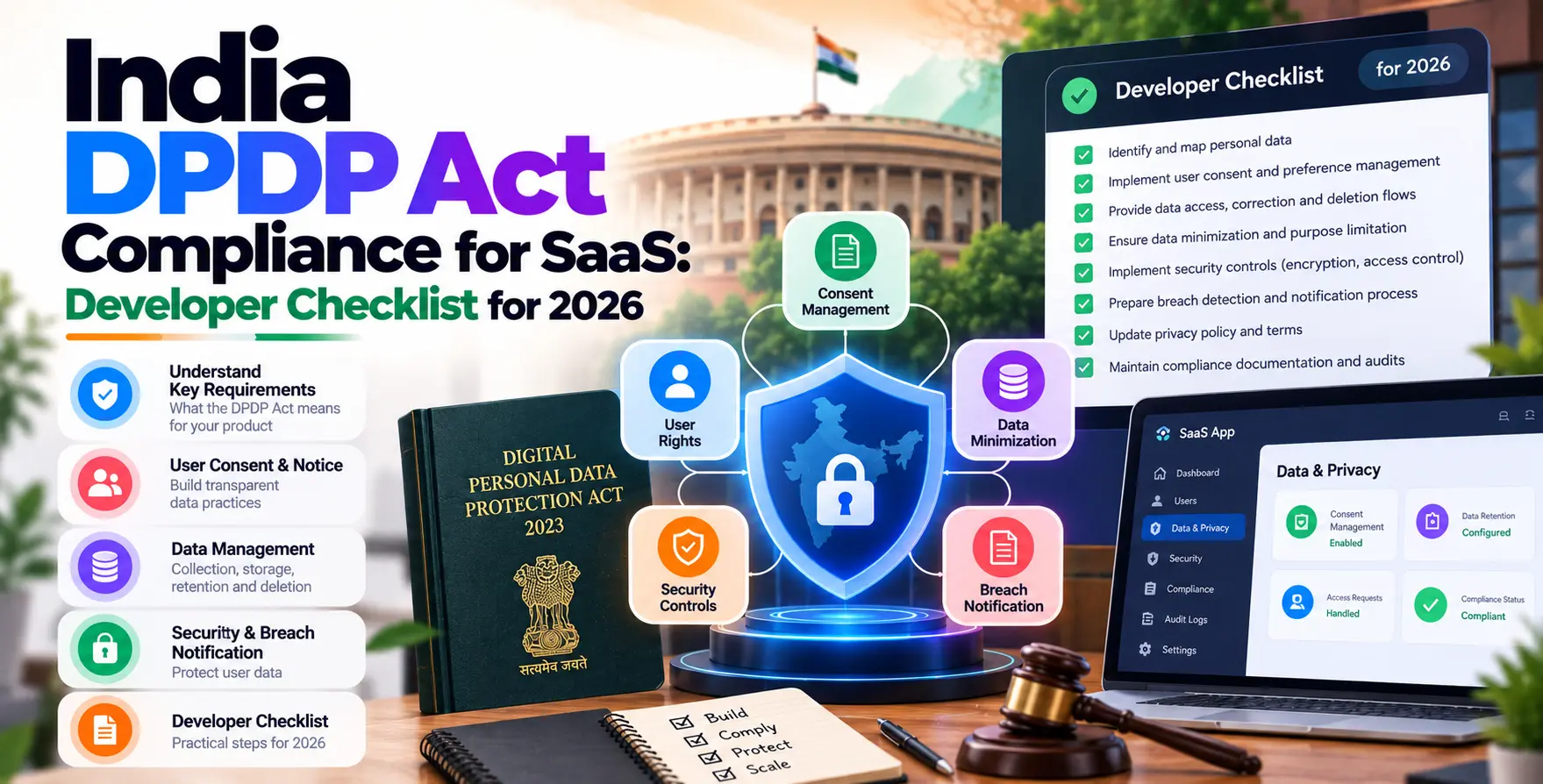
For any India DPDP Act compliance for SaaS developer checklist 2026, understanding the terminology is vital. You need to distinguish between data fiduciaries and data processors to map out your architecture correctly.
SaaS providers often handle massive volumes of sensitive user information. Whether you are working on SaaS development or maintaining an existing platform, the scope of the law is broad.
You must map every data flow within your application. Identifying where data is collected, stored, and processed is the first step in ensuring DPDP compliance for SaaS.
Data minimization is a core tenet of the legislation. You should only collect the data absolutely necessary for the specific service you provide to the user.
Developers need to audit their database schemas and API payloads. If a field is not required for the core application logic, remove it from your data models immediately.
Consent under the new law must be free, specific, informed, and unambiguous. Building a robust consent management system is a high-priority task for your engineering team.
Your application needs to store a clear audit trail of when and how consent was obtained. This system must be easily accessible for users to manage or withdraw their preferences at any time.
Users have the right to access their data, correct inaccuracies, and request erasure. Your platform must provide automated ways to fulfill these requests without manual intervention.
Data portability is another requirement. You should build export features that allow users to download their personal data in a machine-readable format.
You need systems that can process user requests efficiently. This includes verifying identities before granting access to personal data.
These features ensure you meet India data privacy compliance while reducing the operational burden on your support team.
Security is the backbone of any privacy initiative. You must protect personal data against unauthorized access, disclosure, or destruction.
Implement industry-standard encryption for data at rest and in transit. Regularly perform vulnerability scans to ensure no sensitive data is leaking through your logs or error messages.
You cannot keep user data indefinitely. Your application must define clear retention periods based on the purpose for which the data was collected.
Once the purpose is satisfied, data should be deleted or anonymized. Automated background jobs are the best way to manage these retention policies at scale.
Accountability is a major component of the law. You must maintain detailed logs of all data access and processing activities for compliance reporting.
These logs should be immutable and stored in a secure location. This allows you to demonstrate your DPDP Act compliance during any formal review process.
| Log Type | Retention Period | Access Level |
|---|---|---|
| Authentication Logs | 1 Year | Admin Only |
| Data Access Logs | 2 Years | Compliance Team |
| Consent Changes | Indefinite | Read-Only |
| Deletion Records | 5 Years | Audit Team |
Transferring personal data outside of India is subject to specific government restrictions. You need to ensure your infrastructure configuration respects these geographic boundaries.
If you use global cloud providers, verify their regional data residency options. Use regional endpoints to keep traffic within specified borders whenever possible.
Privacy features require the same level of testing as functional code. You must integrate privacy checks into your CI/CD pipeline to prevent accidental data leaks.
Use automated tests to verify that data minimization rules are applied correctly. Ensure that your staging environments never contain real personal data.
Privacy should be part of the development lifecycle, not an afterthought. Shift-left your privacy strategy to catch issues during the design phase.
Educate your team on the requirements of the act. When developers understand the 'why' behind the 'how', compliance becomes a natural part of the coding process.
Documenting your architecture and data handling practices is essential. You must maintain an up-to-date registry of your processing activities.
This documentation serves as proof of your commitment to privacy. It also helps new developers understand the constraints and best practices of your platform.
Navigating the new privacy landscape requires a proactive approach. By following this developer checklist, you can ensure your SaaS platform is prepared for the standards of 2026.
Focus on privacy-by-design, automate your consent and deletion processes, and maintain transparency with your users. Building a secure and compliant platform will ultimately strengthen your product and increase user trust over the long term.


The primary goal is to provide a framework for the protection of personal data and to define the rights and obligations regarding the processing of such data.